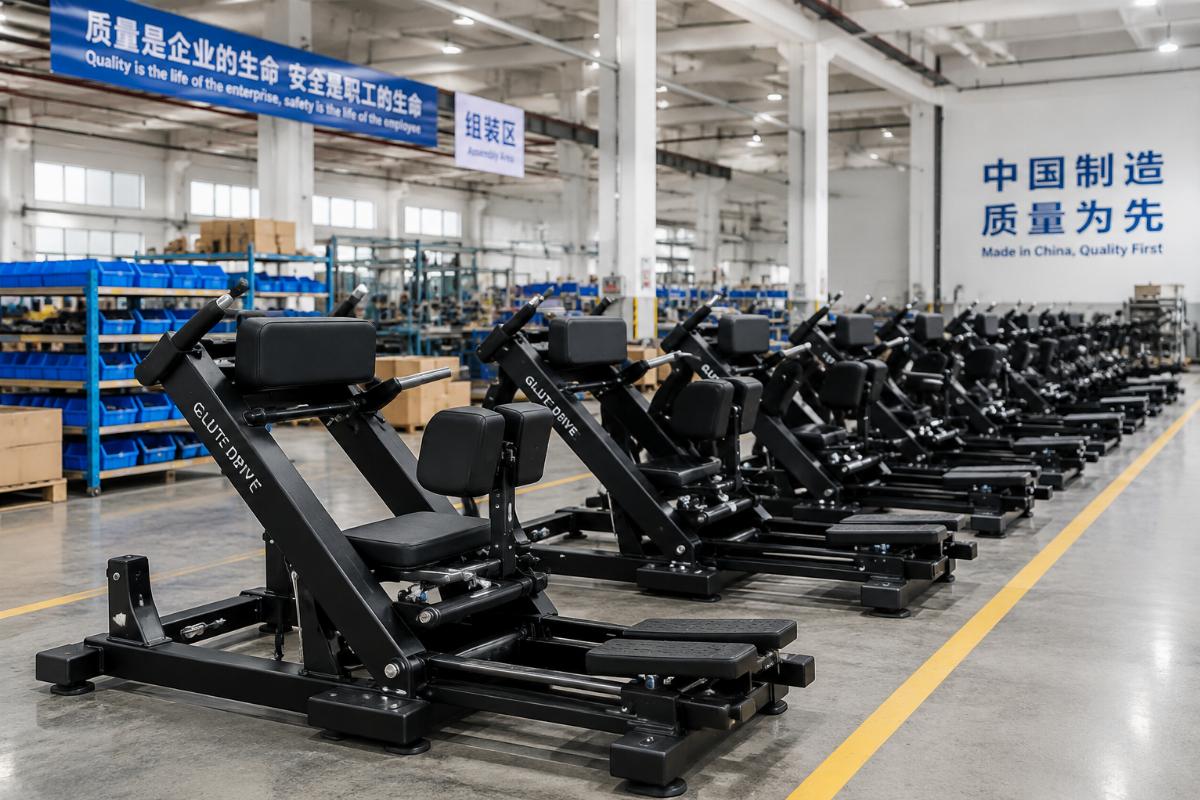
Commercial Treadmill Supplier for Australia: China Factory Direct OEM
Most buyers think motor horsepower and deck thickness decide treadmill lifespan. In reality, thermal management and controller redundancy are what keep machines running through an Australian summer.
Sourcing a reliable commercial treadmill supplier from China for the Australian market requires verifying heat-resistant controller design, validating thermal dissipation pathways against high-ambient conditions, and confirming spare parts availability—not just comparing sticker price and peak HP ratings. Factory-direct procurement can cut acquisition costs substantially, but only when buyers audit the supplier’s engineering documentation rather than relying on marketing brochures alone.
I remember a shipment that arrived in Melbourne a few summers ago. A commercial gym chain had ordered a full batch of treadmills, and within weeks of installation, controllers across multiple units started throwing E07 fault codes during afternoon peak hours. The local technician pulled the drive boards and found the thermal paste had dried out, the heatsink fins were clogged with dust within the first month, and the airflow channel inside the electronics bay had zero provision for the ambient temperatures that Melbourne hits in January. The entire batch nearly got sent back. [NEED_CITE: root cause analysis of treadmill controller E07 fault codes in high-temperature environments] That incident reshaped how I approach every commercial treadmill supplier conversation—terminal climate conditions come first, spec sheets come second.
The lesson was straightforward: a commercial treadmill supplier who cannot walk you through their thermal design validation process is not ready for the Australian market. Let me break down what actually matters.
Why Do Australian Commercial Treadmills Fail with E07 Errors?
The E07 fault code on a treadmill controller almost always traces back to overheating in the drive board—specifically, the IGBT module exceeding its thermal threshold during sustained operation.
This is not a random electronics failure. It is a design-environment mismatch. Australian commercial gyms operate in conditions that many overseas factories never account for. Ambient temperatures in gym facilities during summer regularly push well beyond what standard controller designs anticipate, and the continuous foot traffic on treadmills means the motor draws current without meaningful cool-down intervals. [NEED_CITE: IGBT thermal runaway mechanisms in motor drive controllers under sustained load conditions]
When I inspected those Melbourne units, the thermal imaging told the full story. The heatsink surface was running at temperatures that should have triggered protective shutdown long before the E07 appeared—but the thermal sensor was mounted in the wrong location, reading ambient bay temperature instead of junction temperature. By the time the controller finally flagged the fault, the IGBT had already experienced repeated thermal cycling that degraded the solder joints underneath.
Here is what typically goes wrong in the thermal pathway:
| Thermal Design Element | Inadequate Design | Properly Engineered Design |
|---|---|---|
| Heatsink fin density | Basic extruded profile | High surface-area folded fin array |
| Thermal interface material | Generic paste, dries within months | High-temp compound rated for extended service |
| Airflow channel | Sealed bay, no forced convection | Directed duct with filtered intake |
| Thermal sensor placement | Bay ambient reading | Direct junction or heatsink-base contact |
| Fan operation | Passive or always-on at single speed | Temperature-variable speed control |
A gym owner in Sydney later compared three different commercial treadmill supplier options side by side. The one with the lowest unit price had a completely sealed electronics bay with no airflow ducting whatsoever. The controller relied entirely on passive convection—fine for a Scandinavian winter, disastrous for a Queensland summer. The units that passed validation all had verifiable thermal dissipation pathways, and the operators confirmed extended continuous runtime without thermal faults. [NEED_CITE: treadmill controller thermal management requirements for continuous commercial duty cycles]
The takeaway: any commercial treadmill supplier worth engaging must provide thermal validation data—not just a CE certificate. CE marking confirms electrical safety compliance, but it does not prove the controller survives sustained high-ambient operation. Australian grid conditions and climate demand additional thermal headroom that generic certifications simply do not cover.
How to Verify a Chinese Factory’s Thermal and Controller Design?
Request the factory’s thermal rise test report and thermal imaging documentation under load—this is the single most important validation step before placing an order.
Most factories can produce a treadmill that runs fine in a climate-controlled showroom. The question is whether it survives a gym floor at peak load when the air conditioning is struggling. Here is the verification workflow I use when evaluating a commercial treadmill supplier:
First, ask for the thermal rise test protocol and results. A credible factory will have run the controller under rated load at elevated ambient temperature and recorded the temperature curve over time. If they cannot produce this document, they have not tested for it. [NEED_CITE: IEC standards for thermal testing of motor drive controllers in fitness equipment]
Second, request thermal imaging photographs of the controller board under operating conditions. You want to see the temperature distribution across the IGBT module, the rectifier bridge, and the main power capacitors. Hot spots indicate poor thermal coupling or insufficient heatsink contact.
Third, examine the controller’s redundancy architecture. A well-designed drive board includes:
- Separate driver ICs for each phase with independent protection
- Current sensing on every phase, not just a single shunt
- Over-voltage and under-voltage lockout with hysteresis
- Replaceable fuse links rated for the specific circuit
- Isolated sensor inputs to prevent ground loop interference
When I worked with a commercial treadmill supplier on an OEM project for a hotel chain in Brisbane, we specified a controller with dual current sensing channels and independent phase protection. The factory’s standard board used a single shunt resistor for all three phases—a cost-saving measure that meant a single sensor drift could cause uneven current distribution and premature IGBT stress. Upgrading the board added minimal cost per unit but eliminated an entire failure mode.
Fourth, verify the spare parts supply commitment. Controller boards are the most expensive electronic component on a treadmill. If the commercial treadmill supplier cannot guarantee board-level spare availability for an extended period, your maintenance costs will escalate quickly when failures occur outside warranty. [NEED_CITE: spare parts availability benchmarks for commercial fitness equipment controllers]
A practical test: ask the factory to ship a sample controller board with your initial order, even before you need it. If they hesitate or quote an unusually long lead time for a spare board, that tells you everything about their inventory depth and production planning.
China Factory Direct vs Australian Local Distributor: Which Path?
Buying direct from a Chinese commercial treadmill supplier delivers substantial cost savings on unit price, but the buyer assumes responsibility for spare parts inventory and technical support infrastructure.
This is the decision every Australian gym owner and distributor faces. Let me lay out the trade-offs based on real procurement scenarios I have been involved in.
The cost advantage of factory-direct sourcing is significant. A commercial-grade treadmill sourced directly from a Shandong-based manufacturer typically costs substantially less than the same specification purchased through an Australian distributor who has already layered import margins, warehousing costs, and local support overhead onto the price. For a gym outfitting an entire facility with multiple cardio units, the cumulative savings can fund an entire strength equipment package.
However, the hidden costs emerge when something goes wrong. An Australian distributor provides local technical support, same-day or next-day spare parts dispatch, and on-site service capability. When you buy direct, you become your own service department.
| Support Dimension | Factory Direct | Local Distributor |
|---|---|---|
| Unit acquisition cost | Substantially lower | Includes import and support margins |
| Spare parts lead time | International shipping required | Local stock, rapid dispatch |
| Technical troubleshooting | Remote guidance, time zone gap | On-site capability |
| Warranty claim process | Ship-back or local repair arrangement | Handled locally |
| Custom branding and OEM | Full flexibility | Limited or unavailable |
A fitness equipment distributor in Southeast Asia once told me they switched from buying through a regional agent to sourcing directly from a commercial treadmill supplier in China. Their unit cost dropped noticeably, but their first-year maintenance expenses spiked because they had not pre-stocked controller boards, drive belts, and lower roller assemblies. By the second year, they had built a proper spare parts inventory and their total cost of ownership was clearly lower than the distributor channel. [NEED_CITE: total cost of ownership comparison between direct import and local distribution for commercial fitness equipment]
The key is preparation. If you are sourcing direct, negotiate a spare parts package with your initial order—controller boards, motor drive belts, deck lubrication supplies, lower rollers, and lift motor assemblies. The commercial treadmill supplier should be willing to include these at cost, because they know you will need them eventually.
For buyers who lack in-house technical capability, a hybrid approach works well: source the bulk equipment direct from the commercial treadmill supplier, but establish a service agreement with a local technician who keeps a consignment stock of critical spares. This captures most of the cost advantage while maintaining service responsiveness.
Five Critical Specification Checks When Sourcing Commercial Treadmills
Beyond motor size and running surface, the specifications that determine long-term reliability in Australian commercial environments are thermal management, controller redundancy, spare parts availability, warranty structure, and minimum order flexibility.
When I review specifications from a commercial treadmill supplier, I build a comparison matrix that goes far beyond the marketing brochure highlights. Here are the five areas where real differentiation happens:
Thermal management design. Does the controller bay have a designed airflow pathway with filtered intake? Is the heatsink sized for continuous duty at elevated ambient? Can the factory provide thermal test data? These questions separate gym-grade equipment from light commercial units that will fail under Australian conditions. [NEED_CITE: thermal design validation methods for commercial fitness equipment electronics]
Controller redundancy and protection. As discussed earlier, single-point sensor failures should not be able to cause cascading damage. Phase-level current sensing, independent over-current protection, and replaceable fuse architecture are baseline requirements for commercial duty.
Spare parts supply framework. What is the guaranteed availability period for controller boards and mechanical wear components? Does the commercial treadmill supplier maintain finished spare inventory or produce-to-order? What is the typical lead time for electronic components versus mechanical parts?
Warranty terms and enforcement. Warranty is only as good as the mechanism behind it. Does the commercial treadmill supplier offer replacement parts shipment within a defined timeframe? Are warranty claims processed through the distributor or directly with the factory? What documentation is required to support a claim?
MOQ and customization flexibility. For gym owners outfitting a single facility, the ability to mix cardio and strength equipment in a consolidated container shipment matters enormously. A commercial treadmill supplier who can accommodate mixed SKU containers at reasonable minimums provides real logistical and financial advantage. [NEED_CITE: container consolidation practices for mixed fitness equipment shipments from China]
| Specification Area | Basic Supplier Capability | Advanced Supplier Capability |
|---|---|---|
| Thermal management | Passive convection only | Engineered airflow with thermal validation data |
| Controller protection | Single-point sensing | Multi-phase redundancy with independent protection |
| Spare parts availability | Produce-to-order, extended lead times | Finished goods stock with defined dispatch timelines |
| Warranty enforcement | Claim review with no fixed timeline | Defined response framework with parts dispatch commitment |
| Order flexibility | Fixed SKU minimums | Mixed container consolidation support |
I worked with a hotel group in Brisbane that needed treadmills, ellipticals, and a selection of strength equipment for a new property. The commercial treadmill supplier we partnered with consolidated everything into a single container shipment, applied the hotel’s branding to the console fascias, and included a spare parts kit sized for the first several years of operation. The procurement process from initial inquiry to container loading took a matter of months, and the warranty structure covered electronic components for an extended period with clear spare parts supply terms.
Conclusion
Australian commercial treadmill procurement succeeds or fails on thermal design validation, controller redundancy, and spare parts supply—not on horsepower ratings alone.
Sourcing from a Chinese commercial treadmill supplier delivers meaningful cost advantages, but only when buyers verify thermal management through test documentation, confirm controller protection architecture at the component level, and secure spare parts commitments before the container ships. The factories that can provide this transparency are the ones worth building long-term procurement relationships with.