

Bahrain Distributors Consolidates Air Bike Sourcing from China Manufacturer
Most buyers assume air bikes are mechanically simple, so multi-vendor sourcing saves money. In reality, the hidden after-sales costs from incompatible spare parts far outweigh any initial purchase price difference.
Consolidating air bike sourcing with a single qualified manufacturer eliminates spare parts mismatches, standardizes component specifications, and dramatically reduces after-sales complexity for distributors operating across multiple markets.
I spent years welding frames in a Shandong factory before moving into field installations across Africa. The first time I set up air bikes at a gym project in Nairobi, the fan resistance units started making noise within months. Complaints came straight to my phone. When I inspected the fan blades on-site, I realized the assembly workers were attaching counterweights by feel, not by measurement. That experience pushed me to carry a basic dynamic balancing kit on every installation trip. A Bahrain distributor I later worked with faced a similar but larger-scale problem—they were sourcing from multiple factories, and every batch came with different pedal axle diameters, seat post clamp sizes, and bearing housings. Their warehouse turned into a spare parts puzzle. [NEED_CITE: root cause distribution of fitness equipment after-sales failures per ISO 15243]

The shift toward single-source procurement is not just about convenience. It reflects a broader recognition among Middle East and Africa fitness equipment distributors that total cost of ownership matters more than unit price alone.
Why Did the Bahrain Distributor Consolidate Air Bike Sourcing?
The core issue was spare parts incompatibility across three different supplier batches, which made after-sales service nearly impossible to standardize.
When this distributor first entered the air bike segment, they followed the common instinct: get quotes from multiple factories, compare prices, and mix orders to maximize margin. On paper, it looked efficient. In practice, each factory used slightly different seat post diameters, pedal thread specifications, and fan bearing housing dimensions. Even the chain tensioners were not interchangeable. [NEED_CITE: total cost of ownership models for multi-source vs single-source fitness equipment procurement]
I saw the consequences firsthand during a service visit to one of their gym clients. A bearing failure on a display model meant the technician had to check which factory batch the unit came from before ordering a replacement. The gym had purchased units from all three batches. The technician ended up carrying multiple bearing variants in the service van, and even then, some replacements required minor modifications to fit.
The real cost was not the bearing itself. It was the extended downtime, the technician’s extra travel time, and the gym owner’s frustration. When the distributor tried to calculate their actual after-sales expenditure, they found it consumed a significant portion of their annual margin. [NEED_CITE: after-sales cost breakdown in commercial fitness equipment distribution across MENA region]
By consolidating air bike sourcing with one manufacturer, they eliminated the specification chaos. Every unit rolling off the production line now shares the same frame geometry, bearing housing, pedal axle thread, and seat post diameter. The warehouse spare parts inventory dropped from multiple SKUs per component to a single standardized SKU.
What Spare Parts Mismatch Issues Were Resolved?
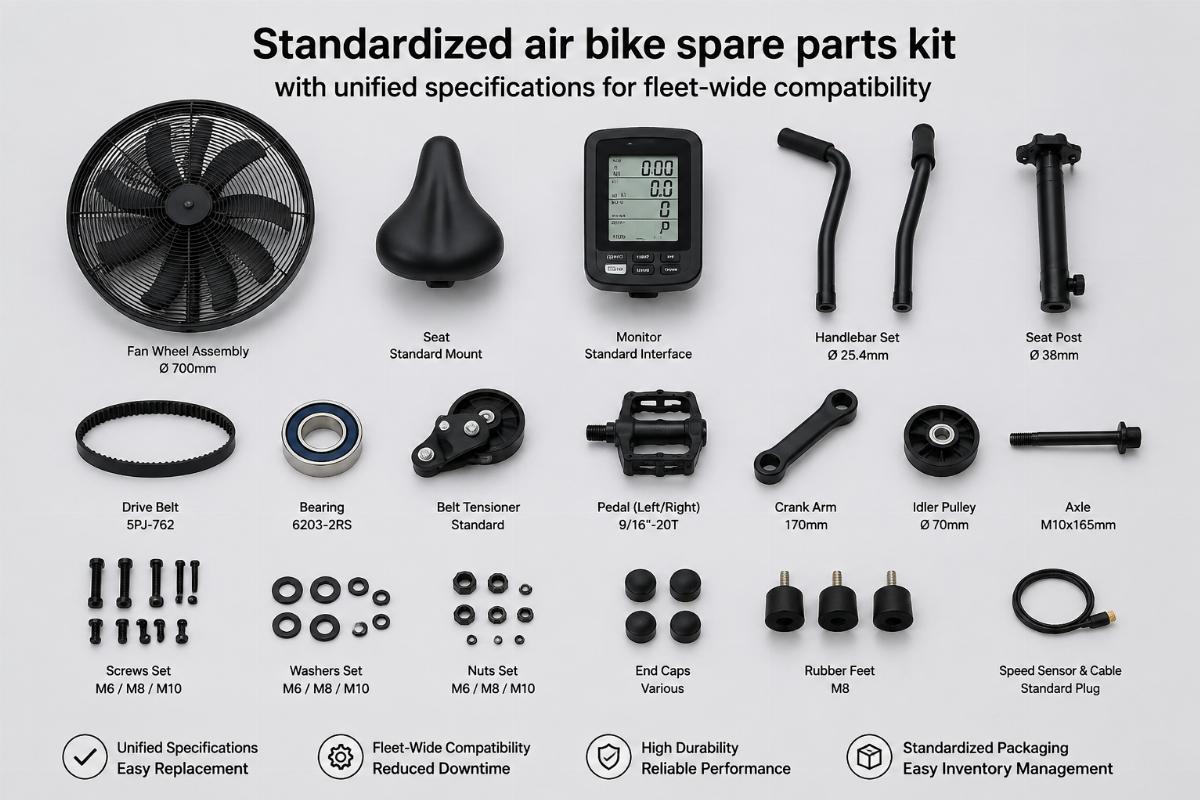
Standardizing to a single manufacturer raised the spare parts commonality rate to a level where one replacement kit covers nearly the entire fleet.
Before consolidation, the distributor’s spare parts inventory included different seat clamps, pedal assemblies, chain guards, and bearing housings for each supplier batch. A technician servicing a gym with mixed-batch units needed to identify the origin of each machine before pulling the correct part. This added steps to every service call and increased the chance of carrying the wrong component.
After switching to unified air bike sourcing, the distributor worked with the manufacturer to establish a standardized spare parts catalog. The manufacturer’s OEM customization capability allowed them to lock in specific dimensions for critical wear components—bearing housing bore diameter, pedal axle thread pitch, seat post outer diameter, and chain tensioner mounting hole spacing. [NEED_CITE: spare parts standardization methodology in commercial fitness equipment distribution]
The result was a spare parts ecosystem where a single bearing replacement kit fits every unit in the fleet, a single pedal assembly works across all models, and the seat clamp is universally compatible. The distributor reduced their spare parts SKU count substantially, which simplified warehouse management and reduced the risk of stocking obsolete components.
From my field experience, this is where single-source procurement shows its real value. When I was running installations in Lagos, carrying a standardized parts kit meant I could service any unit without guessing which batch it came from. The Bahrain distributor achieved the same operational clarity at scale.
How Did Fan Imbalance Cause Early Bearing Failures?
The root cause was uncontrolled fan blade weight distribution during assembly, which created excessive radial load on bearings at high rotational speeds.
Air bikes use a large fan for air resistance. The fan spins at high RPM during intense workouts. If the fan blades are not dynamically balanced, the uneven mass distribution generates centrifugal forces that push unevenly on the bearing housing. Over time, this accelerates bearing wear and leads to premature failure—often accompanied by noticeable vibration and noise. [NEED_CITE: dynamic balancing tolerance standards for rotating fitness equipment components per ISO 1940]
This was exactly the problem I encountered in Nairobi. The factory assembly line did not use precision scales or balancing equipment for the fan blades. Workers attached counterweights by hand, leading to batch-after-batch inconsistency. Some fans ran smoothly; others vibrated enough to loosen nearby bolts.
The Bahrain distributor’s previous suppliers had similar issues. Their gym clients reported bearing noise within months of installation. The distributor initially blamed the bearing quality, but the real problem was upstream—at the fan assembly stage.
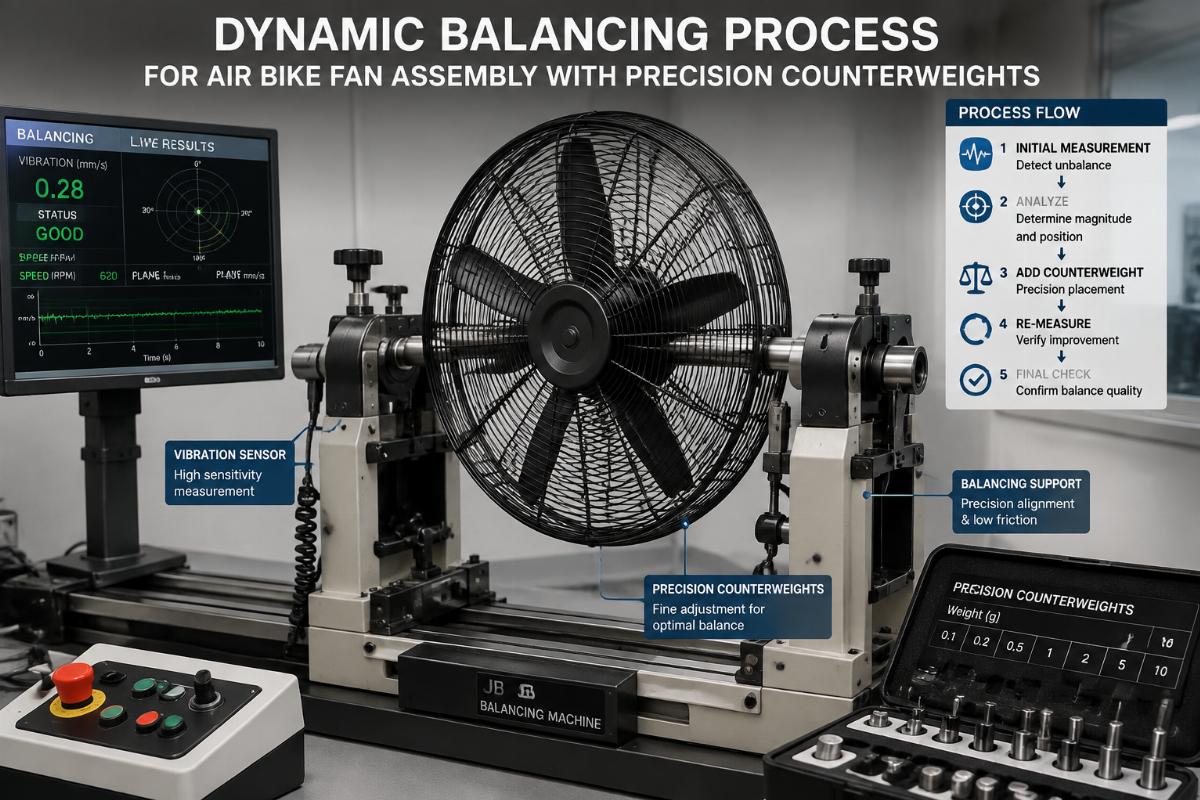
When they consolidated air bike sourcing, they specified that the manufacturer must perform dynamic balancing on every fan unit before installation. The manufacturer implemented a balancing process aligned with recognized industry tolerance grades, checking each fan assembly on a balancing rig and adding precise counterweights where needed. [NEED_CITE: fan assembly quality control procedures in commercial fitness equipment manufacturing]
The bearing failure rate dropped noticeably. Gyms that previously needed bearing replacements twice a year now report substantially extended service intervals. The distributor’s after-sales team spends less time on bearing-related calls, and the gym owners notice the quieter, smoother operation.
What Are the Logistics Benefits of Single-Source Procurement?
Consolidating orders with one manufacturer improves container loading efficiency and reduces per-unit freight costs through optimized space utilization.
When the Bahrain distributor was sourcing from multiple factories, each shipment arrived in separate containers with different packing configurations. Some factories packed air bikes fully assembled; others shipped them partially disassembled. The container loading plans were not coordinated, leading to wasted space in some shipments and the need for additional containers in others.
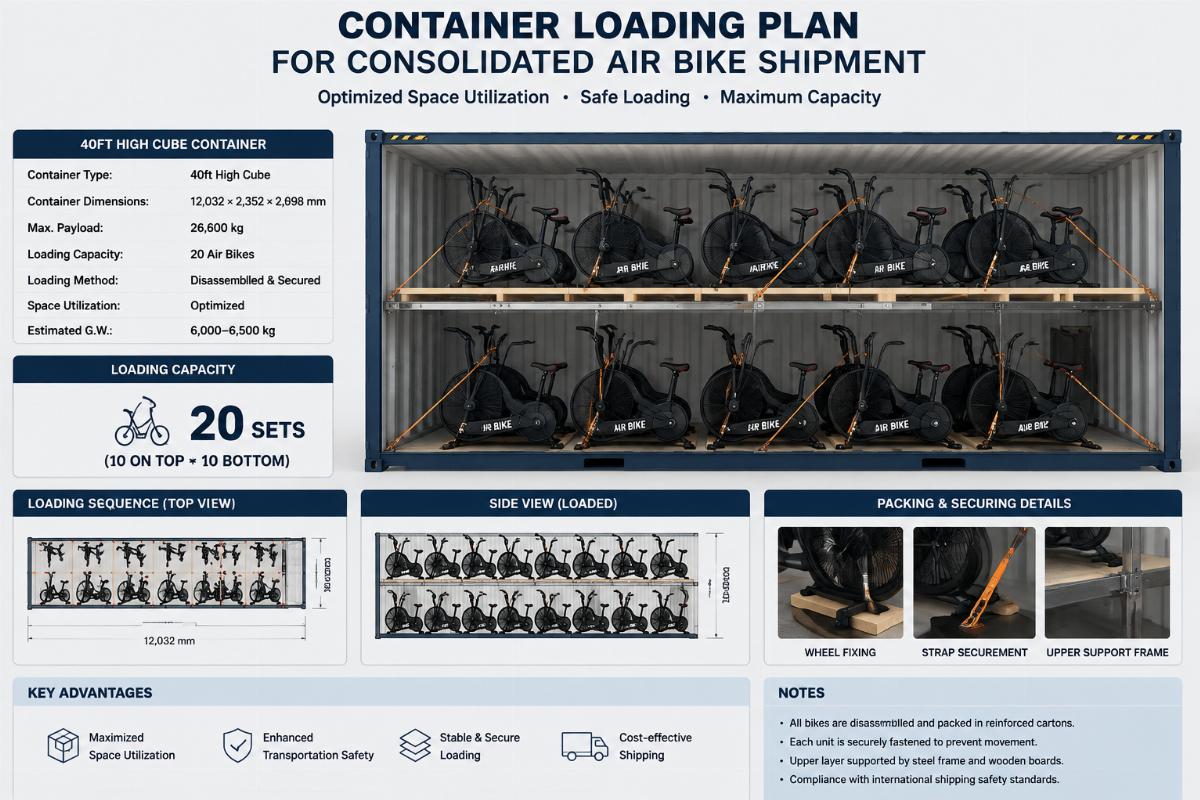
After consolidating air bike sourcing, the distributor worked with the manufacturer to develop a container loading plan that maximizes space utilization. The manufacturer’s packaging engineering team designed a disassembly and nesting configuration that allows more units per container. The handlebars, seat posts, and pedal arms are packed flat within the frame triangle, and the fan units are nested to minimize void space. [NEED_CITE: container loading optimization methods for commercial fitness equipment export]
The logistics improvement was immediate. The distributor could fit more units per container, which reduced the per-unit freight cost substantially. They also eliminated the coordination overhead of managing multiple shipment schedules, customs documentation, and warehouse receiving processes.
From my experience shipping equipment to East Africa, container loading efficiency is a major cost driver. A well-designed packing plan can reduce the number of containers needed for a full gym outfitting project. The Bahrain distributor’s consolidation strategy delivered the same benefit at the distribution level—fewer containers, lower freight costs, and simpler logistics management.
Conclusion
Consolidating air bike sourcing transforms after-sales complexity into operational simplicity. The Bahrain distributor’s experience demonstrates that single-source procurement eliminates spare parts mismatches, standardizes component specifications, and reduces total cost of ownership. For distributors serving commercial gyms across multiple markets, the shift from multi-vendor comparison to unified supplier partnership delivers measurable improvements in service efficiency and customer satisfaction.


