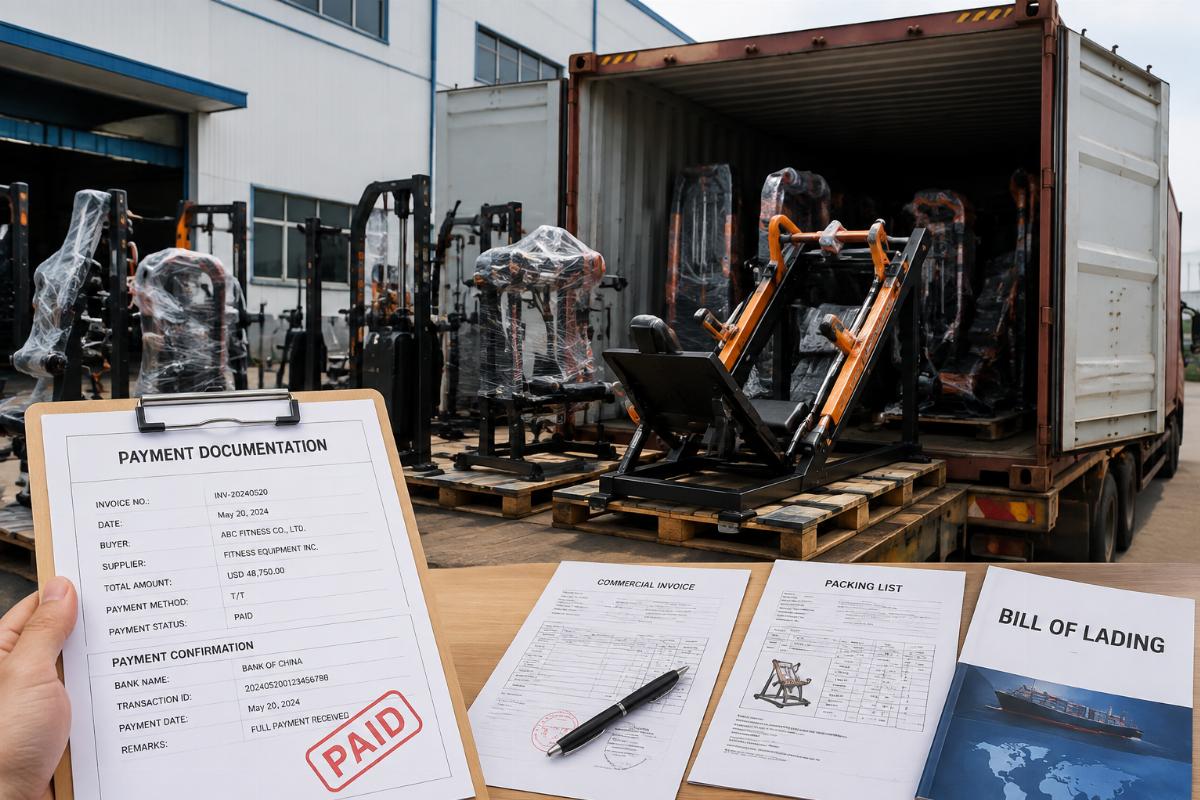
Olympic Weight Plate Set Bonded Warehouse Wholesale Supplier Mexico
Most importers think cargo gets held at Mexican ports because of product quality issues. The real reason is almost always missing paperwork—NOM certification, RFC tax IDs, or Spanish-language labels.
Using a bonded warehouse for Olympic weight plate imports to Mexico allows you to defer tariff payments, reduce upfront cash flow pressure on full-container shipments, and clear goods in batches aligned with actual customer orders. However, this only works if your documentation is fully compliant before the vessel departs China: NOM certification, a valid RFC tax number, and complete Spanish translation of all commercial documents are non-negotiable prerequisites.
I first learned this the hard way. Years ago, I traveled with an after-sales team to Mexico City to install treadmills at a distributor’s warehouse. We sat there for days doing nothing because the entire container was stuck at the Port of Veracruz. The reason? A single HS code prefix was missing from the packing list. The cargo wasn’t defective—the paper was wrong. Since then, I have personally overseen customs documentation for every Latin American shipment, especially to Mexico, where the customs authority operates with zero tolerance for incomplete files. [NEED_CITE: Mexico SAT customs documentation requirements for fitness equipment imports]
Let me walk you through what actually works when importing Olympic weight plate sets into Mexico, based on real shipment scenarios rather than theory.
Why Use a Bonded Warehouse for Olympic Weight Plate Imports to Mexico?
A bonded warehouse lets you store imported Olympic weight plate sets under customs suspension, meaning you do not pay import duties or VAT until the goods are formally cleared for domestic distribution.
This is particularly valuable for distributors who receive full container loads but sell to multiple gym clients on staggered schedules. Instead of clearing an entire container at once—tying up significant working capital in tariff prepayment—you move the shipment into a bonded facility and clear only the quantity needed for each outgoing order.
The two main types of bonded storage in Mexico are the Recinto Fiscalizado (customs-controlled bonded zone, typically located within or adjacent to port areas) and the Recinto de Estrategia (strategic bonded warehouse, which allows longer storage periods and broader logistics operations). [NEED_CITE: Comparison of Recinto Fiscalizado vs Recinto de Estrategia under Mexican customs law]
For an Olympic weight plate set bonded warehouse wholesale supplier Mexico arrangement, the Recinto Fiscalizado is more common for port-adjacent operations at Veracruz or Manzanillo, where containers arrive and need short-term staging before final clearance. The Recinto de Estrategia suits importers who maintain inventory for extended periods and distribute across multiple states.
A distributor in central Mexico once received a full container of bumper plates, competition plates, and technique plates. Rather than clearing the entire shipment immediately, they moved the container into a bonded warehouse near Veracruz. Over the following weeks, they cleared goods in three separate batches matching delivery schedules to commercial gyms in Monterrey, Guadalajara, and Mexico City. This approach noticeably improved their cash flow cycle, as tariff payments were spread across multiple clearance events rather than concentrated on arrival day.
The key advantage here is flexibility. Weight plates are heavy, high-value-per-kilogram products. A single container of calibrated steel plates represents a substantial tariff obligation. Deferring that obligation through bonded storage gives importers breathing room to match tax outflows with actual revenue collection from end buyers.
What Documents Are Mandatory Before Shipping Weight Plates to Mexico?
Three documents are absolutely mandatory before any Olympic weight plate set leaves the loading port: NOM certification compliance proof, a valid RFC tax identification number for the importer of record, and complete Spanish-language translations of all commercial and shipping documents.
Missing any one of these will result in the cargo being refused entry or returned at origin. This is not a theoretical risk—it is the standard operating procedure of Mexican customs.
The NOM (Norma Oficial Mexicana) certification applies to fitness equipment imported into Mexico. Specific NOM standards govern safety labeling, material composition declarations, and Spanish-language user information for gym equipment. [NEED_CITE: Applicable NOM standards for imported gym equipment and free weights in Mexico] For weight plates specifically, the relevant compliance involves proper labeling of weight markings, material composition, and safety warnings in Spanish. The importer must hold or reference a valid NOM compliance certificate before customs clearance can proceed.
The RFC (Registro Federal de Contribuyentes) is the Mexican tax ID number. Without a valid RFC registered with SAT (Servicio de Administración Tributaria), no entity can act as the importer of record. The RFC registration process takes a meaningful amount of time and must be completed well before the cargo arrives. Many first-time importers underestimate this timeline and discover the problem only when the vessel is already approaching port.
Spanish-language translation requirements cover the commercial invoice, packing list, bill of lading, and certificate of origin. These are not optional add-ons. Mexican customs requires that all key commercial documents be presented in Spanish. Attempting to submit English-only documents and "translate later" is a guaranteed path to cargo rejection.
A Latin American fitness equipment distributor once shipped a container of rubber-coated Olympic plates without completing the NOM pre-review process. The cargo arrived at Manzanillo, and customs immediately flagged the shipment for lacking proper NOM documentation. The result was a forced return shipment—the cargo never entered Mexican territory. The financial damage included ocean freight in both directions, port handling charges, and lost sales commitments to gym clients. This entire situation was avoidable with proper pre-shipment document review.
How to Avoid Port Delays at Veracruz or Manzanillo?
The most effective way to avoid multi-day port delays when importing Olympic weight plate sets is to ensure HS code prefix accuracy, packing list consistency with physical cargo, and pre-shipment document review before the vessel departs.
Veracruz and Manzanillo are the two primary entry ports for fitness equipment shipments from Asia to Mexico. Both ports have experienced periodic congestion, and customs clearance efficiency remains the primary variable affecting total transit time. [NEED_CITE: Veracruz and Manzanillo port clearance efficiency trends for fitness equipment imports]
The most common cause of delay is not cargo inspection—it is documentation mismatch. When the HS code on the commercial invoice does not precisely match the product description on the packing list, or when the HS code prefix is incomplete, customs systems flag the shipment for manual review. This manual review adds days to the clearance process and generates demurrage charges that accumulate quickly for heavy cargo like weight plates.
For Olympic weight plates, the HS code classification must accurately reflect the product type (e.g., whether the plates are classified under sports equipment or iron/steel articles, depending on specific product characteristics). The HS code prefix must be complete and consistent across all documents: commercial invoice, packing list, bill of lading, and certificate of origin.
A practical pre-shipment review process should include the following checkpoints:
- Verify that the HS code prefix on the commercial invoice matches the packing list exactly, character for character.
- Confirm that the product description on all documents uses identical terminology—no abbreviations on one document and full descriptions on another.
- Ensure that weight declarations (net weight, gross weight) are consistent across the packing list and bill of lading. For weight plates, where the product itself is defined by weight, any discrepancy between declared weight and actual weight triggers immediate customs scrutiny.
- Confirm that the NOM compliance reference number is printed on the commercial invoice and packing list.
- Verify that the RFC of the importer of record appears correctly on all documents.
An Olympic weight plate set bonded warehouse wholesale supplier Mexico operation should implement this document review as a standard pre-shipment step, not an afterthought. The cost of a thorough document review before loading is negligible compared to the demurrage and storage fees generated by a multi-day port delay.
Bonded Warehouse vs. Direct Clearance: Which Fits Your Import Volume?
The choice between bonded warehouse storage and direct clearance depends on your order fulfillment frequency: importers with staggered multi-client delivery schedules benefit from bonded storage, while those with single-destination full-container deliveries are better served by direct clearance.
Direct clearance means the entire container is cleared through customs upon arrival, all duties and VAT are paid immediately, and the cargo is released for domestic transport. This approach is straightforward and cost-effective when the entire container is destined for a single warehouse or a single client.
Bonded warehouse clearance, as discussed earlier, allows goods to enter Mexico under customs suspension and be cleared in portions over time. This approach is more complex administratively but provides significant cash flow advantages for distributors who sell to multiple gyms, hotels, or retail clients on different timelines.
For an Olympic weight plate set bonded warehouse wholesale supplier Mexico partnership, the decision framework is relatively simple:
- If you receive a container and immediately distribute the full contents to one location, direct clearance is faster and involves lower administrative overhead.
- If you receive a container and need to distribute portions to multiple clients over a period of time, bonded warehouse storage allows you to align customs clearance costs with actual sales revenue.
A distributor serving commercial gym chains across multiple Mexican states typically operates on the bonded warehouse model. They receive full containers of mixed free weight products—plates, barbells, dumbbells—and clear goods in batches corresponding to specific gym outfitting projects. This approach reduces the upfront capital requirement and provides flexibility to adjust delivery schedules based on client construction timelines.
Conversely, a hotel chain purchasing a complete fitness center package for a single property typically opts for direct clearance, since the entire shipment moves to one destination and the project timeline is fixed.
How Does Bick Support Mexico Importers with Customs-Ready Documentation?
Bick provides a complete customs-ready documentation package for Olympic weight plate set shipments to Mexico, including NOM compliance documentation, Spanish-language commercial documents, and HS code pre-verification to minimize port delay risk.
Drawing from extensive experience shipping fitness equipment to Mexican importers, Bick has developed a standardized pre-shipment documentation protocol specifically designed for Mexican customs requirements. This protocol addresses the three critical compliance areas: NOM certification, RFC coordination, and Spanish-language document preparation.
For NOM compliance, Bick ensures that all weight plate products carry proper labeling and that the necessary compliance certificates are prepared and referenced on commercial documents before the cargo leaves the production facility. The NOM certification process is initiated during the production phase, not after the cargo is already on the water.
For Spanish-language documentation, Bick prepares complete Spanish translations of the commercial invoice, packing list, and product specifications. These translations are reviewed for consistency with the HS code classification and product descriptions used in the English-language originals.
For HS code verification, Bick conducts a pre-shipment review of the classification for each product in the shipment, ensuring that the HS code prefix is complete and consistent across all documents. This review specifically addresses the classification of weight plates under Mexican tariff schedules, where the distinction between sports equipment classification and general iron/steel article classification can affect duty rates.
An Olympic weight plate set bonded warehouse wholesale supplier Mexico operation requires this level of documentation discipline. Bick’s approach treats customs compliance as an integral part of the manufacturing and shipping process, not a separate administrative task handled after the fact.
This documentation support extends to coordination with the importer’s customs broker in Mexico. Bick provides the complete document package in advance of vessel arrival, allowing the broker to prepare the customs declaration and verify all details before the cargo reaches the port. This pre-arrival preparation significantly reduces the risk of documentation-related delays at Veracruz or Manzanillo.
Conclusion
Bonded warehouse importation of Olympic weight plates into Mexico is a practical strategy for distributors managing cash flow and multi-client delivery schedules, but it demands rigorous document compliance before shipment. NOM certification, RFC registration, and Spanish-language documentation are not optional—they are the foundation of successful customs clearance. Port delays at Veracruz and Manzanillo are overwhelmingly caused by paperwork errors, not product defects. An Olympic weight plate set bonded warehouse wholesale supplier Mexico partnership that prioritizes pre-shipment document verification protects importers from costly delays, forced returns, and unnecessary capital lock-up in tariff prepayments.