

Rubber Gym Flooring Container Load Wholesale Supplier | Bulk Deal
Thicker rubber mats do not automatically mean better performance—density and formulation matter far more than raw thickness.
When sourcing a rubber gym flooring container load, the real savings come from balancing material density, container loading efficiency, and pre-shipment inspection—not from chasing the lowest per-square-meter price.
I still remember a shipment we sent to a fitness chain in the Middle East a few years back. The rubber mats arrived after weeks of high-temperature sea transit, and the client opened the container to a wave of chemical odor. Worse, the edges of several tiles had curled upward. We traced the issue back to a high proportion of reclaimed rubber in the compound, combined with inadequate vulcanization time. The heat inside the sealed container accelerated off-gassing and warped the mats that had been stacked too tightly near the container walls. That order nearly got rejected at the port [NEED_CITE: common failure modes of rubber gym flooring during ocean freight]. Since then, I have paid close attention to formulation details, loading patterns, and how to verify quality before the container doors close.
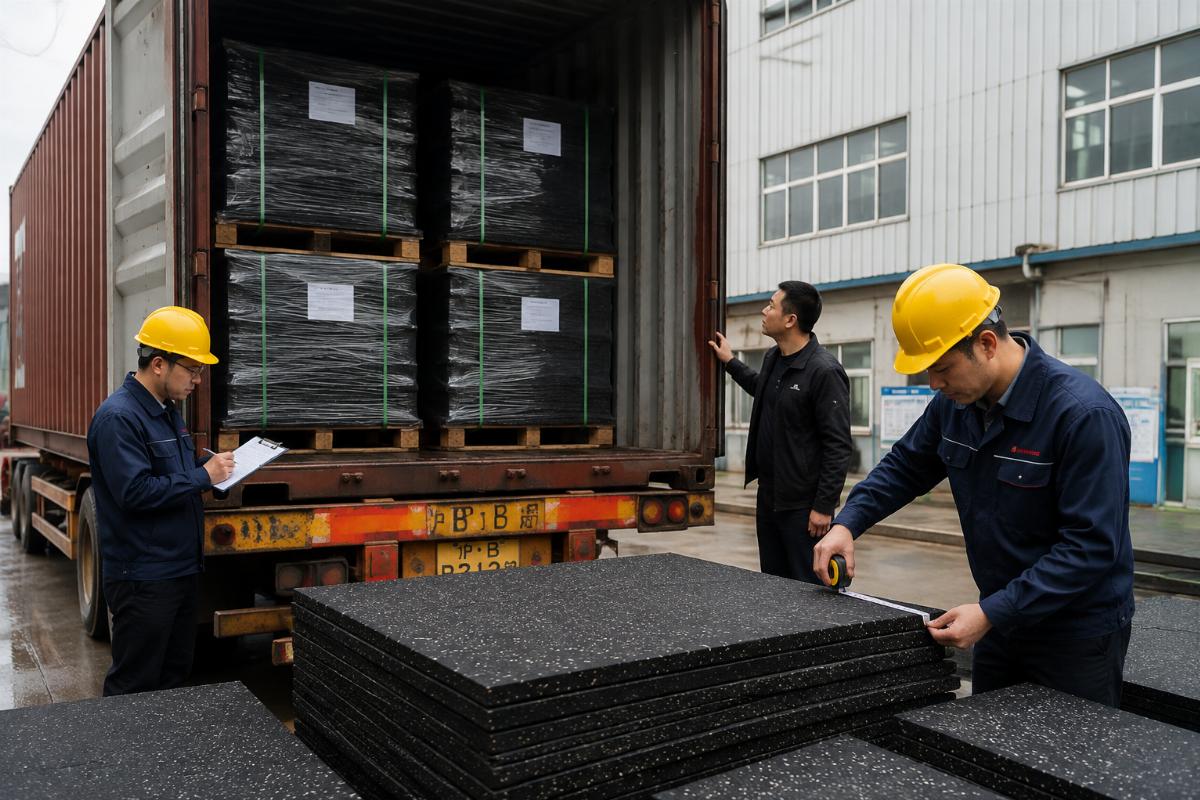
If you are planning a bulk purchase, the sections below walk through the practical decisions you will face—from thickness selection to container math, odor control, and final inspection checkpoints.
What Thickness and Density Do You Actually Need for Different Zones?
The right thickness depends on the activity zone, not on a blanket "thicker is better" assumption.
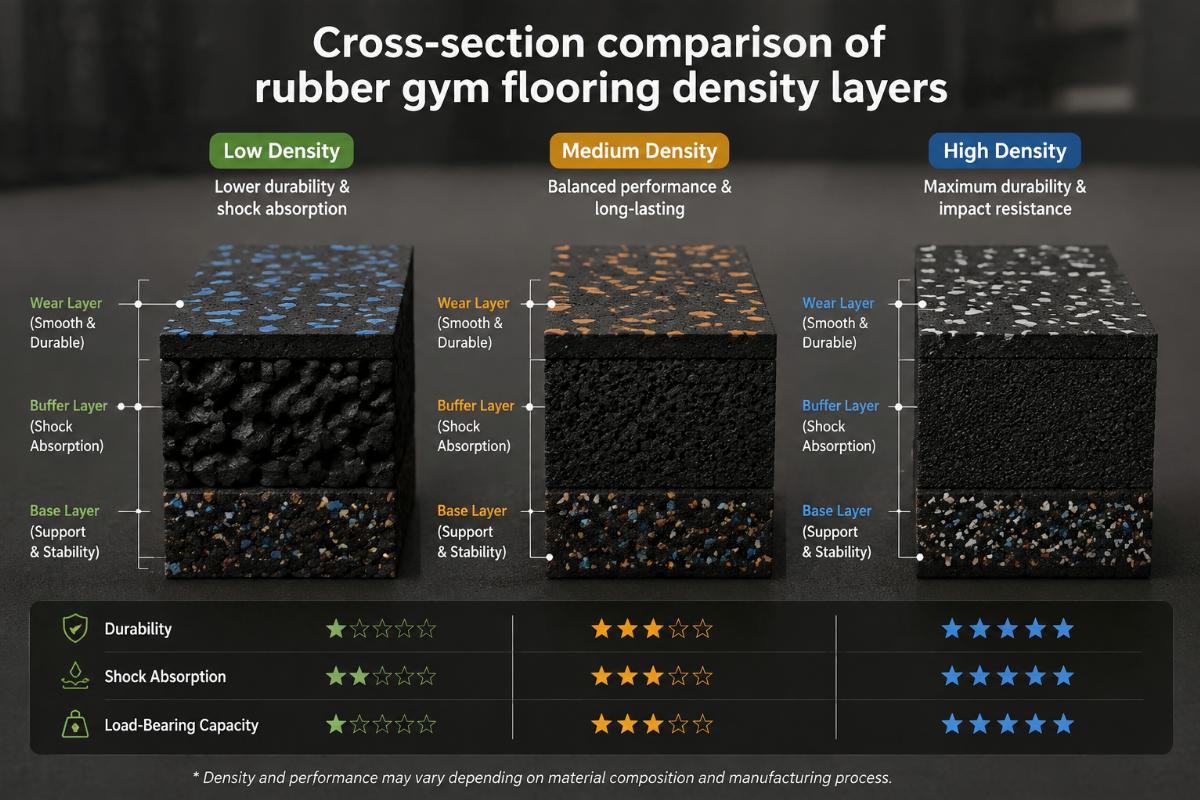
Many buyers assume that ordering the thickest mat available will protect their subfloor and satisfy every type of user. In reality, a low-density thick mat can compress permanently under heavy loads, defeating the purpose of shock absorption. What matters is the match between density (measured in kg/m³) and Shore A hardness [NEED_CITE: relationship between rubber density and shock absorption performance in gym flooring].
Here is how the zones typically break down in a commercial gym layout:
| Zone | Recommended Thickness | Density Range | Shore A Hardness | Load Type |
|---|---|---|---|---|
| Free-weight & platform area | Heavy-duty | High | Firm | Impact + static |
| Functional & CrossFit zone | Medium-heavy | Medium-high | Moderate | Dynamic drop |
| Cardio & open floor | Standard | Medium | Softer | Rolling + foot traffic |
| Stretch & yoga area | Light | Low-medium | Soft | Static comfort |
A mid-six-figure fitness chain in Southeast Asia once ordered uniform heavy-duty mats for their entire facility to simplify procurement. Within months, the yoga and stretching area complained about joint discomfort, while the free-weight zone showed premature compression marks. They ended up replacing sections at a cost that far exceeded what a zone-specific order would have required.
The lesson: specify density and hardness alongside thickness. A high-density medium-thick mat can outperform a low-density extra-thick mat in a deadlift zone [NEED_CITE: Shore A hardness and density specifications for commercial rubber gym flooring].
How Do You Calculate Container Loading to Avoid Paying for "Air"?
A rubber gym flooring container load is constrained by weight limits long before it fills the available cubic meters.
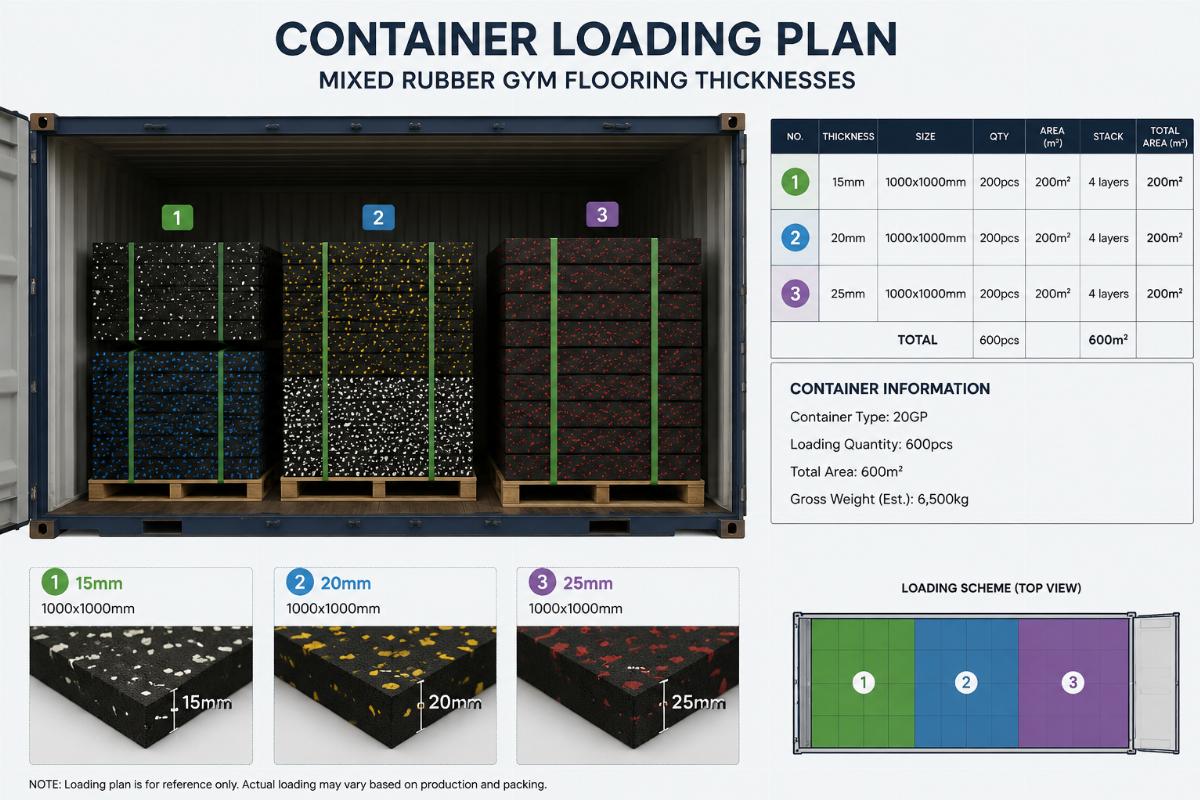
Rubber flooring is heavy. A standard 40-foot high-cube container offers roughly 67–68 CBM of space, but the maximum payload for road transport in many destination countries sits around 26–28 metric tons. If you load only thick, heavy tiles, you will hit the weight limit while leaving significant vertical space unused. If you load only thin rolls, you will fill the volume but stay well under the weight cap—and still pay the same ocean freight.
The loading calculation follows a simple sequence:
- Determine the total square meters needed, broken down by thickness.
- Calculate the gross weight per thickness using the density figure from the supplier.
- Check whether the total weight reaches the road-legal payload at destination.
- If weight is reached before volume is full, supplement with lighter SKUs—thinner tiles, rolls, or even non-flooring items like gym accessories—to utilize the remaining CBM.
- Confirm the stacking pattern: palletized vs. floor-loaded affects both space use and unloading speed at the warehouse.
A distributor in South America once mixed 15 mm and 25 mm tiles in a single container to meet a blended order. The 25 mm tiles consumed weight capacity quickly, leaving nearly a third of the container volume empty. By adjusting the ratio and adding a layer of rolled rubber along the top, they recovered most of the wasted space on the next shipment [NEED_CITE: container loading optimization for heavy rubber flooring products].
This is where consolidation capability matters. Being able to combine flooring with other gym equipment in one container—rather than shipping separate less-than-container loads—can noticeably reduce per-unit freight cost. We routinely handle mixed container loads where rubber flooring shares space with plate-loaded machines or free-weight sets, ensuring the weight-volume balance works for the buyer’s destination port regulations.
Why Does Rubber Gym Flooring Smell, and How Do You Prevent It?
Odor in rubber flooring comes from the formulation and curing process, not from the fact that the material is "new."
A widespread misconception is that virgin rubber is odorless and reclaimed rubber always smells. The reality is more nuanced. The smell typically originates from volatile organic compounds released by low-grade reclaimed rubber, cheap binding agents, or incomplete vulcanization. When these mats are sealed inside a hot container for weeks, the VOCs concentrate and the odor becomes intense upon opening [NEED_CITE: sources of VOC emissions in recycled rubber gym flooring].
To manage this risk, request the following from your supplier before placing a bulk order:
- A material safety data sheet covering the specific compound used.
- A third-party test report for VOC emissions, ideally following a recognized indoor air quality standard.
- A scent rating sample from the current production batch, evaluated on a standardized scale.
Some suppliers offer low-VOC or odor-controlled formulations at a modest cost premium. For projects in enclosed environments—boutique studios, hotel gyms, apartment fitness rooms—this premium is almost always justified. The cost of replacing an entire container of smelly flooring, or of losing end-user trust, dwarfs the per-square-meter savings.
A hotel developer in Europe specified odor-controlled rubber flooring for their fitness centers across multiple properties. They required batch-level scent testing before each shipment. The extra step added a small lead time, but it eliminated the risk of guest complaints and costly post-installation air treatment.

What Are the Key Inspection Points Before Loading?
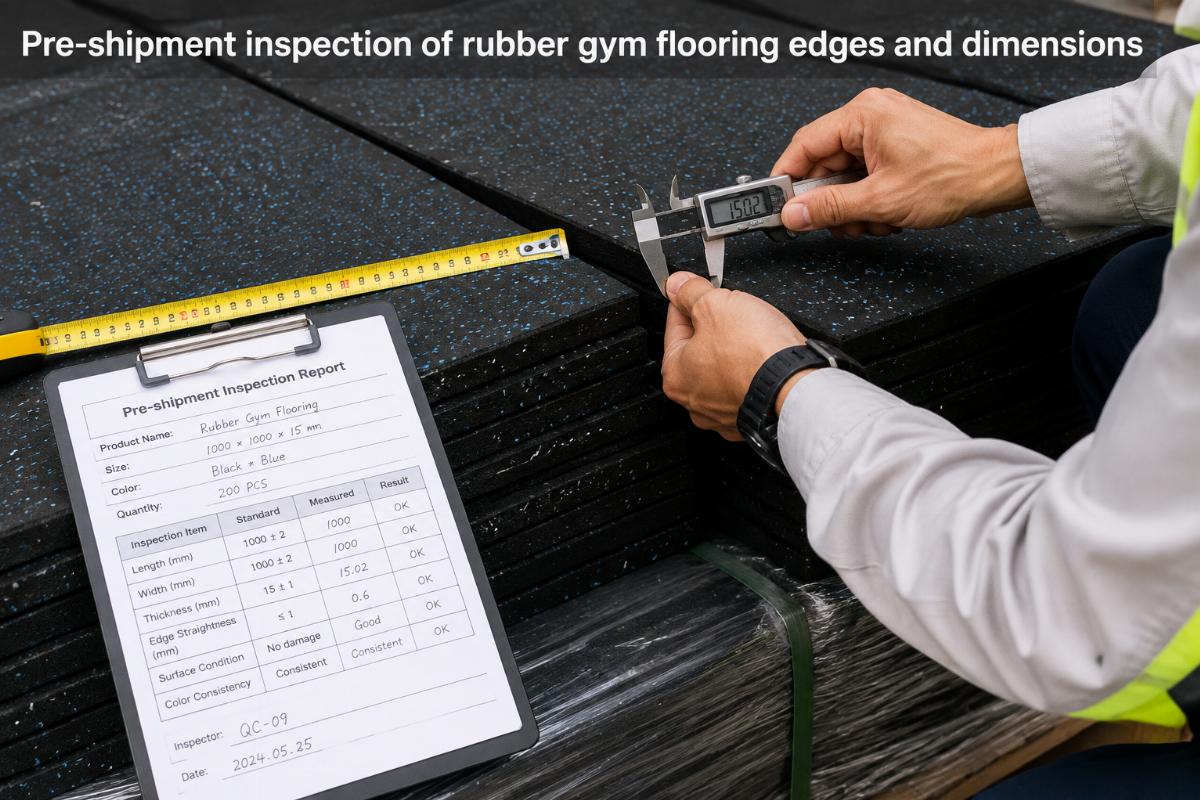
The three most common claims after a rubber gym flooring container load arrives are color variation, dimensional inaccuracy, and edge irregularity.
These issues are almost impossible to fix once the container reaches the destination port. The only effective countermeasure is a structured pre-shipment inspection. Here is what to check:
Color consistency. Rubber mats are produced in vulcanization batches. Even with the same color formula, different batches can show visible shade differences when laid side by side. Request that the supplier group containers by batch and provide laydown photos of multiple tiles from the same shipment under natural light.
Dimensional tolerance. Length, width, and thickness should all fall within the stated tolerance range. A tile that is nominally 1 meter by 1 meter but measures 98 cm creates visible gaps across a large floor. Thickness variation within a single batch is equally problematic—it leads to uneven seams and tripping hazards [NEED_CITE: dimensional tolerance standards for interlocking rubber gym tiles].
Edge quality. Die-cut edges should be clean and square. Ragged or deformed edges indicate worn tooling or improper cooling after vulcanization. In a large installation, these edge defects accumulate and create a visibly uneven floor.
Packaging integrity. Mats should be strapped or wrapped securely to prevent shifting during transit. Loose packaging leads to edge damage, surface scratches, and in severe cases, permanent deformation from pressure points.
We run a full inspection protocol on every container load before it leaves our facility in Shandong. This includes batch-traceable color checks, random dimensional sampling, edge visual assessment, and packaging tension verification. The goal is to catch issues that would otherwise become expensive claims thousands of miles away.
Conclusion
A successful rubber gym flooring container load purchase is built on specification accuracy, loading intelligence, odor control, and rigorous inspection.
Choosing the right density and thickness for each gym zone prevents premature replacement. Calculating the weight-volume balance of your container ensures you are not paying to ship empty air. Verifying formulation and requesting VOC reports keeps odor complaints out of your project. And inspecting color, dimensions, and edges before loading protects you from claims that are nearly impossible to resolve after arrival. Treat these four areas as non-negotiable checkpoints, and the bulk procurement process becomes far more predictable.
