Commercial Fitness Equipment Manufacturer | Free Shipping Factory Direct
Free shipping on fitness equipment is rarely a gift from the manufacturer — it is a pricing structure disguised as a logistics perk.
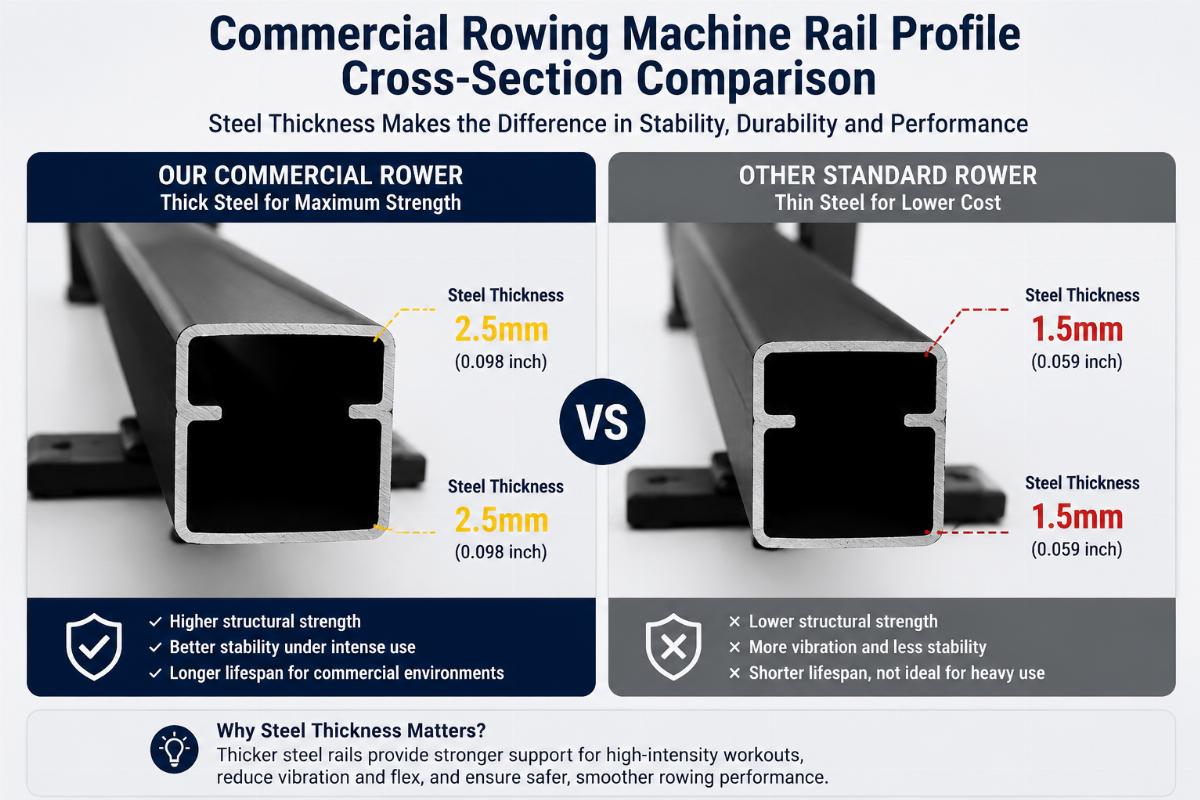
When buyers search for free shipping options, the real question is not whether freight is waived, but whether tube wall thickness, weld integrity, and after-sales spare parts have been silently compressed to absorb that cost. A commercial gym owner evaluating a turnkey package must bundle freight terms with structural verification, or risk paying return-air freight on a full container of unusable steel.
I once supervised the installation of a Smith machine and power rack shipment for a boutique studio in Dubai. The spec sheet looked clean on paper, but when members loaded the bar for squats, the cross-member flexed noticeably. A handheld caliper check on-site revealed the actual tube wall was below the tolerance stated in the drawing. The entire batch was rejected, and the cost of air-shipping replacement parts ran into a mid-six-figure figure. That job moved me from the installation floor into sourcing, and since then I have carried a caliper to every factory audit. [NEED_CITE: structural failure root causes in commercial strength equipment per ASTM F2216 field reports]
The pattern repeats across regions: buyers chase the headline "free shipping" without realizing the freight cost has already been folded into the unit price, and the real variable is whether the manufacturer compensated by thinning the steel or skipping weld inspection. Let us walk through what free shipping actually covers, how to verify quality before accepting it, which buying scenarios genuinely benefit, how to compare total landed cost, and what after-sales support should realistically look like.
What Does "Free Shipping" Actually Cover in Fitness Equipment Orders?
Free shipping in commercial fitness equipment typically follows one of three models — and each model hides a different cost boundary.
The first model is FOB-with-freight-absorbed, where the manufacturer quotes a higher unit price that internally offsets ocean freight to a named port. The buyer sees "free shipping" on the invoice, but the per-unit cost is inflated. The second model is container-load consolidation, where the manufacturer fills a full container with mixed SKUs and spreads the freight cost across all items — this is the only scenario where free shipping can genuinely reduce total cost. The third model is sample-or-LCL-subsidy, where the manufacturer absorbs freight on small orders as a customer-acquisition loss, often cutting packaging protection to preserve margin. [NEED_CITE: Incoterms 2020 freight allocation responsibilities under FOB vs CIF vs DDP]
| Shipping Model | Freight Cost Visibility | Packaging Protection | Quality Risk Exposure |
|---|---|---|---|
| FOB-with-freight-absorbed | Hidden in unit price | Standard | Moderate — margin pressure on materials |
| Container-load consolidation | Spread across SKUs | Full container optimization | Low — volume supports quality control |
| LCL-subsidy | Waived visibly | Often reduced | High — thin packaging invites transit damage |
A distributor in West Africa once placed an OEM-branded order for plate-loaded machines with free shipping quoted on a per-piece basis. The unit price carried a noticeable premium over the same manufacturer’s container-load quotation, and the packaging used single-layer corrugated cardboard instead of the wooden crate standard for full-container shipments. Two machines arrived with bent selectorized guide rods. The "free" shipping cost the buyer several times the freight savings in replacement claims. [NEED_CITE: transit damage frequency comparison between FCL and LCL fitness equipment shipments]
The takeaway is structural: free shipping only becomes economically rational when the order volume supports container-load consolidation. Anything smaller shifts the freight burden into either the unit price or the packaging budget — and packaging is where transit damage begins.
How to Verify Equipment Quality Before Accepting Free Shipping Deals?
Three verification steps — caliper measurement, weld inspection, and load-rating cross-check — separate real commercial-grade equipment from spec-sheet fiction.
The first step is tube wall thickness verification using a digital caliper or ultrasonic thickness gauge. Commercial strength equipment should use steel tubing at a minimum wall thickness consistent with EN and ASTM structural standards for gym environments. [NEED_CITE: minimum tube wall thickness requirements per EN 20957 for commercial strength equipment] Measure at multiple points along the tube — manufacturers who thin the walls often do so selectively at non-visible junctions.
The second step is weld quality inspection via visual check and, where available, ultrasonic or magnetic particle testing reports. Look for consistent bead width, absence of porosity, and full penetration at load-bearing joints. A reputable manufacturer will provide weld inspection documentation on request. [NEED_CITE: weld quality acceptance criteria per AWS D1.1 for structural steel in fitness equipment]
The third step is load-rating cross-check against the manufacturer’s published capacity claims. Request the test protocol used — static load testing, dynamic cycling, or finite element analysis — and compare it against recognized standards. [NEED_CITE: load testing methodology requirements per ASTM F2216 for commercial strength equipment]
| Verification Point | Tool / Document | Acceptable Standard | Red Flag |
|---|---|---|---|
| Tube wall thickness | Digital caliper / ultrasonic gauge | Meets EN 20957 minimum | Below tolerance at non-visible joints |
| Weld integrity | Visual + UT/MT report | Full penetration, no porosity | Self-reported only, no third-party record |
| Load rating | Test protocol documentation | Static + dynamic per ASTM F2216 | Static-only claim without cycling data |
A hotel developer in Southeast Asia was evaluating a turnkey fitness center package with free shipping included. During the pre-shipment inspection, the caliper check revealed that the Smith machine’s main uprights measured below the stated wall thickness at the base weld zone. The manufacturer had thinned the tube at a structurally critical point. The order was renegotiated before shipment, and the supplier replaced the affected frames at no additional freight cost — precisely because the buyer had verified before the container was sealed. [NEED_CITE: pre-shipment inspection failure rate for commercial gym equipment from Shandong manufacturing region]
Which Buying Scenarios Truly Benefit from Free Shipping?
Free shipping delivers real value only when the order structure matches the logistics model — and the mismatch is where most buyers lose money.
The scenario that genuinely benefits is full-container turnkey packages for commercial gyms, hotels, or apartment fitness centers. When a buyer consolidates cardio, strength, and free-weight equipment into a single container, the manufacturer can optimize the loading plan, and the per-unit freight cost drops to near zero without compressing product quality. [NEED_CITE: container loading optimization efficiency for mixed fitness equipment shipments]
The scenario that does not benefit is small-batch trial orders or LCL shipments marketed with "free shipping". In these cases, the manufacturer typically absorbs freight by reducing packaging density, using lighter crate materials, or skipping protective corner bracing. The buyer saves on the freight line item but exposes the order to transit damage — which is especially costly for heavy items like plate-loaded machines and cable crossover frames.
| Buying Scenario | Order Volume | Free Shipping Viability | Primary Risk |
|---|---|---|---|
| Full gym turnkey package | Full container | High — freight genuinely spread | Low if loading plan is optimized |
| Boutique studio package | Partial container | Moderate — depends on consolidation | Packaging reduction possible |
| Trial order or LCL | Less than container | Low — freight folded into unit cost | Transit damage from lighter packaging |
| OEM distributor restock | Full container repeat | High — established loading pattern | Minimal if supplier relationship is mature |
A CrossFit box owner in the Middle East initially planned to order a functional training rig and a set of bumper plates as a trial, with the supplier offering free shipping on the combined order. The rig arrived with a bent cross-member because the open-frame design had not been crated — only stretch-wrapped. The replacement shipment required the buyer to pay return logistics and air freight for the damaged component, which exceeded the original freight savings entirely. The lesson was simple: free shipping on a partial load is a marketing line, not a logistics advantage. [NEED_CITE: transit damage claim frequency for fitness equipment shipped without full crating]
How to Compare Total Landed Cost Across Suppliers Offering Free Shipping?
Total landed cost is the only honest comparison metric — and it must include unit price, freight allocation, spare parts availability, and rework risk, not just the invoice line item.
The comparison matrix below shows how four cost components interact across three supplier models. The "free shipping" supplier often appears cheapest on the unit price line, but the total landed cost tells a different story when rework risk and spare parts latency are factored in.
| Cost Component | Factory-Direct with Transparent Freight | Factory-Direct with "Free Shipping" | Trading Company with Free Shipping |
|---|---|---|---|
| Unit price | Moderate — freight listed separately | Elevated — freight absorbed into price | Highest — margin layers added |
| Freight visibility | Full — buyer controls logistics | Hidden — bundled into unit cost | Hidden — bundled and marked up |
| Spare parts availability | Full batch-level supply | Sample-level or self-reported | Often not provided |
| Rework risk exposure | Low — verifiable quality control | Moderate — margin pressure on materials | High — no direct factory oversight |
A distributor in Latin America was comparing three quotations for a container load of commercial treadmills and strength machines. Supplier A quoted a lower unit price with freight listed separately. Supplier B quoted a higher unit price with "free shipping" included. Supplier C, a trading company, quoted the highest unit price with "free shipping" and no spare parts commitment. When the buyer calculated total landed cost including a standard spare parts package and estimated rework exposure, Supplier A’s transparent model came out lowest — even with freight paid separately — because the quality verification process was more rigorous and the spare parts pipeline was verifiable. [NEED_CITE: total cost of ownership methodology for commercial fitness equipment procurement]
The critical insight is that "free shipping" shifts cost visibility, not cost itself. A buyer who compares only the invoice total will consistently overpay on quality-sensitive categories like structural steel and weld integrity.
What After-Sales Support Should You Expect with Free Shipping?
After-sales support in international fitness equipment transactions is delivered through spare parts packages, technical documentation, and remote guidance — not through on-site repair visits covered by freight-waived orders.
The standard after-sales package from a reputable commercial fitness equipment manufacturer includes three elements: a spare parts kit covering wear components such as cables, pulleys, adjustment pins, and upholstery for the first operational cycle; technical documentation including assembly drawings, wiring schematics, and maintenance schedules; and remote technical support via video call or messaging for installation guidance and troubleshooting. [NEED_CITE: standard after-sales package components for commercial fitness equipment exported to MENA and Africa markets]
What free shipping does not cover is on-site repair logistics. If a component fails and requires physical replacement, the spare part is typically shipped at the manufacturer’s cost only if the failure is covered under warranty terms — and even then, the international courier cost for urgent air shipment is usually borne by the buyer unless explicitly negotiated otherwise.
| After-Sales Element | Standard Inclusion | Typical Exclusion |
|---|---|---|
| Spare parts kit (wear components) | Included for initial cycle | Extended-cycle kits require separate order |
| Technical documentation | Full assembly and maintenance docs | On-site installation supervision |
| Remote technical support | Video call and messaging support | On-site repair visits |
| Warranty replacement parts | Covered for manufacturing defects | Shipping cost for urgent air freight |
A gym chain operator in Southeast Asia received a turnkey package with free shipping from a Shandong-based manufacturer. The shipment included a spare parts box containing replacement cables, pulley wheels, and adjustment knobs for every selectorized machine in the order. When a cable frayed on a cable crossover after several months of use, the operator replaced it on-site using the spare kit — no international shipment was needed, and the machine was back in service within a single maintenance window. The availability of that spare parts box was negotiated as part of the original order, not offered as an afterthought. [NEED_CITE: spare parts consumption rate for commercial cable machines in high-usage gym environments]
Conclusion
Free shipping on commercial fitness equipment is a pricing structure, not a discount — and the real cost lives in tube thickness, weld quality, spare parts coverage, and container-load efficiency.
Buyers who verify structural quality before shipment, consolidate orders into full containers, compare total landed cost rather than invoice line items, and negotiate spare parts packages as part of the original order will consistently land equipment that performs reliably — regardless of whether the freight line reads zero or a separate figure.