Compare Seated Row Machine Suppliers in China for Chain Gym Owners
A lower unit price almost always means a higher total cost once defect rates and warranty claims are factored in.
When comparing Seated Row Machine Suppliers in China, chain gym owners must verify load stack tolerance, rail material grade, structural welding method, and cable system durability — not just the spec sheet numbers. Requesting material certificates and third-party inspection reports before placing bulk orders is the only reliable way to separate commercial-grade equipment from machines that will fail within months under daily use.
I still remember standing in a packed aisle at a Chicago trade show years ago, watching a boutique studio buyer flip through a glossy catalog from one of the many Seated Row Machine Suppliers in China he had shortlisted. The quoted price was noticeably lower than the others, and the spec sheet proudly listed an 80-kilogram load stack. It looked like a solid deal on paper. Weeks later, when the shipment landed at a warehouse on the West Coast, the actual measured weight came in significantly short — closer to the high sixties. The rail material turned out to be plain carbon steel instead of the bearing steel promised, and within a few months of daily commercial use, the machines started flexing and rattling. An entire batch had to be returned. That buyer later told anyone who would listen that comparing Seated Row Machine Suppliers in China requires tearing apart every line on the data sheet and demanding proof behind it. [NEED_CITE: common failure modes in commercial selectorized strength equipment per ISO 20957 field reports]
That story is not an outlier — it is a pattern that repeats across the industry whenever buyers focus on headline specs alone. Let us break down exactly what to compare.
What Specs Should You Actually Compare Between Seated Row Machine Suppliers?
The four verifiable specifications that separate reliable Seated Row Machine Suppliers in China from risky ones are load stack weight tolerance, rail material grade, frame welding method, and cable-pulley system construction.
Most spec sheets from overseas factories will proudly display "commercial grade" or "heavy duty" without defining what those terms actually mean in measurable terms. The reality is that these labels are marketing terms, not engineering certifications. [NEED_CITE: ISO 20957 stationary training equipment safety requirements and classification standards] What matters is whether the supplier can back up each claim with verifiable data.
| Specification | Reliable Supplier | Unverified Supplier |
|---|---|---|
| Load Stack Tolerance | Controlled within narrow range | Noticeably short on actual weight |
| Rail Material | Bearing steel grade | Plain carbon steel |
| Welding Method | CO2 shielded welding | Spot welding only |
| Cable System | Steel cable with sealed bearings | Undersized cable with basic pulleys |
| Material Certificates | Full batch-level documentation | Self-reported or not provided |
| Post-Weld Treatment | Stress-relieved and ground | Uncontrolled or skipped |
A distributor in the Middle East once ordered a full container of seated row machines from a supplier who quoted bearing steel rails. When the goods arrived, a simple magnet test and hardness check revealed plain carbon steel — a material that wears down noticeably faster under cyclic commercial loading. The rails started showing play within a few months, and the entire batch had to be replaced at a cost several times the original savings. [NEED_CITE: bearing steel GCr15 versus carbon steel Q235 hardness and wear resistance comparison]
The lesson is straightforward: if a supplier cannot provide material certificates for the rail steel and the load stack plates, walk away. Spec sheet numbers alone are meaningless without third-party verification.
How Do You Verify Load Stack Accuracy Before Placing a Bulk Order?
Load stack discrepancy is the single most common complaint among gym chain owners who sourced from unverified Seated Row Machine Suppliers in China — and it is entirely preventable with pre-shipment measurement.
The load stack is the heart of any selectorized seated row machine. Members adjust the pin, expect a specific resistance, and build their training around that number. When the actual weight falls short, two things happen: the machine feels inconsistent compared to other equipment in the gym, and the perceived quality of the entire brand drops. [NEED_CITE: load stack tolerance standards in commercial strength equipment manufacturing]
Here is what a proper verification process looks like:
- Request a pre-production sample — before committing to a full container, insist on a single unit built to your exact specifications. Measure the load stack yourself or hire a local inspector.
- Specify tolerance in the purchase contract — do not leave it vague. State the acceptable deviation range explicitly and tie it to payment release terms.
- Conduct pre-shipment inspection — hire a third-party inspection service to weigh a random sample of load plates from the production batch. [NEED_CITE: third-party pre-shipment inspection protocols for fitness equipment]
- Cross-check plate dimensions and density — cast iron plates can vary in actual weight depending on casting quality. A plate that looks the right size may still be underweight if the casting has internal voids.
A chain gym operator in Southeast Asia learned this the hard way. The first order from a new supplier looked perfect on the spec sheet. But when the machines were installed across multiple locations, members started complaining that the row machines felt lighter than the equivalent machines from other brands. A spot check revealed that the load stacks across the batch were consistently underweight — not by a small margin, but by a noticeable amount that made the equipment unusable for serious training. The operator had to negotiate a partial refund and source replacement plates locally, which ate into the margin completely.
Why Does Rail Material Matter More Than Frame Thickness?
Rail steel grade determines long-term smoothness and wear resistance — no amount of frame thickness can compensate for a rail that degrades under daily commercial use.
The rail system is what guides the seat carriage back and forth during every repetition. In a commercial gym environment, a seated row machine can see hundreds of cycles per day. That means the rail surface is under constant friction, and the material it is made from directly determines how long the machine will operate smoothly. [NEED_CITE: linear rail material selection for high-cycle commercial fitness equipment]
Bearing steel — specifically the GCr15 grade — is the industry benchmark for rail applications because of its hardness and wear resistance. Plain carbon steel, on the other hand, is significantly softer and will develop surface wear, pitting, and play much faster under the same conditions. The difference in service life is substantial, not marginal.
| Rail Material | Hardness | Wear Resistance | Expected Service Life Under Commercial Use |
|---|---|---|---|
| Bearing Steel (GCr15) | High | Robust | Substantially extended |
| Carbon Steel (Q235) | Moderate | Vulnerable | Noticeably reduced |
Some Seated Row Machine Suppliers in China will quote bearing steel in the initial proposal and then ship carbon steel in production, banking on the fact that most buyers will not inspect the rails closely. The swap is difficult to detect visually — both materials look similar to the untrained eye — but the performance gap becomes obvious within months of commercial use. The seat starts wobbling, the movement feels rough, and members notice immediately.
The fix is simple but non-negotiable: require the supplier to provide a material test report for the rail steel with every shipment, and include a hardness verification step in your inspection checklist. [NEED_CITE: GCr15 bearing steel material certification requirements]
What Questions Should You Ask Suppliers About Welding and Structural Integrity?
Welding method and post-weld treatment are the hidden factors that determine whether a seated row machine frame will hold up under years of cyclic loading — or start flexing and cracking within months.
The frame of a seated row machine absorbs significant dynamic force with every pull. If the welding is inconsistent or the joints are not properly treated after welding, micro-cracks can develop and propagate over time, eventually leading to visible frame flex or even structural failure. [NEED_CITE: welding quality standards for commercial gym strength equipment frames]
CO2 shielded welding produces deep, consistent penetration and is the standard for commercial-grade frames. Spot welding, while faster and cheaper, creates weaker joints that are more prone to fatigue failure under repeated stress. The difference is not subtle — it is the gap between a machine that lasts a decade and one that needs to be replaced in a few years.
Key questions to ask any of the Seated Row Machine Suppliers in China you are evaluating:
- What welding process is used on the main frame? — If the answer is spot welding, ask why. A supplier using spot welding on primary structural joints is cutting corners.
- Is there a post-weld stress relief process? — Welding introduces residual stress into the metal. Without stress relief — whether through heat treatment or mechanical methods — the frame is more likely to distort over time.
- What load testing protocol is followed before shipment? — A reliable supplier will subject each frame to a static load test that exceeds the maximum user weight rating by a significant margin.
- Can you provide weld inspection reports? — Batch-level weld quality documentation is a sign of a mature quality control system.
A gym chain owner in Latin America once received a batch of row machines where roughly a fraction of the units showed visible frame flex during the first month of use. Investigation revealed that the supplier had switched from CO2 shielded welding to spot welding on the production run to speed up output — without informing the buyer. The entire batch had to be pulled from the gym floors, and the reputational damage to the chain took far longer to repair than the financial loss.
How Do You Evaluate OEM Capability and After-Sales Support for Chain Gym Rollouts?
For chain gym operators scaling across multiple locations, the supplier’s OEM flexibility, spare parts availability, and container consolidation capability matter far more than a low per-unit price or a flexible minimum order quantity.
When you are outfitting a chain of gyms — whether across one country or multiple regions — consistency is everything. Every machine in every location needs to look, feel, and perform identically. That means your supplier must be capable of producing to exact branding specifications, maintaining color and finish consistency across production runs, and delivering replacement parts on demand — not just selling you a box and disappearing. [NEED_CITE: OEM quality consistency requirements for multi-location fitness equipment rollouts]
Here is what to look for when evaluating Seated Row Machine Suppliers in China for a chain rollout:
- In-house branding capability — Can the supplier handle custom logo placement, color matching, and branded packaging without outsourcing? Outsourced branding introduces inconsistency and delays.
- Spare parts inventory and supply — Cables, pulleys, seat pads, and load pins will wear out over time. A supplier that keeps spare parts in stock and can ship them quickly will save you from extended machine downtime.
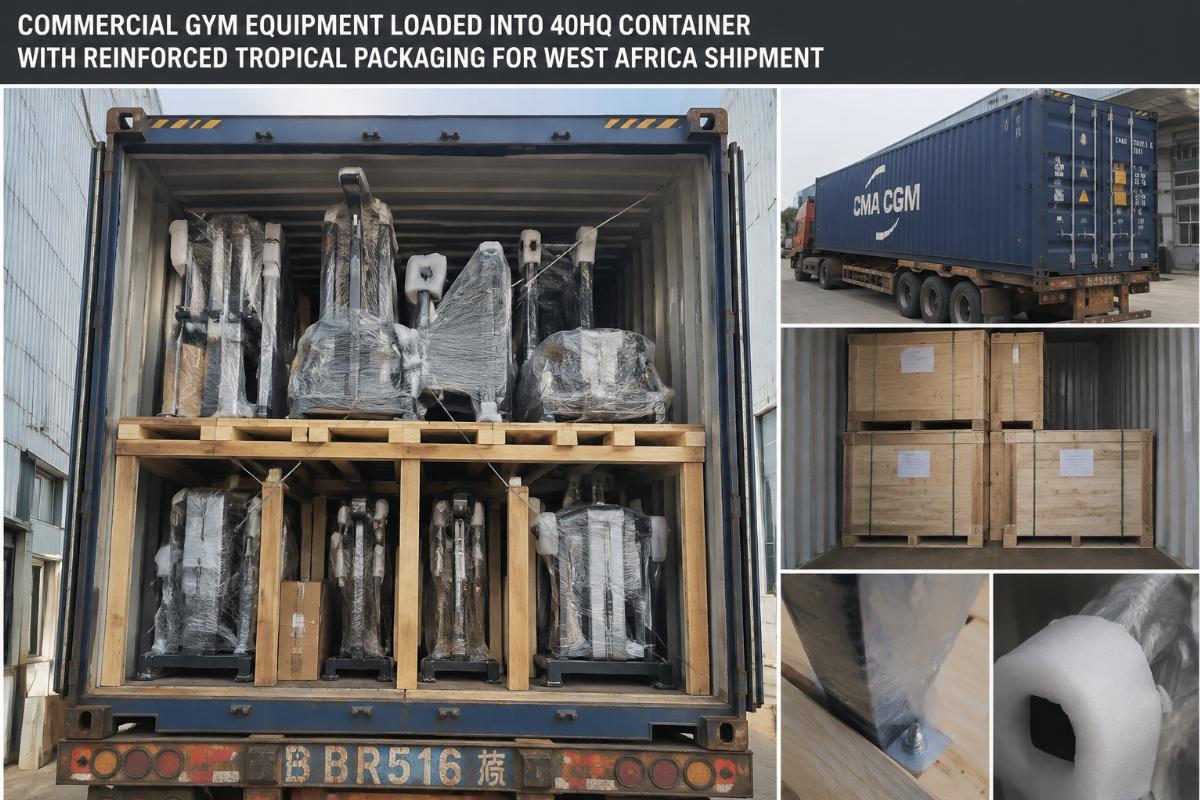
- Container consolidation for multi-machine orders — A chain gym package typically includes a mix of cardio, strength, and free-weight equipment. A supplier that can consolidate different machine types into a single container shipment reduces logistics cost and complexity significantly.
- Technical support responsiveness — When a machine goes down in a gym, every hour of downtime is a member complaint. The supplier needs to have a support channel that responds within hours, not days.
One of the manufacturers that consistently meets these requirements is Bick, based in Shandong Province. Their factory produces a full range of commercial strength equipment — including ISO-lateral and selectorized seated row machines — with in-house OEM and ODM branding, spare parts supply, and the ability to consolidate complete gym packages into container loads. Their pricing sits substantially below premium international brands while maintaining CE certification and commercial-grade construction. For a chain operator looking to scale across multiple locations without managing a dozen different suppliers, that kind of turnkey capability is a genuine competitive advantage.
Conclusion
Comparing Seated Row Machine Suppliers in China is not about finding the lowest quote — it is about verifying the specs that actually determine equipment lifespan under commercial conditions. Load stack accuracy, rail material grade, welding quality, and cable system durability are the four factors that separate machines that last from machines that fail. Demand material certificates, insist on pre-shipment inspections, and choose a supplier that can support your chain rollout with consistent OEM branding, spare parts, and container consolidation. The extra effort upfront will save you from the far greater cost of equipment failure down the line.