

Fitness Equipment Price in Italy: 2026 Complete Buyer Guide
Most buyers assume the landed price is the final cost — until a motor burns out in month three and the retrofit bill wipes out the entire margin.
Fitness equipment price in Italy in 2026 ranges from entry-level home units at a few hundred euros to full commercial cardio and strength lines that can reach mid-six figures per facility. The gap between Italian retail pricing and direct factory sourcing from China typically spans a substantial proportion, but the real cost drivers are steel grade, motor sizing, CE documentation completeness, and whether you ship full containers or consolidated LCL loads.
I still remember a full container of commercial treadmills we sent to a gym chain in Rio de Janeiro. The client flipped the breakers, and within minutes the drive boards started smoking. Brazil runs a mixed grid — some outlets at 127V, others at 220V, all at 60Hz. We had spec’d the motors for 220V/50Hz, which is standard for the Chinese domestic market. The entire batch needed motor and control board replacements on-site. The airfare, hotel, and parts for that retrofit trip cost several times the profit on the original order. Since then, before I quote anyone — whether they’re in São Paulo, Milan, or Dubai — the first questions out of my mouth are voltage, frequency, and plug type. Italy runs 230V/50Hz as the national standard, but older buildings in cities like Rome and Naples often have unstable voltage that can shorten motor life if you don’t spec adequate headroom [NEED_CITE: Italian electrical grid voltage tolerance standards per CEI]. That’s the kind of detail that separates a quote from a real cost picture.

Let’s break down where the fitness equipment price in Italy actually lands, what pushes it up or down, and how buyers who source directly from Chinese factories can navigate the pitfalls without learning them the hard way.
How Much Does Commercial Fitness Equipment Cost in Italy in 2026?
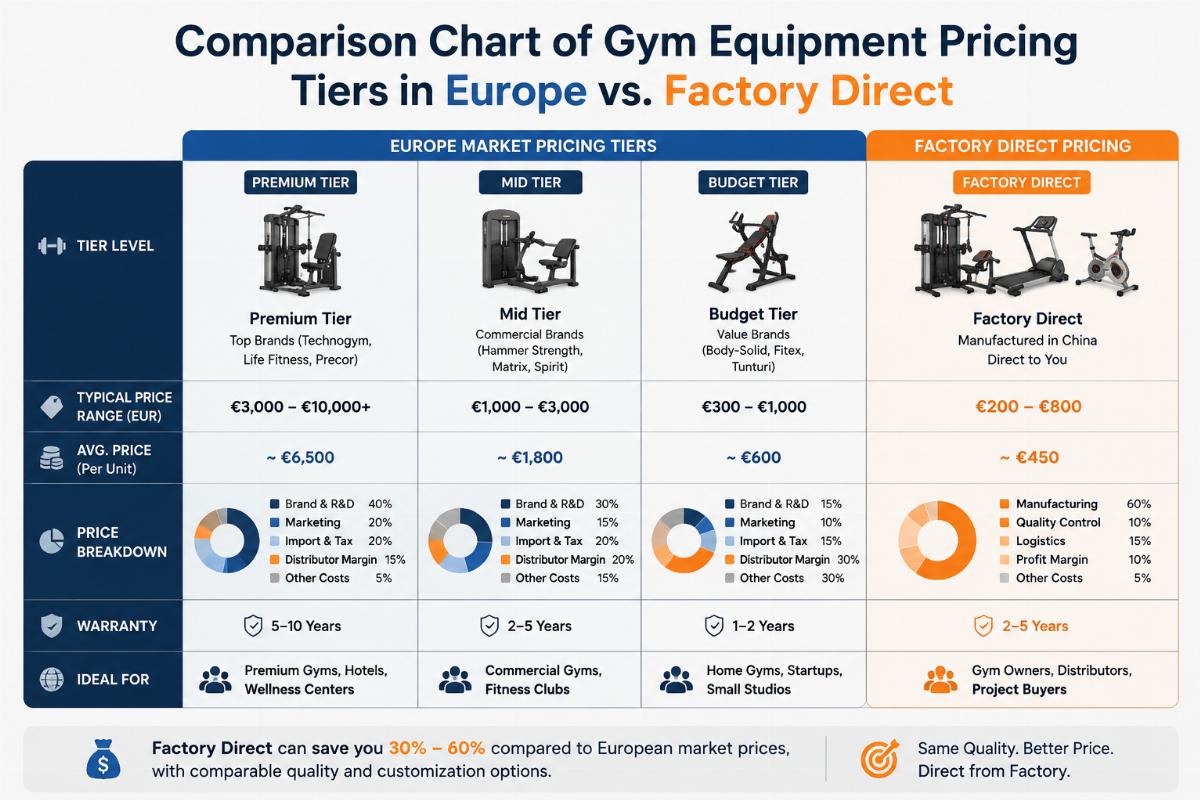
Italian retail pricing for commercial gym equipment carries a significant markup over factory-direct sourcing, with the spread driven by European distributor margins, brand premiums, and local compliance overhead.
When a gym owner in Milan walks into a showroom and asks for a commercial treadmill, the sticker price he sees has already absorbed brand licensing, European warehousing, local VAT, dealer margin, and the cost of maintaining a service network. Strip all of that away, and the underlying manufacturing cost is a fraction of the retail figure. The table below compares typical Italian market positioning against factory-direct sourcing across the three major equipment categories:
| Equipment Category | Italian Retail / Distributor Level | Factory-Direct from China Level | Primary Cost Gap Driver |
|---|---|---|---|
| Commercial Treadmills (AC motor, 3HP+) | Premium tier — branded European or American labels | Noticeably reduced — comparable commercial-grade build | Brand premium, EU distribution layer |
| Commercial Strength Machines (Plate-loaded, Selectorized) | Premium to mid-tier — heavy steel frames, premium upholstery | Noticeably reduced — same steel thickness, OEM finishing | Brand premium, localized assembly cost |
| Free Weights (Dumbbells, Barbells, Plates) | Mid-tier — rubber-coated, branded packaging | Noticeably reduced — identical casting and coating processes | Packaging, branding, smaller order inefficiency |
| Functional Training Gear (Racks, Cable Crossovers) | Mid to premium tier | Noticeably reduced — standard steel fabrication | Brand premium, logistics markup |
| Complete Turnkey Gym Package | Premium — full project management included | Noticeably reduced — factory consolidation of all categories | Project management fee, multi-vendor coordination cost |
[NEED_CITE: European fitness equipment market pricing structure and distributor margin analysis]
A boutique studio owner in Turin recently compared quotes for a full strength line — a Smith machine, a cable crossover, and a full set of plate-loaded stations. The European brand quote came in at roughly triple the factory-direct equivalent from a Shandong manufacturer. The steel gauge was identical. The upholstery was the same supplier. The difference was purely the brand name and the import-to-retail pipeline.
The fitness equipment price in Italy is not a single number — it’s a range shaped by where you sit in the supply chain. Buyers who understand this structure can make sourcing decisions that protect margin without sacrificing commercial durability.
What Factors Drive Fitness Equipment Pricing for Italian Buyers?
Steel grade, motor specification, CE documentation depth, and shipping method are the four variables that determine whether your per-unit cost stays controlled or spirals.
Let’s walk through each one, because most buyers fixate on the unit price and miss the variables that actually move the total cost.
Steel Frame Construction
Commercial-grade equipment uses heavy-gauge steel tubing with reinforced welding at stress points. Home-grade or budget commercial lines use thin-wall tubing that flexes under repeated load. The material cost difference is noticeable, but the failure cost is far higher — a cracked frame on a loaded Smith machine is a liability event, not a warranty claim [NEED_CITE: commercial fitness equipment steel thickness standards and durability testing protocols].
Motor Sizing and Electrical Components
For cardio equipment, the motor is the single most expensive component. An undersized motor in a commercial treadmill will overheat within months of daily use. The key is matching the motor to the expected usage intensity and, critically, to the local voltage and frequency. Italian facilities on 230V/50Hz need motors wound and tested for that specification — not a generic universal motor that "should work."
CE Certification Completeness
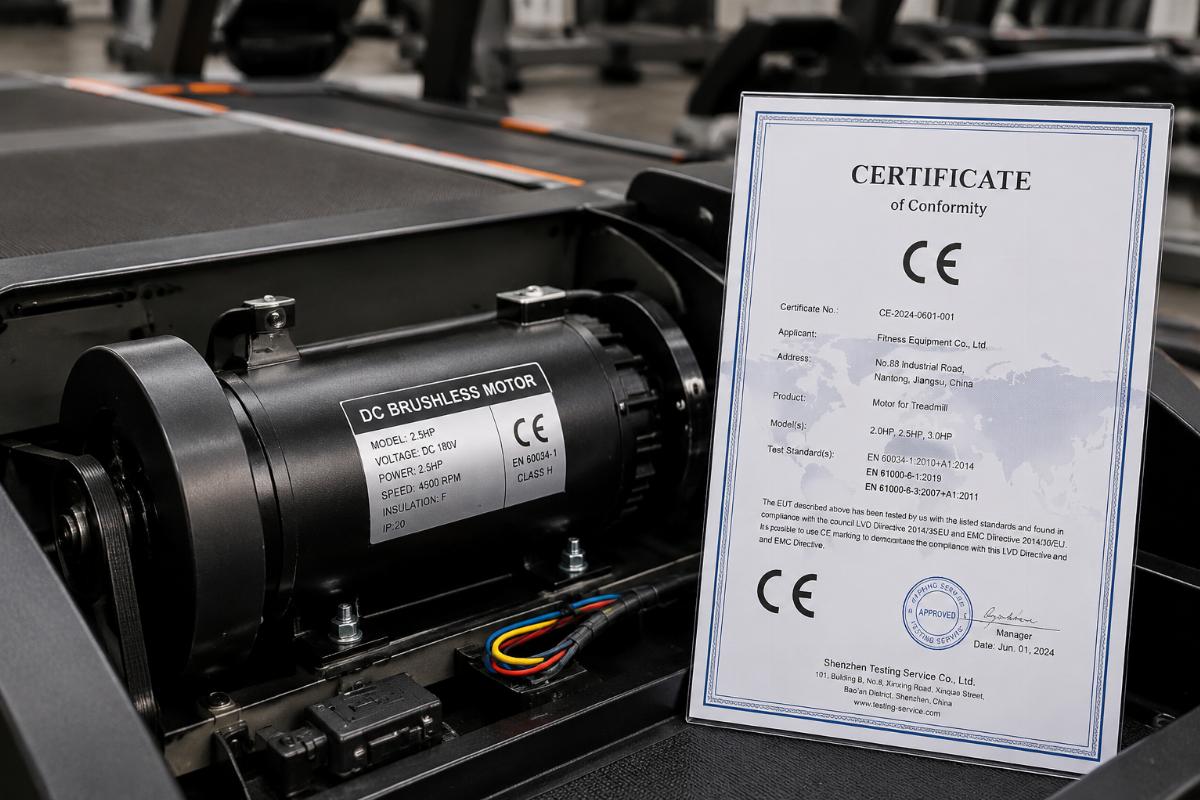
This is where many buyers get caught. A CE mark on the nameplate is not enough. Italian customs and market surveillance authorities can request the full Technical File — including risk assessments, test reports, declarations of conformity, and component certifications. Missing any document means the shipment gets held at the port, and demurrage charges accumulate daily [NEED_CITE: EU Machinery Directive and Low Voltage Directive technical file requirements for fitness equipment imports].
| CE Documentation Level | Customs Clearance Risk | Market Surveillance Risk |
|---|---|---|
| Full Technical File with test reports | Resistant | Resistant |
| Nameplate CE mark only, no supporting docs | Vulnerable | Vulnerable |
| Self-declared CE with no third-party testing | Vulnerable | Vulnerable |
Shipping Method: Full Container vs. LCL Consolidation
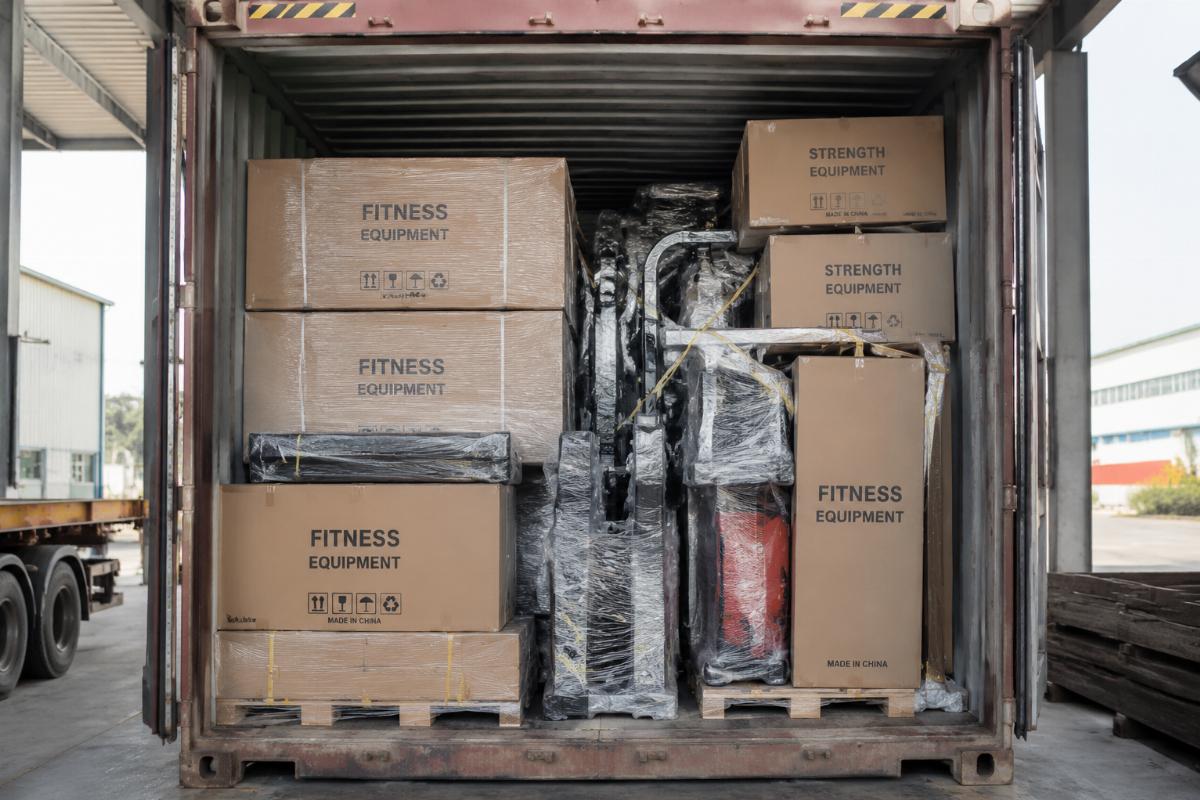
Shipping a full 40HQ container from a single factory dramatically reduces the per-unit freight cost. Buyers who order single machines from multiple vendors end up paying LCL rates, which include handling fees, consolidation charges, and higher damage risk from mixed loading. A buyer outfitting a hotel gym in Sardinia consolidated cardio, strength, free weights, and flooring into a single container from one manufacturer — the per-unit freight cost dropped noticeably compared to sourcing each category separately.
How to Avoid Costly Mistakes When Importing Gym Equipment to Italy?
Voltage-frequency mismatch, inadequate motor headroom for aging building wiring, and incomplete CE technical files are the three mistakes that turn a good deal into a mid-six-figure loss.
I’ve seen all three happen, and the pattern is always the same: the buyer focused on unit price and skipped the technical due diligence.
Mistake One: Ignoring Voltage and Frequency Specifications
Italy’s standard is 230V/50Hz with a Type L or Type F plug. But here’s what most import guides don’t tell you — older commercial buildings, especially converted warehouses and historic structures used as gyms, often have voltage fluctuations that can dip or spike beyond tolerance. If your treadmill motor is spec’d at exactly 230V with no headroom, those fluctuations will shorten the motor’s service life substantially. The fix is to request motors wound with a tolerance band that accommodates real-world grid conditions, not just the nominal voltage [NEED_CITE: Italian commercial building electrical infrastructure voltage fluctuation patterns].
Mistake Two: Treating CE Certification as a Sticker
I reviewed a shipment once where the factory had slapped a CE logo on the equipment but could not produce a single test report when Italian customs asked. The container sat at the port of Gioia Tauro for weeks. The demurrage and storage fees ended up exceeding the value of the equipment inside. CE compliance for fitness equipment falls under the Machinery Directive and the Low Voltage Directive — both require a documented Technical File that travels with the goods [NEED_CITE: EU customs seizure statistics for non-compliant fitness equipment imports].
| Compliance Approach | Documentation Status | Port Clearance Outcome |
|---|---|---|
| Full Technical File with third-party test reports | Complete and verifiable | Smooth clearance |
| CE mark only, no Technical File | Incomplete | High risk of detention |
| Forged or copied CE certificates | Fraudulent | Shipment seizure and penalties |
Mistake Three: Not Planning for Spare Parts Availability
Commercial equipment will need maintenance. Belts wear, bearings fail, control boards malfunction. If your supplier cannot provide spare parts within a reasonable timeframe, a minor repair becomes a machine sitting idle for weeks — and an idle machine in a commercial gym is lost revenue every single day.
Is Buying Fitness Equipment from China Worth It for Italian Gyms?
Direct factory sourcing from China delivers a meaningful cost advantage at commercial grade, but only when the manufacturer can prove CE compliance, voltage customization capability, and after-sales parts supply.
The short answer is yes — with conditions.
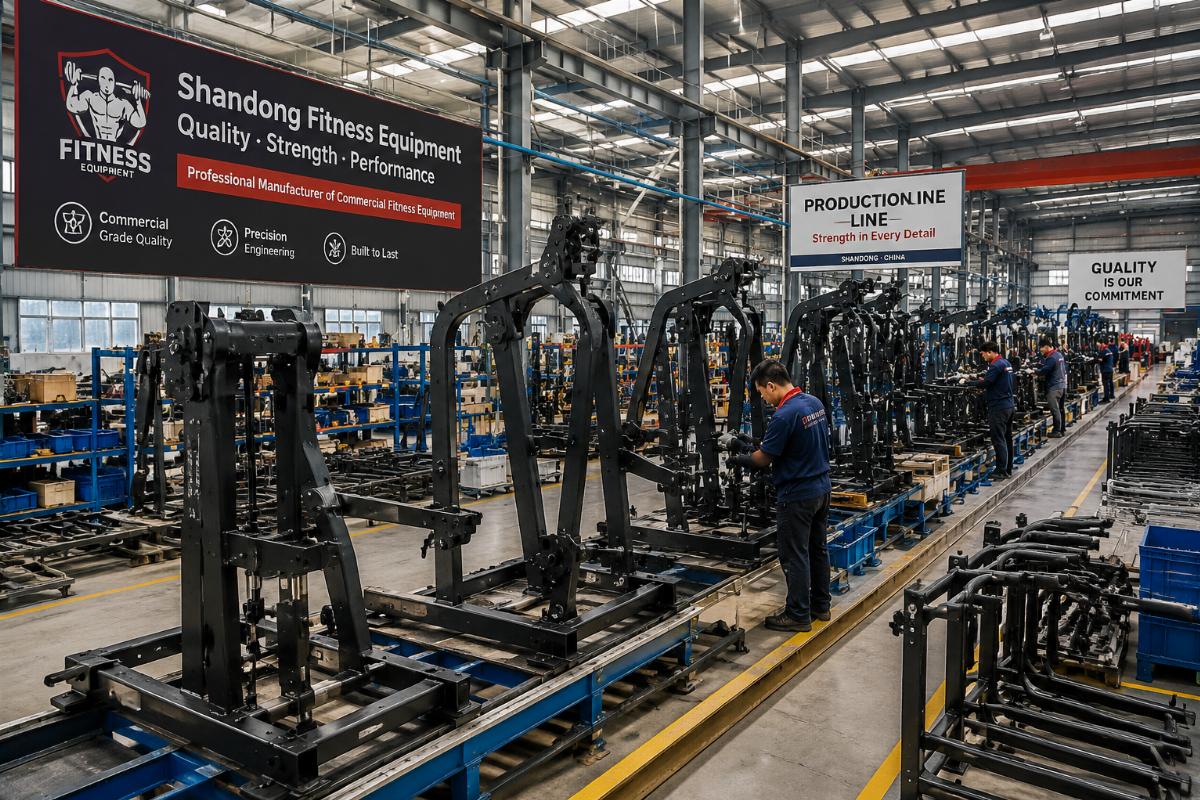
Shandong Province has concentrated a dense cluster of commercial fitness equipment manufacturers over the past two decades. The supply chain for steel tubing, motor winding, upholstery, and electronic control boards is fully localized. This means a factory there can produce a commercial treadmill or a plate-loaded leg press at a cost structure that is structurally lower than European manufacturing, even before any brand premium is removed.
But "cheap" and "cost-effective" are not the same word. I’ve worked with gym owners across multiple regions — from Latin America to the Middle East to Southern Europe — and the ones who succeed with Chinese sourcing are the ones who treat it like a manufacturing partnership, not a marketplace purchase.
What to verify before placing an order:
- CE Technical File availability — ask to see the actual test reports, not just a certificate image. A legitimate manufacturer will provide them without hesitation.
- Voltage and frequency customization — confirm in writing that motors and control boards are built to 230V/50Hz for Italy, with adequate tolerance for grid fluctuations.
- Steel gauge and weld quality — request material certificates and, if possible, visit the factory or hire a third-party inspector.
- Spare parts commitment — get a written agreement on parts availability and lead times for a defined period after delivery.
- OEM and branding flexibility — if you’re a distributor or a gym chain building your own brand, confirm the manufacturer’s MOQ for custom branding on frames, consoles, and packaging.
[NEED_CITE: Chinese fitness equipment export quality standards and CE compliance verification methods]
A gym chain operator in southern Italy recently transitioned from a premium European brand to a direct OEM relationship with a Shandong factory for their new locations. The per-unit cost dropped substantially. The steel quality matched. The CE documentation was complete. The only adjustment was retraining their maintenance technician on the control board layout — a one-time effort that paid for itself within the first quarter.
The fitness equipment price in Italy will always be higher at the retail level. The question is whether you’re willing to invest the time in sourcing diligence to access the factory-level cost structure.
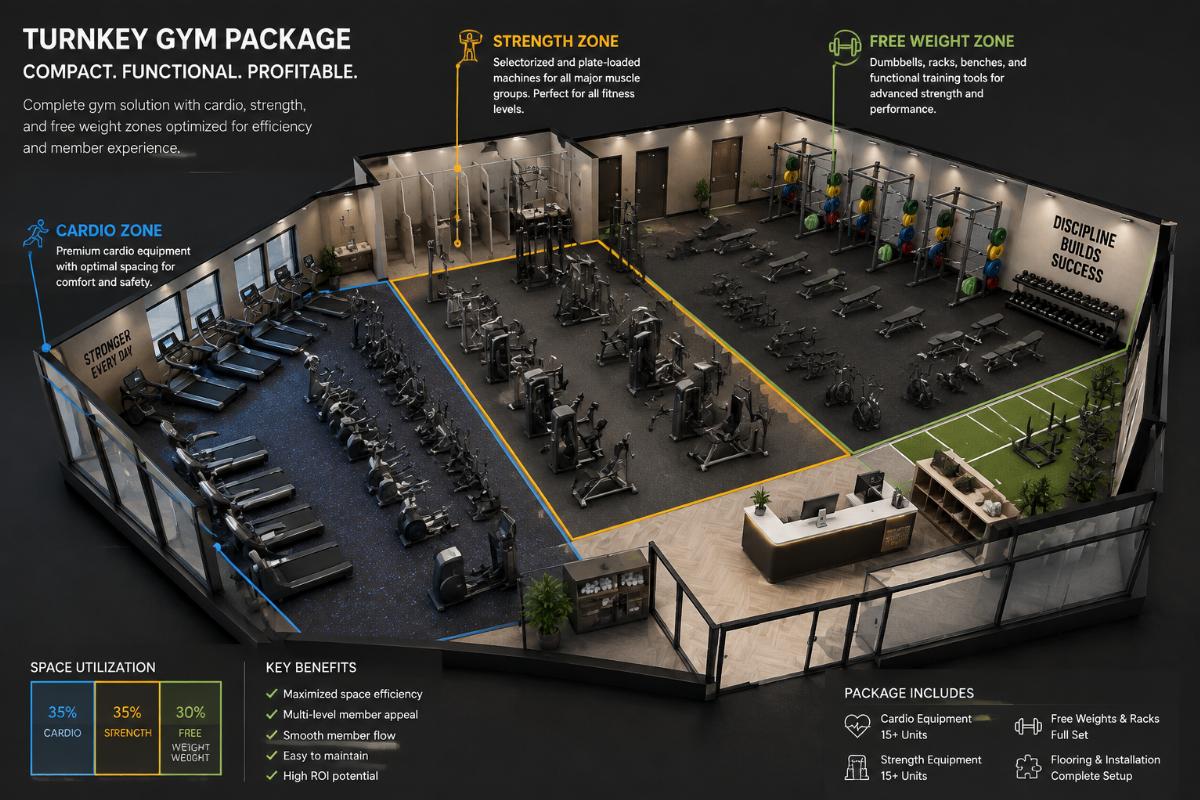
How to Build a Complete Turnkey Gym Package Within Budget?
Consolidating cardio, strength, free weights, functional gear, and flooring into a single factory package optimizes container utilization, reduces per-unit freight, and simplifies project management.
Most gym buildouts fail on budget not because the equipment is too expensive, but because the logistics and coordination costs spiral out of control. You order treadmills from one vendor, strength machines from another, free weights from a third, and flooring from a fourth. Each vendor ships separately. Each charges LCL rates. Each has a different lead time. Your project manager spends more time tracking shipments than designing the gym layout.
The alternative is a turnkey package from a single manufacturer that covers the full equipment spectrum. Here’s how the cost structure compares:
| Cost Component | Multi-Vendor Sourcing | Single-Factory Turnkey Package |
|---|---|---|
| Equipment unit price | Standard per-vendor pricing | Noticeably reduced through bundled volume |
| Freight per unit | LCL rates across multiple shipments | Full container rate, cost spread across all categories |
| Customs clearance | Multiple entries, multiple document sets | Single entry, unified CE documentation |
| Project coordination | Multiple contacts, multiple lead times | Single point of contact, synchronized production |
| Spare parts inventory | Multiple suppliers, fragmented stock | Unified parts catalog from one source |
[NEED_CITE: turnkey gym equipment package cost optimization strategies for commercial facilities]
A hotel developer on the Amalfi Coast needed to equip fitness centers across three properties. The space was tight — each gym had to fit cardio, a compact strength circuit, free weights, and functional training gear into a limited footprint. By working with a single manufacturer that could supply the full range in commercial-compact formats, the developer loaded a single container per property with everything needed — including the rubber flooring. The per-unit freight cost was a fraction of what multi-vendor LCL shipping would have required.
The fitness equipment price in Italy doesn’t exist in isolation. It’s part of a total project cost that includes freight, customs, installation, and long-term maintenance. Buyers who optimize the entire package — not just individual machines — end up with a gym that’s built on budget and built to last.
Conclusion
The fitness equipment price in Italy is shaped less by the machine itself and more by the supply chain decisions around it — sourcing channel, compliance documentation, electrical specification, and shipping strategy. Buyers who invest in technical due diligence and consolidate their procurement into factory-direct turnkey packages consistently access a cost structure that retail and distributor channels cannot match. The margin between a successful import and an expensive lesson is measured in voltage specs, CE file completeness, and container load planning — not in the sticker price on a showroom floor.
