Cable Crossover OEM Manufacturer for Military Base MWR Buyers
"Commercial grade" is not a standard—it is a marketing phrase that means nothing without material-level verification.
Military MWR buyers must prioritize specification-level verification over surface-level claims to avoid field failures in high-intensity base gym environments. The real difference between a cable crossover that lasts a decade and one that fails in months lies in steel grade, bearing type, and wire rope rating—not in the label on the frame.
I remember a Middle East military base MWR gym project where we sourced over twenty cable crossovers for a facility in the Gulf region. The supplier’s quotation clearly stated "commercial grade frame." When the units arrived at the base in Riyadh and were installed, the weight stack guide rails were made from ordinary cold-rolled steel instead of the specified grade. Within a short period, the rails warped and jammed, rendering entire units inoperable. The cost of airfreighting replacement parts wiped out the profit from the entire container load. That experience fundamentally changed how I approach OEM production—every frame steel specification, pulley bearing type, and wire rope rating now gets broken down to the drawing level with the buyer before a single unit enters production. Buyers are not afraid of paying more; they are afraid of discovering on-site that what arrived does not match what was promised.
The sourcing decisions military MWR procurement officers make today determine whether base gyms operate reliably for years or become costly maintenance burdens within months. Let us break down what actually matters when you are sourcing equipment for high-intensity military fitness facilities.
What Specifications Actually Define "Commercial Grade" for Military Use?
"Commercial grade" is meaningless without material-level verification; military MWR requires specification breakdown to steel grade, bearing type, and wire rope rating.
The fitness equipment industry uses "commercial grade" as a blanket descriptor, but different manufacturers define this term in completely different ways. One factory’s "commercial grade frame" might use high-yield steel with proper thickness tolerances, while another’s might use lower-grade material with minimal surface treatment. The performance gap between these two approaches only becomes visible after months of heavy use in a military base gym where equipment sees continuous, high-intensity operation from physically demanding personnel.
| Specification Element | Proper Military MWR Grade | Substandard Alternative |
|---|---|---|
| Frame Steel Type | High-yield cold-rolled steel with controlled thickness tolerance | Basic hot-rolled steel with wide tolerance variance |
| Guide Rail Material | Precision-ground steel with wear-resistant coating | Untreated standard steel prone to deformation |
| Pulley Bearing Type | Sealed precision bearings rated for high rotational load | Basic bearings with inadequate load rating |
| Wire Rope Construction | Multi-strand aviation-grade cable with verified breaking strength | Standard cable with unverified tensile properties |
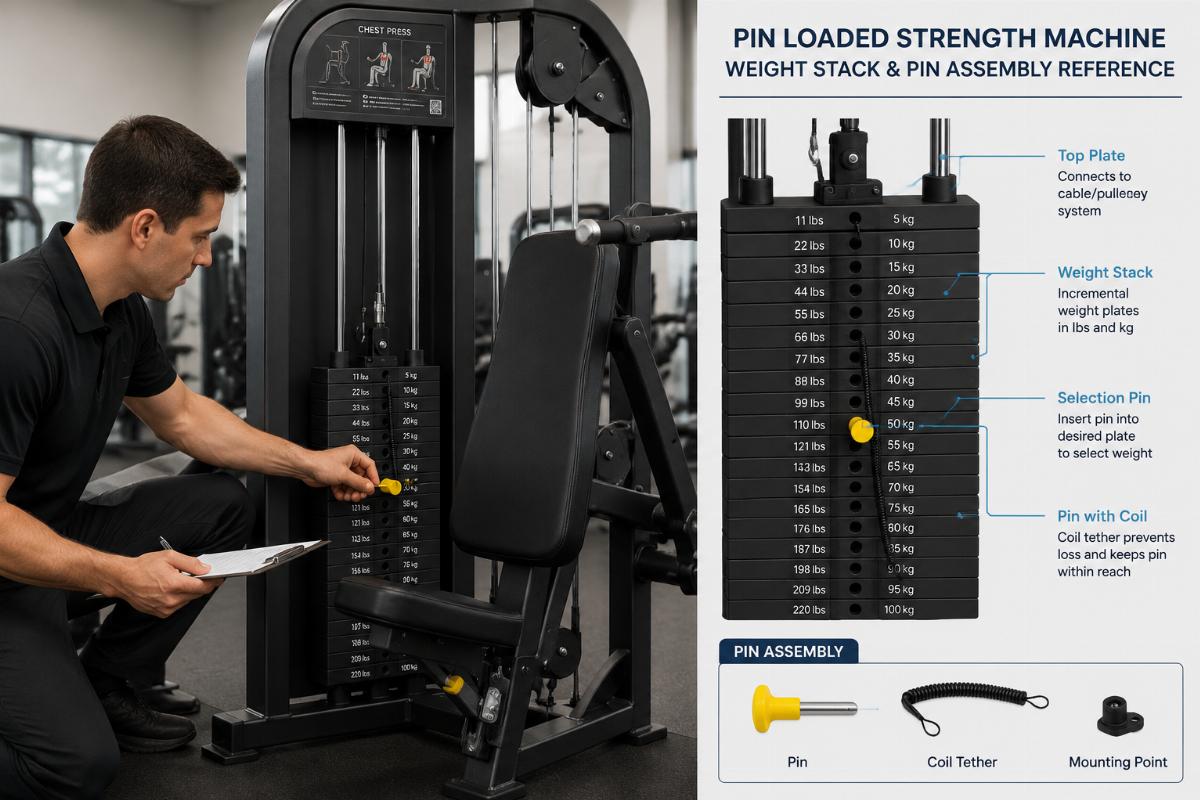
| Weight Stack Guide | Linear precision rails with controlled straightness tolerance | Basic rod guides vulnerable to misalignment |
The frame steel alone reveals significant variation. Cold-rolled steel offers superior yield strength and tighter thickness tolerances compared to hot-rolled alternatives, which directly affects how the frame handles repeated loading cycles [NEED_CITE: mechanical property differences between cold-rolled and hot-rolled steel per ASTM standards]. Surface treatment matters equally—proper powder coating applied after phosphating pretreatment provides corrosion resistance that basic paint simply cannot match, especially in humid coastal base environments.
Pulley systems represent another critical divergence. The bearing type determines how smoothly the cable moves under load and how long the system operates without noise or binding. Sealed precision bearings rated for the specific rotational speeds and load ranges of the weight stack travel distance prevent the异响 and卡顿 that plague under-specified units. When bearings are not matched to the actual usage frequency of a military gym—where equipment may see continuous use throughout operating hours—failure becomes inevitable.
Wire rope specifications demand equal scrutiny. The cable diameter, strand construction pattern, and verified breaking strength must align with the weight stack mass and safety factor requirements [NEED_CITE: wire rope safety factor calculations per ISO fitness equipment safety standards]. A cable that appears adequate visually may lack the actual tensile strength needed for safe operation, creating a liability that no amount of frame quality can compensate for.
How Do You Validate Supplier Claims Before Committing to a Container Load?
Request material certificates, welding inspection reports, and load test data; cross-reference with independent third-party verification.
The gap between what a supplier claims and what actually ships represents the single largest risk in international fitness equipment procurement. Verifying claims before production begins—and again before shipment—prevents the expensive discoveries that happen only after equipment reaches the base gym floor.
The validation process should cover several key documentation requirements:
- Material certificates for frame steel, guide rail material, and wire rope, specifying grade, chemical composition, and mechanical properties
- Welding inspection reports documenting weld quality on structural joints, particularly at high-stress connection points
- Load test data showing actual performance under specified weight conditions, including deflection measurements
- Third-party certification from recognized testing bodies confirming compliance with international safety standards
Material certificates deserve particular attention. A certificate stating a specific steel grade should be traceable to the actual material batch used in production, not a generic certificate from a different order [NEED_CITE: material traceability requirements in ISO quality management systems]. Cross-referencing certificate numbers with mill test reports provides additional verification that the material matches specifications.
Welding quality on cable crossover frames affects structural integrity over thousands of loading cycles. Visual inspection alone cannot detect subsurface defects; proper documentation should include inspection methodology and acceptance criteria. High-stress areas where the frame connects to the weight stack guide and pulley mounting points require particular scrutiny.
Load testing should replicate actual usage conditions, not just static weight application. Dynamic testing that simulates the acceleration and deceleration forces generated during exercise reveals how the frame and components behave under realistic conditions. Deflection measurements under load indicate whether the frame maintains rigidity or flexes excessively, which affects both user experience and long-term durability.
A Southeast Asian naval base gym renovation project illustrates the consequences of inadequate validation. The cable crossovers specified for this facility required pulley systems capable of handling high-frequency use throughout daily operating hours. The supplier provided documentation that appeared complete on the surface, but the bearing specifications did not match the actual load and speed requirements. Within months of installation, the bearings developed noise and binding, requiring complete pulley system replacement across multiple units. The maintenance disruption affected gym availability during a critical facility upgrade period.
What Are the Hidden Costs of Specification Mismatches in Field Deployment?
Field failures due to downgraded materials lead to exponential costs—airfreight for replacements, facility downtime, and reputational damage with military stakeholders.
The initial purchase price of fitness equipment represents only a fraction of the total cost of ownership. When specification mismatches cause field failures, the cascading costs quickly dwarf any savings achieved through lower initial pricing.
Consider the cost structure of a specification failure:
- Replacement part logistics: Airfreighting heavy steel components internationally costs multiples of sea freight, often consuming the entire profit margin from the original order
- Facility downtime: Gym equipment outages in military base facilities affect morale and training readiness, creating operational impact beyond mere equipment costs
- Technical support deployment: Sending technicians to remote base locations for repairs involves travel costs, accommodation, and per diem expenses that accumulate rapidly
- Reputational impact: Military procurement officers operate within visible command structures; equipment failures that affect base operations create lasting impressions that affect future contract opportunities
The Middle East base gym project mentioned earlier demonstrates how these costs compound. When the guide rails warped and jammed, the solution required manufacturing replacement rails, arranging airfreight to the base location, and coordinating installation. The airfreight cost alone for the steel components consumed a substantial portion of the original order profit. Beyond the direct financial impact, the facility experienced extended downtime while waiting for parts, affecting gym availability for base personnel during a period when fitness facilities serve critical morale functions.
A Latin American army physical training center procurement revealed another dimension of hidden costs. The wire rope specifications did not properly match the weight stack mass, creating a safety concern that required immediate attention. The solution involved not only replacing the cables but also conducting comprehensive safety inspections across all units, documenting the corrective actions, and providing additional certification to military safety officers. The administrative burden of this process consumed significant staff time and created scrutiny that extended well beyond the immediate technical fix.
These scenarios illustrate why specification verification before production—not after delivery—represents the most cost-effective risk management strategy. The cost of requesting additional documentation, conducting factory inspections, or requiring third-party testing before shipment is minimal compared to the expense of correcting problems after equipment reaches an overseas military base.
How Do You Structure a Turnkey Sourcing Strategy for Base MWR Gyms?
Consolidate cardio, strength, and free-weight packages from a single OEM with proven military and MWR track record to ensure compatibility, warranty coverage, and spare parts availability.
Military base MWR gyms require comprehensive equipment packages that cover cardiovascular training, strength equipment across all muscle groups, and free-weight stations. Sourcing these categories from multiple suppliers creates compatibility issues, fragmented warranty coverage, and spare parts logistics challenges. A consolidated approach with a single manufacturer who can deliver complete gym packages simplifies procurement and ensures cohesive equipment ecosystems.
The turnkey sourcing strategy should address several key elements:
- Equipment compatibility: Ensuring that cardio machines, strength equipment, and free-weight stations work together as a cohesive training environment
- Unified warranty terms: Single-source warranty coverage that eliminates disputes about responsibility when issues arise
- Spare parts consolidation: Maintaining inventory of replacement components across all equipment categories from one supplier
- Space planning integration: Coordinating equipment layout to optimize traffic flow and training zone functionality
Complete gym packages from a single OEM allow for coordinated design where equipment aesthetics, color schemes, and user interface elements create a unified facility appearance. This matters in military base gyms where the facility reflects institutional quality and supports morale objectives.
The OEM capability to customize equipment specifications to military requirements represents another advantage of consolidated sourcing. When a single manufacturer produces the entire equipment package, specification adjustments for military use—such as enhanced durability requirements, specific safety features, or compatibility with existing base maintenance capabilities—can be implemented consistently across all equipment categories.
Spare parts availability becomes significantly simpler with a single-source approach. Instead of managing relationships with multiple suppliers for replacement components, base maintenance staff work with one point of contact for all equipment service needs. This reduces administrative overhead and accelerates repair turnaround times when equipment requires attention.
What After-Sales Support Infrastructure Should Military Buyers Demand?
Beyond warranty, require spare parts inventory, technical documentation, and remote troubleshooting support to minimize base gym downtime.
Warranty coverage provides a baseline protection, but military base gyms operating in remote locations require comprehensive after-sales support infrastructure that goes well beyond standard warranty terms. The geographic isolation of many military installations means that equipment downtime cannot be resolved through quick technician visits; support systems must enable local maintenance staff to handle most issues independently.
Essential after-sales support elements include:
- Spare parts inventory programs: Pre-positioned spare parts at regional locations or within the base itself, ensuring immediate availability when components fail
- Comprehensive technical documentation: Detailed maintenance manuals, troubleshooting guides, and exploded parts diagrams that enable local staff to perform repairs
- Remote technical support: Access to manufacturer technical staff via communication channels for guidance on complex issues
- Training programs: Initial and refresher training for base maintenance personnel on equipment service procedures
The spare parts strategy deserves particular attention. High-wear components such as cables, bearings, and adjustment mechanisms should be stocked in quantities that account for the equipment’s expected service life and usage intensity. A spare parts program that merely promises "availability" without specifying actual inventory locations and delivery timelines provides insufficient protection against extended downtime.
Technical documentation quality directly affects maintenance effectiveness. Documentation should be clear, comprehensive, and available in languages understood by base maintenance staff. Visual aids, step-by-step procedures, and troubleshooting decision trees enable personnel without specialized fitness equipment training to perform routine maintenance and basic repairs.
Remote support capabilities bridge the gap between local maintenance capacity and manufacturer expertise. When base staff encounter issues beyond their training or experience, access to manufacturer technical personnel through communication channels enables real-time problem-solving without waiting for technician travel.
Conclusion
Military MWR gym equipment procurement succeeds through specification-level verification, not surface-level claims. Breaking down cable crossover specifications to steel grade, bearing type, and wire rope rating prevents the field failures that create exponential costs through airfreight replacements and facility downtime. Consolidating equipment sourcing with a single OEM who understands military requirements ensures compatibility, unified warranty coverage, and streamlined spare parts logistics. Comprehensive after-sales support infrastructure—spare parts inventory, technical documentation, and remote troubleshooting—minimizes gym downtime in remote base locations where technician visits are impractical. The difference between reliable long-term operation and costly early failure lies in the details verified before production begins.