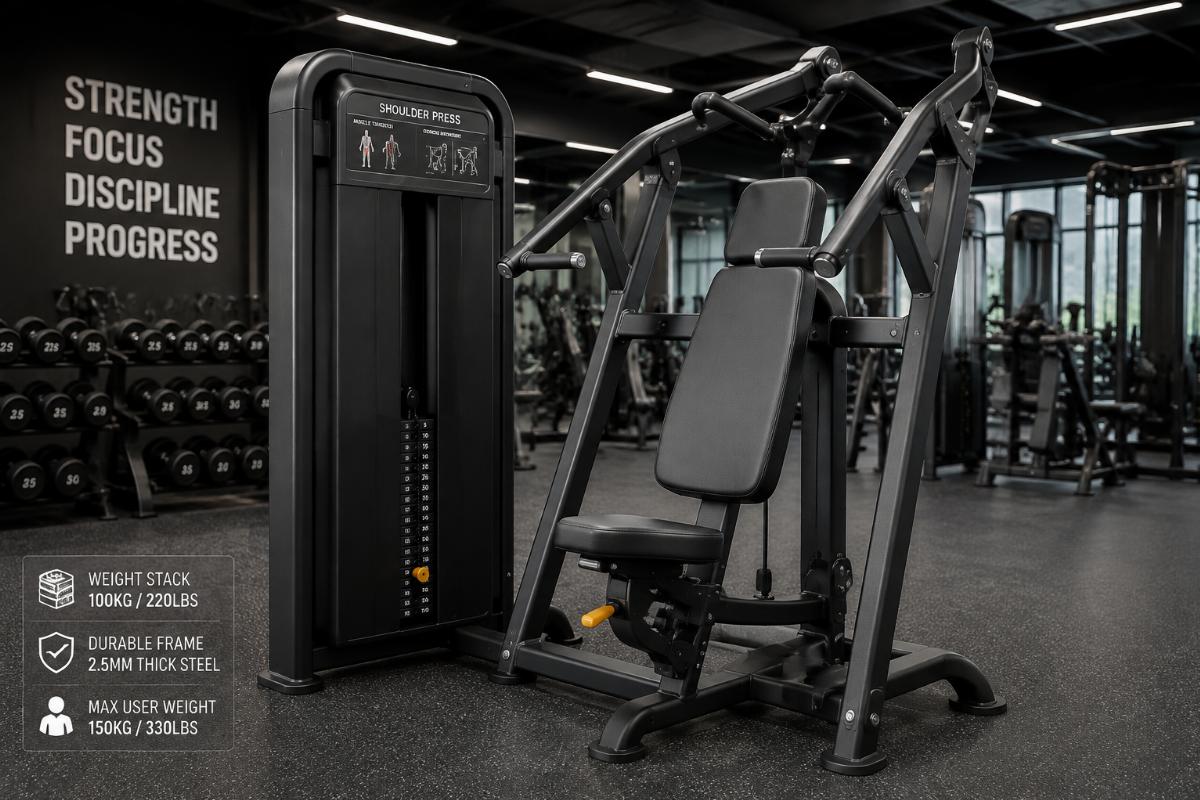
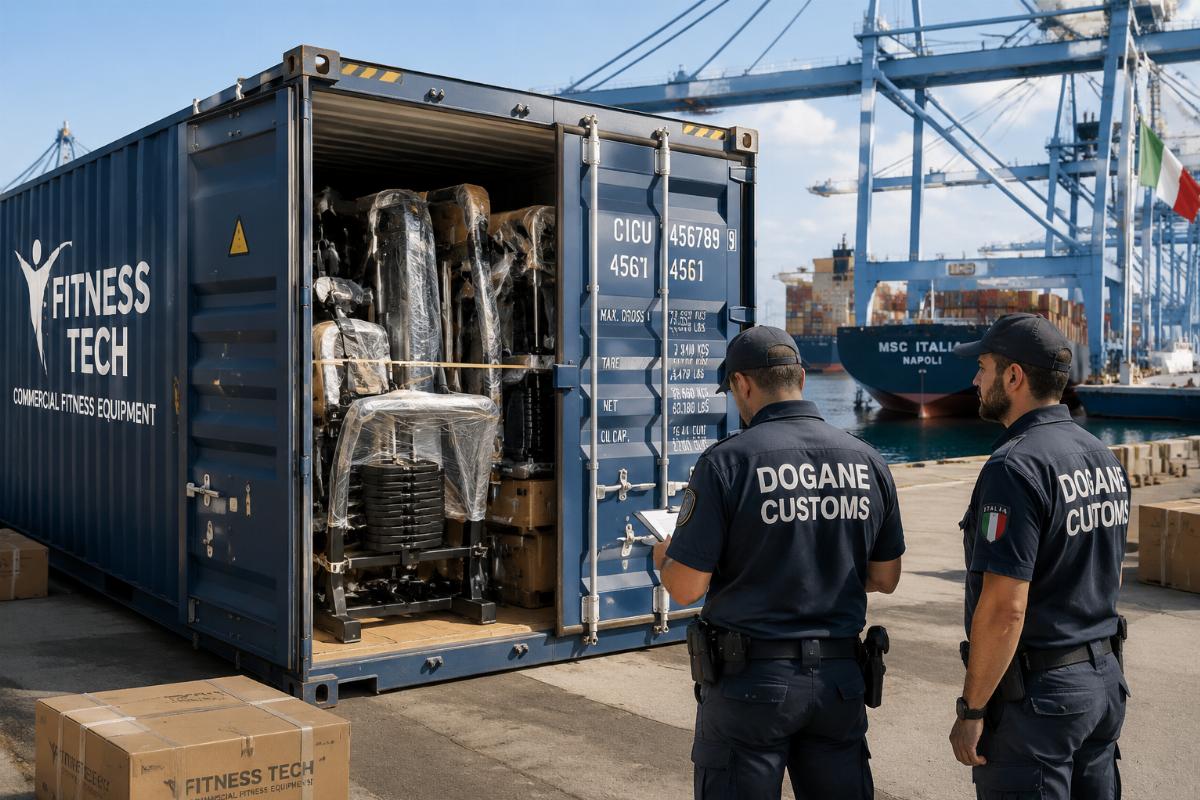
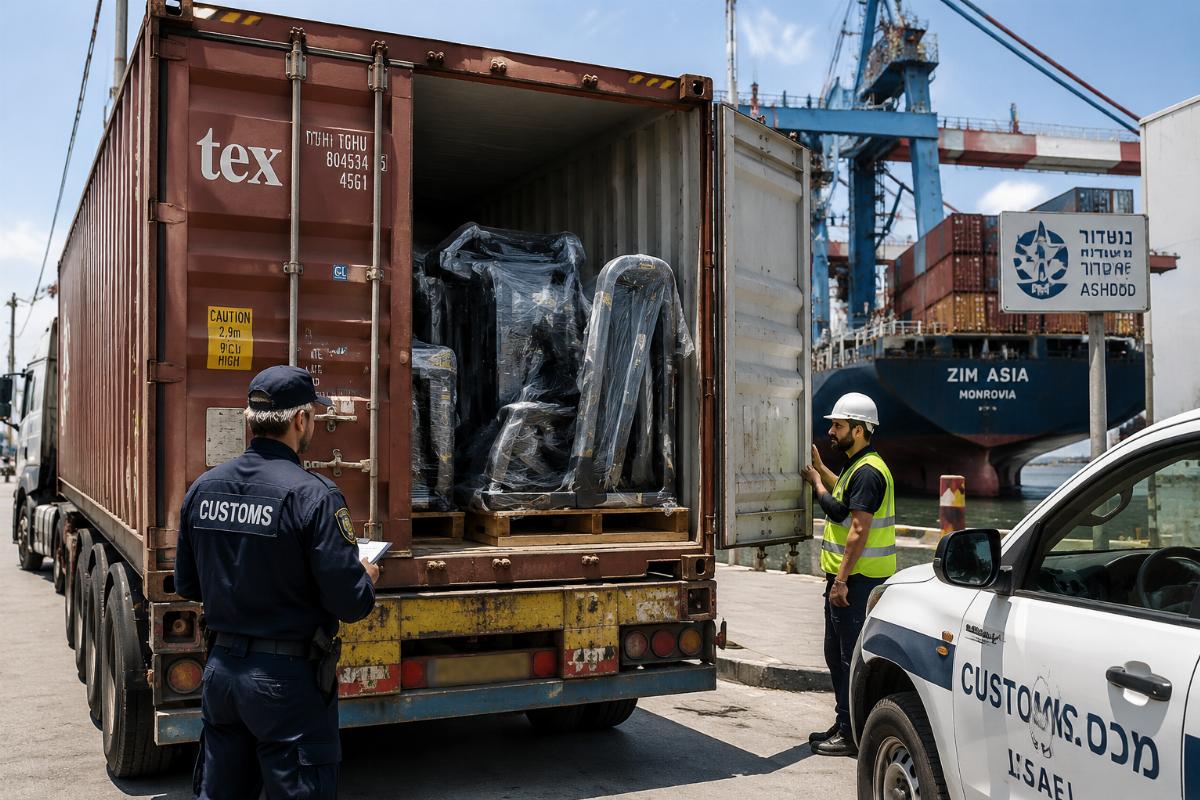
Commercial Gym Equipment Manufacturer OEM Strength Machines Bulk Supply
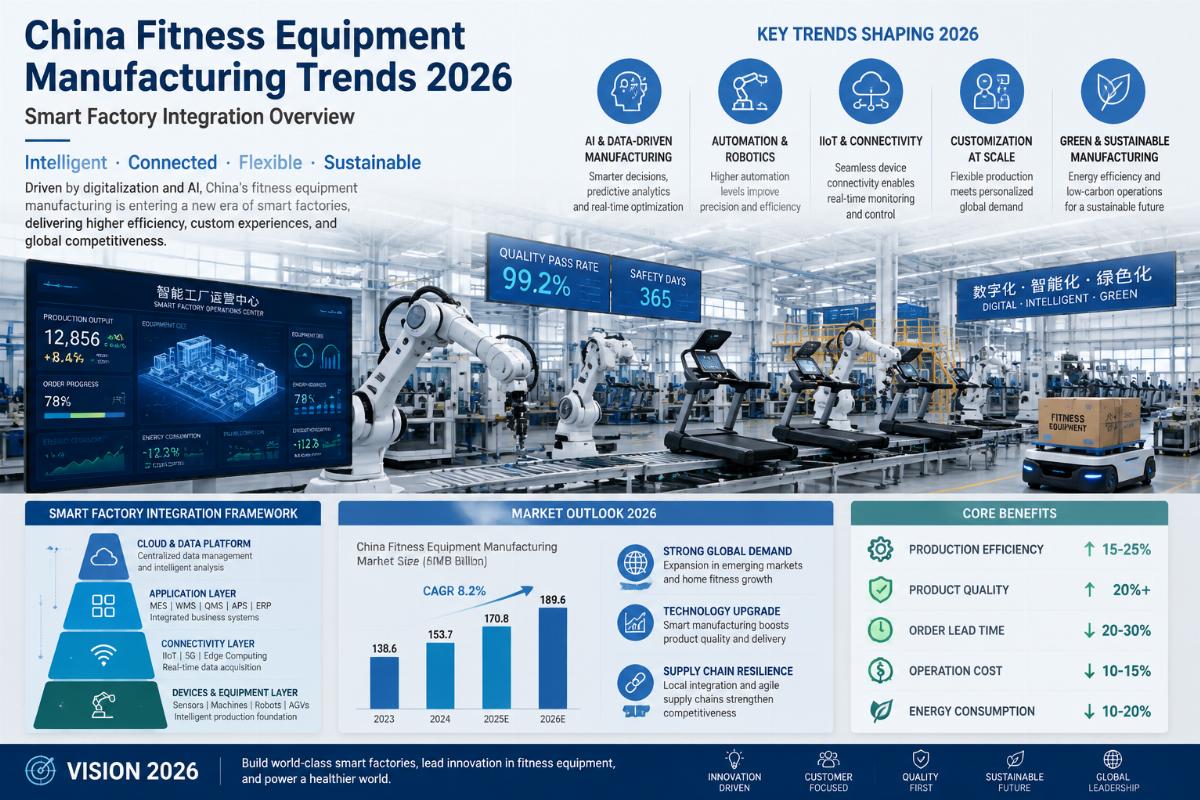
China fitness equipment manufacturing trends 2026 are no longer defined by labor-cost arbitrage. They are defined by smart factory integration, climate-adapted material engineering, and turnkey OEM depth at container-load scale.
For B2B buyers sourcing strength machines and complete gym packages, the competitive question has shifted from "who quotes lowest" to "who can integrate branding, material specs, and logistics under one roof—and prove it with auditable process data."
I spent my early career on factory floors in Shandong checking weld seams and powder coating thickness before moving to the trade side. That shift changed how I see bulk orders. Not long ago, we shipped a full turnkey package to a gym chain in Dubai—Smith machines, plate-loaded rigs, cable crossovers, the lot. The client wanted full OEM branding, custom RAL colors, logos laser-etched on every shroud. Everything passed QC under our factory lights. But once those selectorized machines sat in their glass-fronted showroom under Gulf sun, the standard pad-printed logos faded within months. The client called it cheap. We re-did the entire branding run with UV-cured ink at our cost. That’s when it hit me: OEM isn’t just about stamping a name on a frame. It’s about matching every finish and material spec to the environment the machine will actually live in. Bulk supply means bulk mistakes if you don’t think past the factory gate.
What follows is a ground-level reading of where Chinese commercial fitness manufacturing actually stands heading into late 2026—based on factory visits, buyer site inspections across the Gulf, and the kind of mistakes that only show up after a container has cleared customs.
What Has Actually Changed in China’s Fitness Equipment Factories by 2026?
The competitive edge has moved from labor cost to process integration—automated welding, digital QC tracking, and ERP-driven production planning now separate tier-one suppliers from the rest.
A decade ago, a buyer evaluating a China fitness equipment manufacturer OEM strength machines bulk supply partner would walk the floor looking for welder count and machine tool age. Today, the meaningful indicators are different. Automated robotic welding cells handle repetitive frame joints on plate-loaded machines, reducing human variation in penetration depth. Digital QC systems log torque values on every pivot bolt and cable tension reading on every selectorized stack before the unit leaves the line. ERP-linked production planning compresses lead times by synchronizing raw material arrival with fabrication schedules rather than batching by product family.
These shifts are not cosmetic. They directly affect what a buyer receives in a forty-foot container. [NEED_CITE: adoption rate of smart manufacturing systems in Shandong fitness equipment cluster] A gym chain owner ordering a mixed load of Smith machines, cable crossovers, and functional rigs is no longer accepting whatever sequence the factory produces. Production planning software now allows container-load consolidation across multiple SKUs while maintaining per-SKU branding and packaging specs—something that was operationally chaotic just a few cycles ago.
I visited a facility in Dezhou earlier this year where the welding line ran with minimal human intervention on standard frame geometries, while technicians focused entirely on custom jig setups for OEM-specific shroud shapes. The bottleneck had shifted from welding capacity to engineering setup speed. That is the real marker of a mature China fitness equipment manufacturer OEM strength machines bulk supply operation: the ability to switch between standardized production and deep customization without sacrificing throughput.

Why Are Middle East and Emerging Market Buyers Rewriting Their Spec Sheets?
Climate-adapted materials—UV-resistant coatings, heat-stable vinyl, anti-corrosion treatments—have moved from premium upgrades to baseline requirements for any serious China fitness equipment manufacturer OEM strength machines bulk supply engagement.
The Gulf region does not forgive material shortcuts. Ambient temperatures regularly exceed forty-five degrees Celsius in summer, and showroom environments with floor-to-ceiling glazing amplify UV exposure on equipment surfaces. Standard powder coat formulations designed for temperate climates will chalk and fade. Standard vinyl upholstery will soften, become tacky, and eventually crack along stitch lines.
A hotel developer in Doha learned this the hard way. They specified a complete strength package for a rooftop fitness center—selectorized machines, adjustable benches, dumbbell sets. The initial sample approval happened during a cool-season visit to the factory. Six months after installation, the seat bolsters on the leg extension and leg curl showed visible degradation. The powder coat on the weight stack shrouds had lost its gloss and showed micro-chalking. The operator faced a full upholstery and refinish replacement at a cost that dwarfed any initial material savings.
Since then, spec sheets from Middle East buyers routinely include clauses for UV-cured pad printing, high-temperature vinyl rated for sustained heat exposure, and zinc-rich primer systems on any component near floor level where humidity and cleaning chemicals accelerate corrosion. [NEED_CITE: material specification trends in MENA commercial fitness procurement] This is no longer a niche request. Any China fitness equipment manufacturer OEM strength machines bulk supply partner that cannot demonstrate material traceability and environmental testing documentation is being filtered out during the sourcing stage.
The implication for buyers is straightforward: ask for material test reports before sample approval, not after. Verify that the coating system is rated for the specific climate zone where the equipment will operate. And treat any supplier who dismisses these requirements as "standard" with deep skepticism.

How Has OEM Customization Evolved for Bulk Orders?
Full turnkey branding—laser-etched logos, custom RAL colors, branded packaging, multilingual documentation—is now standard at container-load MOQ, not a premium service tier.
The old model required buyers to source equipment from one factory, packaging from another, and documentation translation from a third. The integration burden sat entirely on the buyer’s procurement team. That model has collapsed.
Today’s mature China fitness equipment manufacturer OEM strength machines bulk supply operations handle the entire branding chain in-house. Laser-etched logos on selectorized shrouds, custom color matching to buyer Pantone or RAL references, branded carton printing with regulatory marks for the destination market, and multilingual user manuals and warranty cards—all produced, quality-checked, and consolidated under one roof.
A distributor importing into West Africa recently placed a mixed-container order spanning plate-loaded machines, free weight sets, and functional training accessories. Each product category carried distinct branding requirements: different logo placements, different color palettes, different language packs for the documentation. The factory’s OEM team managed all variants within a single production run, with digital work orders ensuring that the packaging line pulled the correct carton and manual set for each SKU as it moved through final assembly.
[NEED_CITE: OEM customization depth metrics in Chinese fitness equipment exports] The number of branding touchpoints per machine has expanded significantly. It is no longer just a logo on the frame. It includes seat embossing, shroud graphics, cable guard printing, weight stack insert labeling, and even branded quick-start guides mounted on the machine itself. A buyer evaluating a China fitness equipment manufacturer OEM strength machines bulk supply partner should request a complete branding audit trail—showing how each touchpoint is controlled, verified, and documented.
The risk of getting this wrong is not aesthetic. It is financial. Misaligned branding across a full container means repackaging costs at destination, potential customs delays if documentation does not match carton markings, and brand credibility damage with end users who notice inconsistency.

What Should B2B Buyers Verify When Evaluating Manufacturing Claims?
Factory audits, material test reports, and climate-specific sample validation protocols matter far more than catalog specifications when evaluating any China fitness equipment manufacturer OEM strength machines bulk supply partner.
Catalogs lie. Or more precisely, catalogs show the best-case scenario under controlled conditions. They do not show how a powder coat performs after six months of Gulf sun exposure. They do not show whether a cable crossover’s pulley system maintains smooth operation after a thousand hours in a high-humidity coastal environment. They do not show whether the vinyl on a leg press seat will remain stable at forty-five degrees Celsius ambient.
Buyers conducting serious due diligence should insist on three verification layers before committing to a bulk order.
First, a physical factory audit—ideally unannounced or conducted by a third-party inspection firm. The goal is not to check boxes on a compliance form. The goal is to observe production flow, QC station placement, and whether digital tracking systems are actually in use or simply installed for show. [NEED_CITE: third-party factory audit adoption rates among Chinese fitness equipment manufacturers]
Second, material test reports specific to the destination market’s environmental conditions. Salt spray test results for coating systems. UV resistance ratings for pad printing and vinyl. Tensile strength data for cable systems. These are not optional documents. They are the only evidence that the supplier’s material claims are grounded in testing rather than assumption.
Third, climate-specific sample validation. Request a production-intent sample—built with the exact materials, finishes, and branding that will go into the bulk order—and deploy it in the actual installation environment for a defined evaluation period. A gym operator in Riyadh did exactly this with a selectorized line package. The sample sat on their showroom floor through a full summer cycle before the bulk order was released. Two minor issues surfaced: the foam density on one seat model was insufficient for the expected usage intensity, and the quick-adjust pin mechanism on the lat pulldown showed premature wear. Both were corrected before the full container shipped. The cost of that sample validation was negligible compared to the cost of a container full of non-conforming product.

Conclusion
China fitness equipment manufacturing trends 2026 reward buyers who evaluate process integration, material engineering, and OEM depth—not just unit price.
The suppliers winning serious bulk orders are those who have invested in smart production systems, climate-specific material capabilities, and end-to-end branding integration. Buyers who source on catalog specs alone will continue to discover problems only after the container has arrived. Those who verify through audits, test reports, and environment-specific sampling will build supply relationships that perform in the field.