

Multi-Property Boutique Fitness Studios Standardize on Smith Machine – OEM Supplier
Bigger is not better when it comes to boutique studio layouts. The single most common mistake multi-location studio owners make is ordering commercial-gym-sized Smith machines without first locking down floor dimensions, ceiling height, and member traffic flow.
For boutique studios operating across multiple properties, the correct approach is to standardize on a compact, commercial-grade Smith machine from a qualified OEM supplier—one that balances load capacity, footprint, and attachment versatility—then replicate the exact SKU across every location to simplify maintenance, spare parts, and coach training. [NEED_CITE: space utilization benchmarks for boutique fitness formats per IHRSA boutique studio report]
I learned this the hard way. A client in the Middle East, running three studio locations under six hundred square meters total, insisted on full-frame deep-squat racks paired with plate-loaded Smith machines—the kind you would see in a big-box commercial gym. I pushed back twice. They would not listen. When the containers arrived, two machines placed side by side left the coach no room to turn around. That entire shipment sat in a warehouse for months before they finally figured out a reconfiguration. From that point on, my first step with any studio inquiry is to request a floor plan—even a hand-drawn sketch will do. Whether the machine is good is one thing; whether it physically fits and flows is another.
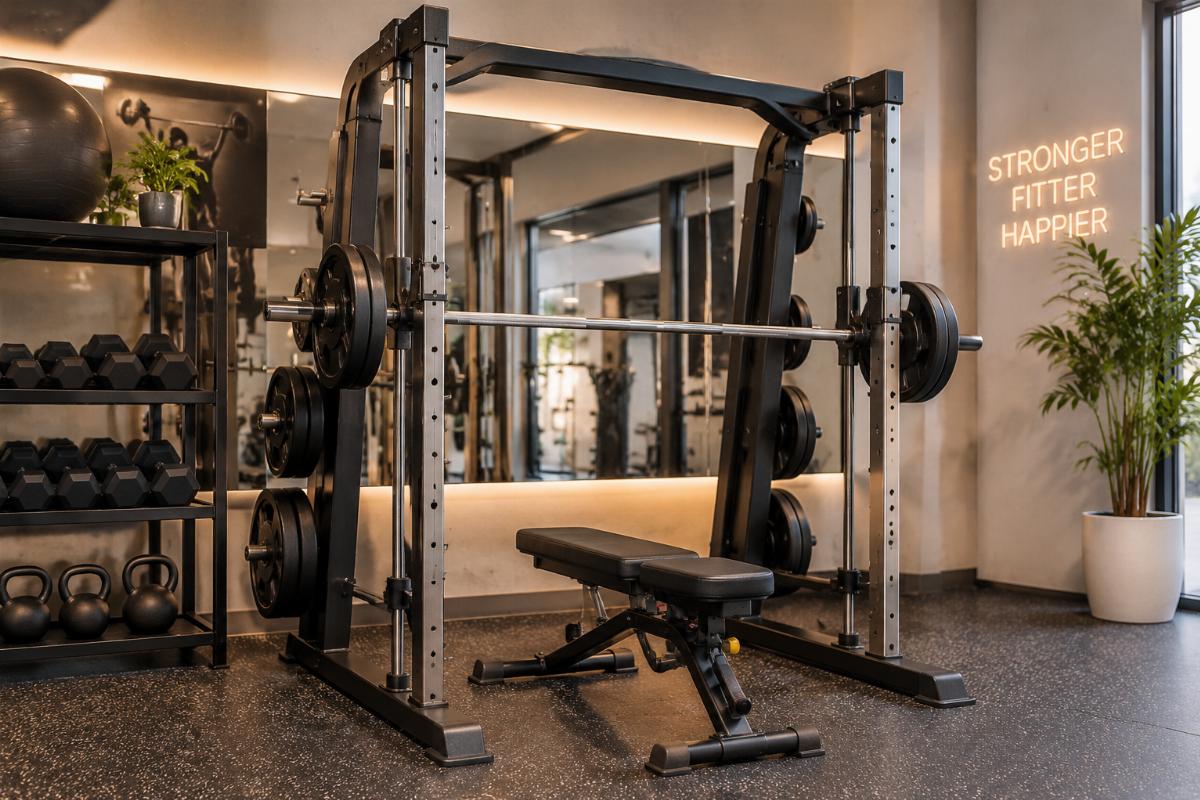
Getting the machine selection right at the drawing-board stage is what separates studios that scale smoothly from those that bleed money on returns and rework.
Why Boutique Studios Keep Choosing Smith Machines Over Power Racks?
The Smith machine consolidates squat, bench, row, and unilateral work into a single footprint, which is exactly what boutique operators need when every square meter must generate revenue. Unlike a standalone power rack, which demands separate accessory purchases—safety straps, J-hooks, monolift, landmine—a well-designed Smith machine ships with integrated linear bearings, adjustable J-cups, and often a built-in pull-up bar. [NEED_CITE: functional training equipment preference trends among boutique fitness operators]
In a studio environment, members rotate through sessions quickly. Coaches do not have time to swap out safety bars or re-rack plates between clients. A Smith machine with a counterbalanced barbell reduces setup time to near zero—the bar starts at a set weight, the user loads plates, and goes.
A European boutique chain I worked with operates locations in three different cities. Their original plan called for a mix of half-racks and dedicated squat stations across the properties. After reviewing their class structure—primarily small-group strength sessions of four to six people—they switched entirely to a single Smith machine model per location. The result: coaches could move between any of the three studios and immediately know where every adjustment knob sat, members experienced identical equipment feel, and the maintenance team only needed to stock one set of replacement cables and bearings.

The decision is not about which piece of equipment is superior in absolute terms. It is about which one serves the operational model. For studios built on coached small-group rotations, the Smith machine wins on density of function per square meter.
What Specifications Actually Matter When Selecting a Smith Machine for Studio Use?
Studio operators should evaluate Smith machines across four dimensions: frame gauge and weld integrity, linear bearing travel smoothness, attachment compatibility, and ceiling-height clearance—rather than fixating on maximum load rating alone.
Many buyers open a spec sheet and go straight to the weight capacity number. In a boutique studio context, that figure matters far less than you might think. Members in coached small-group sessions rarely load a Smith bar beyond moderate working weights. What they do notice—and what causes complaints and churn—is a bar that sticks, jerks, or rattles mid-rep. That is a bearing and rail problem, not a load problem.
| Evaluation Dimension | What to Look For | What to Ignore |
|---|---|---|
| Frame Construction | Gauge of steel tubing, weld continuity at stress joints | Marketing claims of "military-grade steel" |
| Bar Path Feel | Linear bearing type, rail straightness tolerance | Maximum load number alone |
| Attachment Ecosystem | Compatibility with aftermarket hooks, landmines, rows | Number of included accessories |
| Spatial Fit | Ceiling clearance for full bar travel, depth with plate storage | Overall footprint without context |
[NEED_CITE: linear bearing versus bushing performance comparison in guided barbell systems]
I once inspected a shipment where the manufacturer had substituted bushings for linear bearings on the guide rods to cut cost. The machines looked identical from two meters away. But under load, the bar dragged noticeably on the upstroke. In a commercial gym with experienced lifters, that might generate a few complaints. In a boutique studio where first-time members are paying premium per-session rates, it generates silence—they simply do not come back.

The lesson: ask the OEM supplier for a video of the bar traveling unloaded and under load before you commit to a container. If they cannot provide one, that is your answer.
How Do Multi-Property Operators Standardize Equipment Without Over-Committing?
The proven method is to pilot a single unit at one location, run it through a defined evaluation window, then lock the specification and replicate across remaining properties with identical attachment packages.
This sounds obvious, but the number of operators who skip the pilot phase and order full fleet quantities based on a trade-show handshake is surprisingly high. The risk is not just financial—it is operational. If the bar knurling feels wrong, or the safety catches sit at an awkward height, or the plate horns interfere with the coach’s walking path, you discover that after twenty units have already been welded, powder-coated, and crated.
The pilot approach works in stages:
- Request a single sample unit from the OEM supplier with your exact specification sheet—frame color, upholstery density, bearing type, attachment set.
- Install in the highest-traffic location and let coaches and members use it for a minimum period of regular programming cycles.
- Collect structured feedback using a simple form: bar path smoothness, ease of plate loading, safety catch positioning, coach sightline during instruction.
- Document any adjustments needed—cable length, J-cup spacing, horn angle—and confirm the factory can replicate the revised version identically.
- Place the fleet order only after the pilot unit has passed all operational checks.
[NEED_CITE: equipment standardization best practices for multi-unit fitness operators]
A studio group in Southeast Asia followed this process precisely. Their pilot unit revealed that the standard plate storage horns, positioned at floor level on both sides, created a tripping hazard in their particular layout where members walked behind the machine during rest intervals. The factory shifted the horns to a rear-angled position at no additional tooling cost. That single change, caught during pilot, prevented a liability issue across their entire fleet.

Skipping the pilot saves nothing. It only moves the cost of discovery from a single unit to an entire container.
What Should Buyers Verify About the OEM Supplier Before Placing a Fleet Order?
Before committing to a multi-unit order, studio operators must verify three things independently: the factory’s actual production capability for the specific Smith machine model, their quality control documentation at the batch level, and their after-sales parts supply chain—not just their marketing brochure claims.
The fitness equipment manufacturing landscape, particularly in the Shandong production cluster, is dense. There are dozens of factories within a short drive of each other, many sharing similar模具 and supply chains. On the surface, their catalogs look nearly identical. The differences emerge in how they handle tolerances, weld inspection, and post-shipment support.
Ask the OEM supplier these questions directly:
- Can you provide weld inspection records for the specific batch, not just a generic ISO certificate? A factory that inspects every stress joint and can show you the documentation is operating at a different level than one that hands you a laminated certificate from a third-party auditor who visited once.
- What is your policy on replacement parts for orders placed over a year ago? Linear bearings, cables, and upholstery all wear. If the factory cannot guarantee parts availability for the lifespan of the equipment, your fleet will develop dead machines within a few years.
- Do you offer container-load consolidation with other equipment types? Studios often need more than just Smith machines—cable crossovers, functional trainers, free-weight accessories. A supplier who can consolidate multiple product lines into a single shipment reduces freight cost and customs complexity significantly.
[NEED_CITE: quality verification checklist for commercial fitness equipment OEM sourcing]

I have seen buyers receive samples that were clearly hand-finished by the factory’s best technicians, then receive production units where weld quality had dropped noticeably. The safeguard is to include a pre-shipment inspection clause tied to the same quality standard as the approved sample—not a vague "commercial quality" phrase that means nothing in a dispute.
Conclusion
Standardizing on a single Smith machine specification across multiple boutique studio locations reduces maintenance complexity, ensures coach familiarity, and protects member experience consistency. The path to getting it right is unglamorous: start with a floor plan, pilot a single unit, collect structured feedback, verify the OEM supplier’s batch-level quality documentation, then replicate. The machines themselves are only half the equation—the other half is the operational discipline to measure before you scale.


