Commercial Fitness Equipment Manufacturer & Wholesale Supplier for Gyms
Most buyers think import duty is the biggest cost when shipping fitness equipment to the UAE — the real profit killer is HS code misclassification and the demurrage that follows.
The UAE applies a flat 5% customs duty plus 5% VAT on fitness equipment imports, governed by the GCC Common External Tariff. The HS code you declare determines whether your shipment clears in days or sits at Jebel Ali for weeks.
I still remember a container of commercial treadmills I sent to a gym chain in the Gulf a while back. The contract clearly stated 3.0HP continuous motor rating, but within months the client reported multiple motor burnouts. When the failed motors came back to our workshop in Shandong, I tore them open and found the stator winding wire gauge was nowhere near what was specified. That single batch cost us freight, replacements, and nearly the entire Middle East account. Since then, I check every parameter obsessively — CE certification, load testing, continuous-run data. I will not sign off on a shipment without all of it. That habit has shaped how I view customs compliance, too: every detail matters, and shortcuts always come back to you [NEED_CITE: GCC Common External Tariff structure and duty rate schedule for sporting goods].

Getting the paperwork and classification right is not just about avoiding fines — it is about protecting your landed cost and your reputation with the end user. Let me walk you through what actually matters when you are importing fitness equipment into the UAE.
What Is the Current Import Duty Rate for Fitness Equipment in the UAE?
The standard customs duty on fitness equipment entering the UAE is 5% of CIF value, with an additional 5% VAT applied at the point of clearance. This rate is set under the GCC Common External Tariff, which all member states apply uniformly [NEED_CITE: UAE Federal Tax Authority guidance on customs duty rates for sporting and fitness goods]. There is no separate "fitness equipment surcharge" or category-specific tariff — the 5% duty applies across the board to items classified under the relevant HS headings for gym and training machinery.
What trips people up is not the rate itself but the valuation basis. Customs calculates duty on the CIF value — cost of goods, insurance, and freight to the UAE port of entry. If your commercial invoice understates the freight component or separates insurance into a different document, the customs officer may reassess the entire shipment value. I have seen buyers argue over a few hundred dollars in declared freight, only to have the entire container held for revaluation.
VAT is a separate layer. The 5% VAT is charged on the CIF value plus the duty amount, not on CIF alone. So the effective tax burden is slightly above 10% of the original goods value. For a full container of commercial treadmills and strength machines, that gap between "5% plus 5%" and the actual stacked calculation can mean a meaningful difference in cash flow planning.
A Middle East distributor I worked with once assumed the duty was the only government charge. He budgeted for 5% and was caught off guard when the VAT invoice arrived at clearance. The unexpected cash outflow delayed his payment to us by weeks. Now he builds the full landed cost — duty, VAT, port handling, inland transport — into his purchase order before he even sends us an inquiry.

Which HS Codes Apply to Commercial vs. Home Fitness Equipment?
The HS code you choose determines your duty rate, and misclassification can push your shipment into a higher tariff bracket or trigger a customs hold for re-examination. Fitness equipment generally falls under HS Chapter 95, specifically heading 9506 for articles and equipment for general physical exercise. Within that heading, the subheadings split between different types of apparatus, and the distinction between commercial-grade and home-use equipment is not always obvious to customs officers who do not handle gym machinery every day.
Commercial treadmills, ellipticals, and cable crossover machines typically classify under subheadings for "articles and equipment for general physical exercise, gymnastics, and athletics" [NEED_CITE: WCO Harmonized System classification logic for HS 9506 subheadings covering gym equipment]. Free weights — dumbbells, barbells, kettlebells, weight plates — often fall under a different subheading within the same heading, one that covers "other articles and equipment for general physical exercise." The duty rate is the same 5% under the GCC tariff, but the documentation requirements and the level of scrutiny at inspection can differ.
Here is where the real problem surfaces. A buyer in the Gulf once imported a mixed container — cardio machines, plate-loaded strength stations, and a pallet of rubber flooring. The customs broker filed everything under a single HS code for "sports equipment." Customs flagged the rubber flooring as a separate product category requiring different classification. The entire container was held while the broker filed amendment requests. The delay ran into double-digit days, and the demurrage charges ate into the margin on the whole order.
The lesson is straightforward: each distinct product type in a mixed container needs its own HS code line on the declaration. Even if the duty rate is identical, the classification must match the product description on the commercial invoice and packing list. When we prepare export documents for a mixed container — say, a full gym package with cardio, strength, free weights, and flooring — we list every category separately with its corresponding code. The broker on the receiving end can then file a clean declaration without back-and-forth with customs.
Another common mistake: classifying a motorized commercial treadmill under an electrical appliance heading instead of a sports equipment heading. The treadmill has a motor, a console, and electrical components — it looks like an appliance. But its primary function is physical training, and the HS system classifies by function, not by component. A misfiled treadmill under an appliance code can attract a different duty treatment and almost certainly triggers an inspection.

How Do Free Zones Affect Fitness Equipment Import Costs?
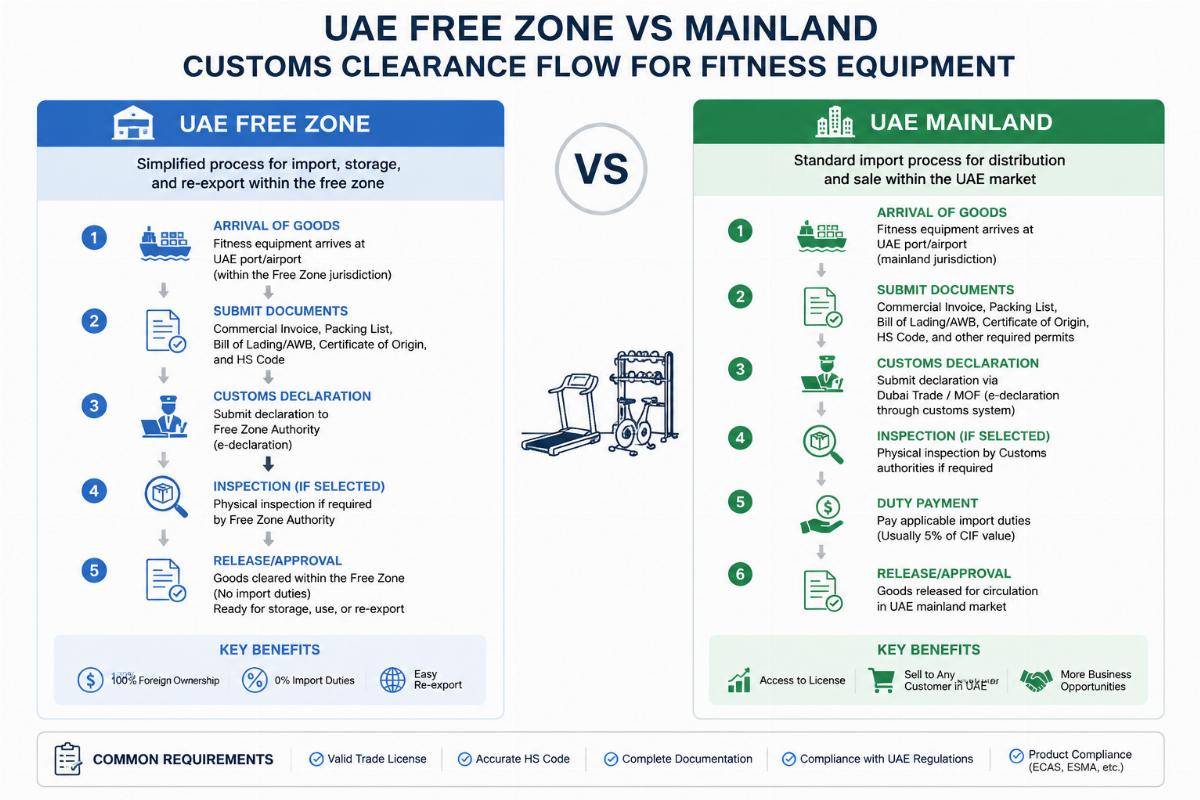
Importing fitness equipment into a UAE free zone does not mean the goods are duty-free — it means duty and VAT are deferred until the products enter the UAE mainland market. This is one of the most persistent misunderstandings I see among overseas buyers setting up distribution in the Gulf. They hear "free zone" and assume zero tax. The reality is more nuanced, and getting it wrong can create serious cash flow surprises.
When fitness equipment arrives at Jebel Ali Free Zone or any other designated zone, it can be stored, displayed, and even repackaged without immediate duty or VAT payment [NEED_CITE: UAE free zone customs suspension rules for imported sporting goods]. The goods are technically "in the country" but not yet "imported" for tax purposes. Duty and VAT become payable only when the products cross from the free zone into the mainland customs territory — meaning they are delivered to a gym, a retail store, or an end user on the mainland.
For a distributor operating out of a free zone warehouse, this deferral is a genuine advantage. You can receive a full container of commercial gym equipment, hold it in your zone warehouse, and only pay duty and VAT when you sell and ship individual units to mainland clients. Your cash stays in your business longer. But if you are a gym owner buying equipment for a facility on the mainland — in Dubai city, Abu Dhabi, Sharjah — the free zone route does not save you anything. The duty and VAT must be paid before the equipment reaches your gym floor.
I once worked with a hotel project in the region that planned to receive equipment through a free zone entity, assuming the tax would be avoided entirely. The equipment was destined for a mainland hotel fitness center. When the goods moved from the free zone to the mainland, the full duty and VAT were assessed. The project team had not budgeted for that payment at that stage, and it created a cash flow gap that delayed the gym opening.
The practical takeaway: if your end users are on the mainland, plan for full duty and VAT at the point of mainland entry, regardless of where the goods first land. If you are a distributor using a free zone as a regional hub, the deferral benefit is real — but you still need to account for the eventual tax liability when you quote prices to mainland buyers.
What Documents Are Required to Avoid Customs Delays?
Clean customs clearance for fitness equipment in the UAE requires a complete, consistent document set — commercial invoice, packing list, bill of lading, certificate of origin, and product compliance certificates — with every detail matching across all papers. Missing or mismatched documents are the single most common cause of clearance delays, and the cost of those delays — demurrage, storage, re-inspection fees — often dwarfs the duty itself.
The commercial invoice must state the correct HS code for each item, the CIF value breakdown, and the country of origin. The packing list must match the invoice line by line — quantities, weights, and package counts need to align exactly. The bill of lading must reflect the same consignee and shipper details. The certificate of origin confirms where the goods were manufactured, which matters for GCC trade agreements and for customs verification [NEED_CITE: UAE customs documentary requirements for imported fitness and sporting goods].
Product compliance certificates — CE marking, test reports for electrical safety on motorized equipment — are not always demanded at the document review stage, but customs can request them at any point, especially if the shipment is selected for physical inspection. If you cannot produce the certificates when asked, the goods will be held. I have seen motorized treadmills held at port because the importer could not produce the CE Declaration of Conformity on the spot. The delay lasted over a week.
For mixed containers — which is how most commercial gym orders ship — the documentation must clearly separate product categories. A container carrying commercial treadmills, Smith machines, dumbbell sets, and rubber flooring needs four distinct line items on the invoice and packing list, each with its own HS code, unit count, and value. Lumping everything under one line item invites customs to hold the shipment for clarification.
When we prepare shipments for the Gulf market, every container gets a full document package: commercial invoice with itemized HS codes, detailed packing list with gross and net weights per item, bill of lading, certificate of origin issued by the relevant Chinese trade authority, CE certificates for all motorized cardio equipment, and a material test summary for free weights and steel structures. The broker on the other end can file immediately without chasing us for missing papers. That preparation is not optional — it is the difference between a container that clears in a day and one that sits at port for weeks.

How Can Importers Reduce Landed Costs Legally?
The most effective ways to lower your total landed cost for fitness equipment in the UAE are full container consolidation, pre-shipment HS code verification, and proper VAT registration for input tax recovery — not cutting corners on declared value. Each of these approaches works within the legal framework and protects you from the penalties and delays that erase any short-term savings.
Full container loading is the most obvious lever. Shipping a partial container means you pay the same port handling fees, the same customs clearance costs, and the same inland transport charges — but spread over fewer units. The per-unit landed cost rises noticeably. When we build full gym packages for commercial clients — cardio, strength, free weights, functional gear, flooring — we consolidate everything into one or more full containers. The shipping cost per unit drops, and the clearance process is simpler because all goods arrive together under one set of documents.
HS code pre-verification is the second lever. Before the goods leave our factory, we confirm the correct HS classification for every product category in the order with the buyer’s customs broker on the receiving end. This eliminates the risk of misclassification at the port. A few hours of email coordination before shipment saves days of delay and thousands in demurrage after arrival. I have seen buyers skip this step to "save time," only to lose far more time and money at the other end.
VAT registration and input tax recovery is the third lever. If your business is VAT-registered in the UAE, the 5% VAT you pay at customs clearance can be claimed as input tax credit against your output VAT on sales [NEED_CITE: UAE VAT input tax credit mechanism for registered businesses importing fitness equipment]. This means the VAT is not a true cost — it is a cash flow item that you recover. But you must be registered, and you must file your VAT returns correctly. A buyer who is not VAT-registered absorbs the full 5% as a cost. For a large commercial gym order, that is a significant amount.
A gym chain operator in the region once told me he avoided VAT registration because he thought it was "too much paperwork." He was paying the full 5% VAT on every container as a sunk cost. Once he registered and started claiming input credits, his effective tax burden on imports dropped to near zero on the VAT side. The paperwork was minimal compared to the savings.
These three approaches — consolidation, pre-verification, and VAT recovery — work together. They do not require any gray-area valuation tricks or document manipulation. They are standard trade practices that professional importers use everywhere, and they apply fully to the UAE market.

Conclusion
Importing fitness equipment into the UAE is straightforward when you treat customs compliance as a technical discipline, not an afterthought. The 5% duty and 5% VAT are fixed — your control lies in correct HS classification, complete documentation, smart container planning, and proper VAT registration. Get those right, and your equipment clears fast, your landed costs stay predictable, and your clients get their gym equipment on schedule.