

Buy Commercial Grade Rowing Machine | OEM Factory Direct Wholesale
Most buyers assume the flywheel is where commercial rowing machines earn their price premium. In reality, the cost gap sits in the rail profile thickness, seat pulley load rating, and frame welding工艺 — the parts nobody photographs for the catalog.
A commercial grade rowing machine is defined by its rail cross-section geometry, load-bearing frame construction, and daily usage duration rating — not by resistance type or console features. For gyms, hotels, and distributors sourcing in volume, the selection criteria must center on structural durability under continuous daily use, resistance maintenance costs at scale, and supplier verification of steel specs before container loading.
I spent years handling shipping documents at a warehouse near Yantian Port, watching containers of fitness equipment get stuffed and sealed. Rowing machines always looked deceptively simple — a rail, a seat, a flywheel, a strap. But when a Dubai hotel group once compared our magnetic-resistance commercial quote against a competing air-resistance home-style unit, the price gap looked steep enough to push them toward the cheaper option. Months later, the rail started wobbling, the seat pulleys were grinding, and end-user complaints piled up. They came back asking for replacement pulleys and rail segments — and those loose parts filled a noticeable volume in a follow-up shipment. That order taught me one thing permanently: commercial selection starts with rail specs and usage hours, not with the resistance type brochure.
Let’s walk through what actually separates a true commercial unit from a residential one dressed up in black paint.
What Defines a "Commercial Grade" Rowing Machine?
The difference between commercial and residential rowing machines lives in the steel, not the sticker. A commercial grade rowing machine is engineered for a minimum daily usage window that far exceeds home environments, and that requirement cascades into every structural decision the manufacturer makes.
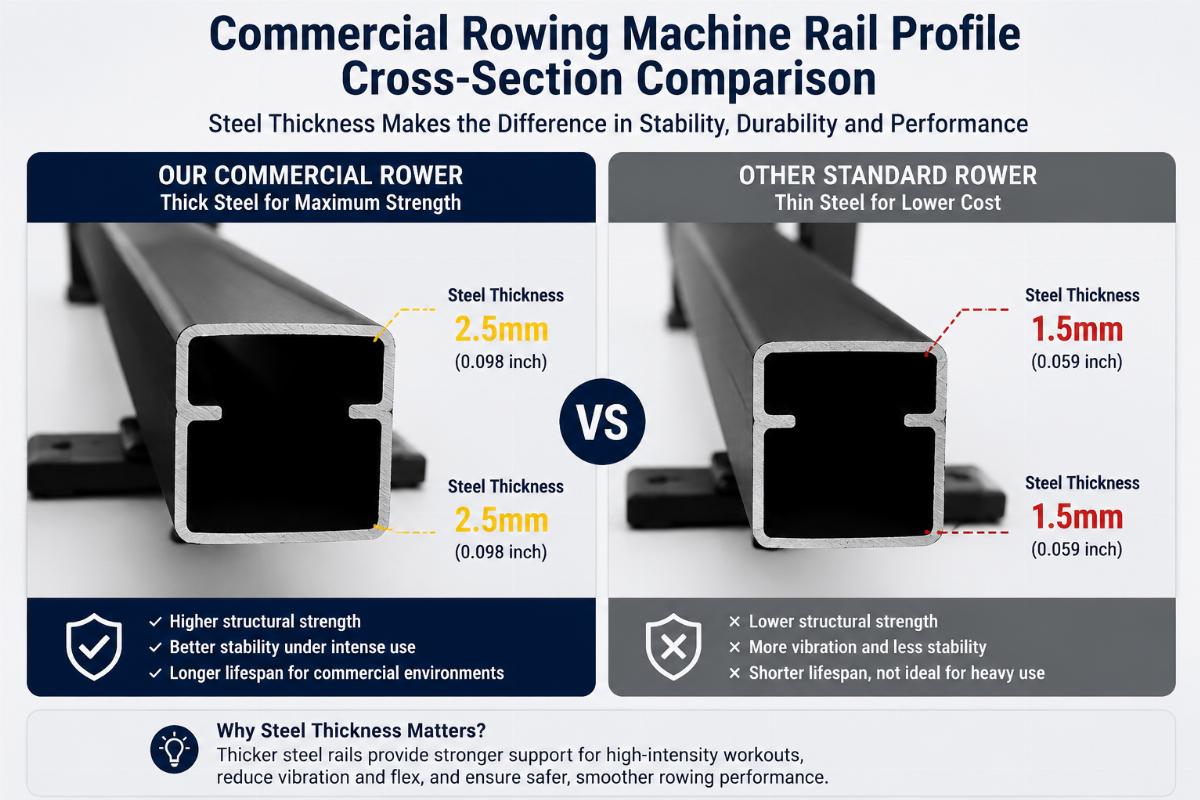
The rail profile is the single most telling indicator. Residential models typically use a narrow aluminum or thin-wall steel rail with a compact cross-section. Commercial units require a wider, thicker-walled rail profile — the cross-section geometry directly determines whether the seat glides smoothly after months of continuous use or starts developing lateral play [NEED_CITE: rail profile deflection standards per EN 957-10 stationary training equipment]. I have seen units where the rail looked perfectly acceptable in a showroom photo but measured noticeably thinner in wall thickness once calipers came out during a pre-shipment inspection.
Seat pulley assemblies carry the second-highest failure risk in daily commercial use. Residential pulleys use small-diameter bearings rated for light intermittent loads. Commercial pulley groups must handle sustained load cycles throughout the day — the bearing material, seal type, and axle diameter all matter. A pulley that holds up fine with one user doing twenty minutes at home will show visible wear within a short window when rotated through dozens of users at a hotel fitness center.
Frame welding工艺 is the third structural differentiator. Commercial frames require continuous welds at high-stress junctions — the rail-to-frame connection, the flywheel mount, the footplate anchor points. Spot welds or short intermittent welds may pass a static load test but will develop micro-cracks under repetitive dynamic loading typical of gym environments [NEED_CITE: welding inspection criteria for fitness equipment frames per ASTM F2276].
| Structural Element | Residential Grade | Commercial Grade |
|---|---|---|
| Rail Wall Thickness | Thin-wall, light-duty | Thick-wall, heavy-duty |
| Seat Pulley Bearing | Small diameter, intermittent rating | Large diameter, continuous-duty rating |
| Frame Welding | Spot or intermittent welds | Continuous welds at stress junctions |
| Daily Usage Rating | Up to moderate hours | Extended hours, multi-user rotation |
| Overall Net Weight | Lightweight for portability | Substantially heavier for stability |
A Middle East hotel buyer once asked why our commercial rowing machine weighed noticeably more than a competing quote. The answer was straightforward: thicker rail steel, larger pulley housings, and a heavier frame base. That weight difference is not shipping cost padding — it is the physical manifestation of durability engineering.

Water vs. Magnetic vs. Air: Which Resistance Type Fits Your Scenario?
The resistance type debate in commercial procurement rarely has a universal winner — it has a scenario-correct answer. Each resistance mechanism carries distinct maintenance profiles, and the wrong choice for your usage environment will show up in service costs long before it shows up in user complaints.
Water resistance delivers a highly authentic rowing feel and visual appeal — the transparent tank with splashing water looks striking on a boutique studio floor. However, the water tank密封件 and impeller assembly face accelerated aging in high-turnover environments. In a CrossFit-style studio where multiple athletes rotate through the same machine in rapid succession, the tank seals experience thermal cycling and mechanical stress that shorten their service life noticeably compared to controlled studio environments [NEED_CITE: elastomer seal degradation patterns in water-resistance fitness equipment under continuous use]. Water models also require periodic water treatment to prevent cloudiness and biological growth — a maintenance task that gym staff often deprioritize until the tank looks visibly murky.
Air resistance has long held a reputation as the "serious athlete’s choice," and for good reason — the drag-based resistance scales naturally with user effort. But in a commercial setting with high daily usage hours, the air flywheel assembly introduces maintenance considerations that many buyers overlook. The fan housing accumulates dust and lint from the gym environment, the recoil starter mechanism sees heavy cycling, and the strap or chain drive requires periodic inspection. In a high-traffic hotel gym running extended hours daily, air-resistance units tend to generate service calls at a noticeably higher frequency than magnetic-resistance counterparts [NEED_CITE: comparative maintenance frequency data for air vs. magnetic resistance cardio equipment in commercial fitness environments].
Magnetic resistance operates through a quiet, sealed mechanism with no friction-based wear components in the resistance generation system itself. For commercial environments where the machine runs for extended hours with multiple users, magnetic resistance delivers the lowest maintenance burden of the three types. There is no water to treat, no fan housing to clean, no recoil mechanism to rebuild. The trade-off is a slightly different feel profile — but for the majority of hotel gym users and general fitness center members, the difference is far less significant than the difference between a working machine and one waiting for a service technician.
| Resistance Type | Best-Fit Scenario | Maintenance Profile | Commercial Durability |
|---|---|---|---|
| Water | Boutique studios, visual-priority installations | Moderate — seal and water care | Vulnerable to high-turnover aging |
| Air | Performance-focused gyms, athletic training | Moderate-to-high — fan, recoil, drive | Robust but service-intensive |
| Magnetic | Hotels, high-traffic commercial gyms, distributors | Low — sealed magnetic system | Robust with minimal scheduled service |
An African distributor who regularly imports full containers of fitness equipment once shifted a large portion of their rowing machine order from air-resistance to magnetic-resistance after tracking warranty claim patterns across multiple shipment batches. The magnetic units generated noticeably fewer parts replacement requests over the same deployment period — and for a distributor managing after-sales logistics across long supply chains, that difference translates directly into margin protection.

Key Specs to Verify Before Placing an Order
Never approve a commercial rowing machine purchase order based on catalog photos and a price list alone. The specs that determine whether the equipment survives its first year in a commercial environment are rarely the ones featured in marketing materials. Requesting and verifying a short list of structural parameters before order confirmation separates buyers who get long-service equipment from buyers who get expensive lessons.
Start with the rail profile cross-section dimensions. Ask the supplier for the exact rail width, wall thickness, and material grade — not a vague description like "heavy-duty aluminum rail." The rail is the load-bearing spine of the entire machine, and its geometry directly governs long-term glide smoothness and lateral stability [NEED_CITE: rail deflection testing methodology for rowing ergometers per relevant ISO fitness equipment standards]. A rail that measures adequately thick in cross-section will resist the gradual deformation that causes seat wobble in underbuilt units.
Next, verify the seat pulley group specification. Request the bearing type, bearing diameter, and axle material. Commercial-grade pulley groups use larger-diameter bearings with sealed construction rated for continuous duty cycles. If the supplier cannot provide these details or dismisses the question as unnecessary, treat that as a red flag — a manufacturer confident in their pulley design will answer immediately.
The整机 net weight is a surprisingly effective quick-screening metric. A genuine commercial grade rowing machine will weigh substantially more than a residential model because of the heavier gauge steel throughout the frame, rail, and flywheel housing. If two machines look similar in photos but one weighs noticeably less, the lighter unit almost certainly uses thinner materials somewhere in the structure.
Frame welding quality should be verifiable through inspection photos or on-site audit. Request close-up images of the weld joints at the rail-to-frame connection, the flywheel mounting bracket, and the footplate attachment points. Commercial-grade welding shows consistent, continuous bead patterns with no visible porosity or undercut. If the supplier cannot provide weld inspection imagery, consider arranging a third-party pre-shipment inspection [NEED_CITE: visual welding inspection acceptance criteria for fitness equipment structural frames].
| Spec Parameter | What to Request | What It Reveals |
|---|---|---|
| Rail Cross-Section | Width, wall thickness, material grade | Long-term glide stability and load capacity |
| Seat Pulley Group | Bearing type, diameter, axle material | Wear resistance under continuous commercial use |
| 整机 Net Weight | Confirmed shipping weight | Overall material gauge and structural mass |
| Welding Quality | Close-up joint photos or audit report | Frame integrity under repetitive dynamic loading |
| Footplate Construction | Material, adjustability mechanism, strap type | User safety and component longevity |
A buyer from a Southeast Asian gym chain once shared that their previous supplier’s rowing machines developed noticeable rail play within a short deployment window. When they switched to a new commercial grade rowing machine source and specifically requested rail cross-section documentation and pulley bearing specs before ordering, the equipment performed reliably through extended daily use with no structural complaints.

Common Procurement Mistakes and How to Avoid Them
The most expensive rowing machine purchase is the one that looks cheap on the invoice. Commercial procurement errors in this category tend to follow predictable patterns — and each pattern has a straightforward countermeasure if caught before the container is sealed.
The first recurring mistake is pure price comparison across mismatched product tiers. A commercial grade rowing machine and a residential-style machine with a "commercial-looking" paint job will never cost the same to manufacture. When a buyer selects based on the lowest unit price without verifying structural specifications, the gap between expected and actual product quality shows up rapidly in the field. The downstream costs — replacement parts, service calls, end-user complaints, and reputation damage — routinely dwarf the initial unit price savings.
The second mistake is ignoring the usage scenario when selecting resistance type. A buyer who specifies air-resistance machines for a hotel gym with extended daily operating hours, without accounting for the higher maintenance profile of air systems in that environment, will face a steady stream of service requirements that magnetic-resistance units would have avoided entirely. The resistance type must match the operational reality, not the marketing appeal.
The third mistake is failing to verify supplier capability for after-sales parts supply. A commercial rowing machine will require wear-component replacement at some point — seat pulleys, drive straps, footplate straps, and monitor batteries are all consumables over a long service life. If the supplier cannot commit to a structured spare parts supply program, the buyer owns the entire risk of equipment downtime. For distributors managing territories across multiple countries, this is not a minor inconvenience — it is a business continuity issue [NEED_CITE: spare parts availability as a criterion in commercial fitness equipment procurement best practices].
A distributor in the Middle East learned this sequence the hard way. They selected a supplier based on the lowest per-unit quote for a hotel project, skipped structural spec verification, and did not confirm spare parts availability. When the rail and pulley issues emerged, the original supplier was unresponsive to parts requests. The distributor ended up sourcing compatible replacement parts from a different manufacturer at a significantly higher per-unit cost, plus expedited shipping fees — a total expense that far exceeded the original price difference they had chased.
The countermeasure for all three mistakes is the same: before committing to an order, request and document the rail specs, pulley specs,整机 weight, welding inspection evidence, and a written spare parts supply commitment. A supplier operating at commercial grade will provide all of this without hesitation.

How to Source Commercial Rowing Machines from China
China remains the world’s primary manufacturing base for commercial fitness equipment, and Shandong Province hosts a concentrated cluster of manufacturers with deep capability in both commercial and residential product lines. Sourcing a commercial grade rowing machine from this supply base offers clear advantages — but only if the buyer applies the right filtering criteria to separate genuine commercial-grade manufacturers from assembly operations that lack structural engineering depth.
The first filter is manufacturing scope. A factory that produces only residential equipment and has added a "commercial" label to certain models is not the same as a manufacturer whose production lines, welding fixtures, and quality control protocols are built around commercial durability requirements from the ground up. Look for suppliers whose product range includes a full commercial cardio lineup — treadmills, ellipticals, spin bikes, and rowing machines — because the engineering standards required for commercial treadmills typically carry over into the rest of their commercial product family.
The second filter is certification and compliance documentation. CE certification for the European market is a baseline expectation for any serious commercial fitness equipment manufacturer [NEED_CITE: CE marking requirements for stationary training equipment under EU machinery directive]. Suppliers who can provide current, verifiable certification documentation demonstrate a level of quality system maturity that correlates strongly with consistent product quality.
The third filter is order flexibility and OEM capability. Different buyers have different needs — a gym owner may need a small batch of branded units, a distributor may need a full container of private-label equipment, and a hotel developer may need a mixed container combining rowing machines with other cardio and strength equipment. A manufacturer that offers flexible MOQ from single units to full container loads, combined with OEM branding capability, serves the broadest range of commercial buyers efficiently.
Bick, based in Shandong Province, operates as a commercial fitness equipment manufacturer that meets all three filters. The product range spans a complete commercial cardio line including rowing machines alongside treadmills, ellipticals, and spin bikes, plus a full strength equipment lineup and free weight systems. CE certification is in place, OEM and ODM branding services are available, and order flexibility extends from single-unit testing orders to full gym package containers. For buyers evaluating a commercial grade rowing machine source, the structural specifications — rail profile, pulley group, welding quality — are available for verification through factory audit or pre-shipment inspection.

The fourth filter is after-sales infrastructure. A supplier who commits to structured spare parts supply and technical support — not just a vague promise but a documented parts catalog with availability timelines — reduces the buyer’s long-term operational risk substantially. For distributors managing end-user relationships across multiple countries, this commitment is often the deciding factor between a sustainable supply partnership and a one-time transaction.
Conclusion
A commercial grade rowing machine earns its classification through structural engineering — rail profile, pulley durability, frame welding, and daily usage rating — not through appearance or resistance type alone. Match the resistance mechanism to your actual operating environment, verify structural specifications before ordering rather than after delivery, and confirm that your supplier can support the equipment with spare parts throughout its service life. The upfront discipline of spec verification and scenario-matched selection prevents the far costlier downstream cycle of complaints, replacements, and reputation erosion.
