

Gym Equipment Financing Options: Payment Plans for Commercial Fitness
Most buyers assume full prepayment is the safest route—until they realize it strips away every negotiating lever they had. The most practical gym equipment financing options include T/T installment structures tied to production milestones, irrevocable letters of credit for high-value container orders, equipment leasing programs for operators preserving working capital, and deferred payment terms backed by export credit insurance. Each path suits a different order scale, import policy environment, and buyer credit profile.
I spent years on the shop floor in Shandong watching steel tubes get cut, welded, and powder-coated before moving into trade operations. That background means I look at payment terms the same way I used to look at weld seams—checking for hidden stress points. A gym owner in Riyadh once insisted on paying the balance sixty days after seeing the bill of lading for a full container of plate-loaded machines. We shipped without credit cover, and the final payment dragged on for months. That single order reshaped how I structure every deal afterward. [NEED_CITE: export credit insurance coverage mechanisms for machinery shipments]
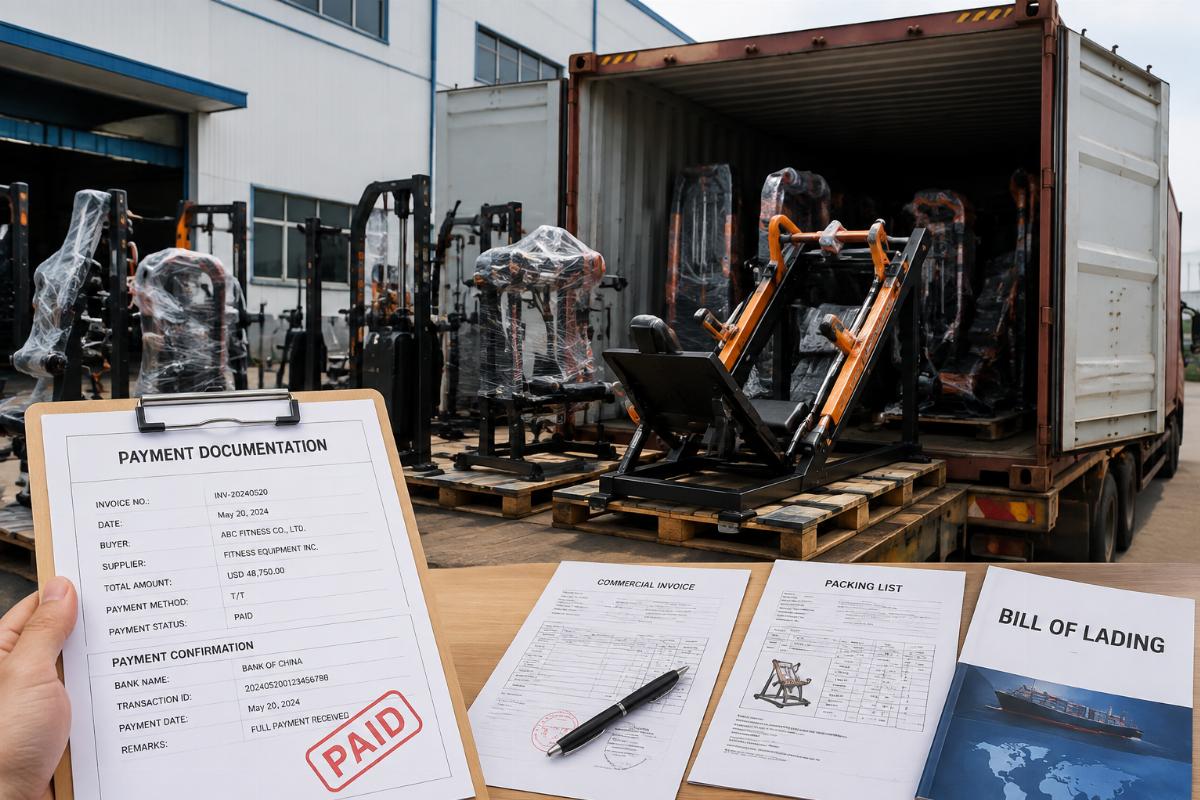
Getting the financing structure right before production begins prevents disputes long after the machines are installed. Let me walk through each option with real trade scenarios.
What Payment Plans Are Available for Gym Equipment Orders?
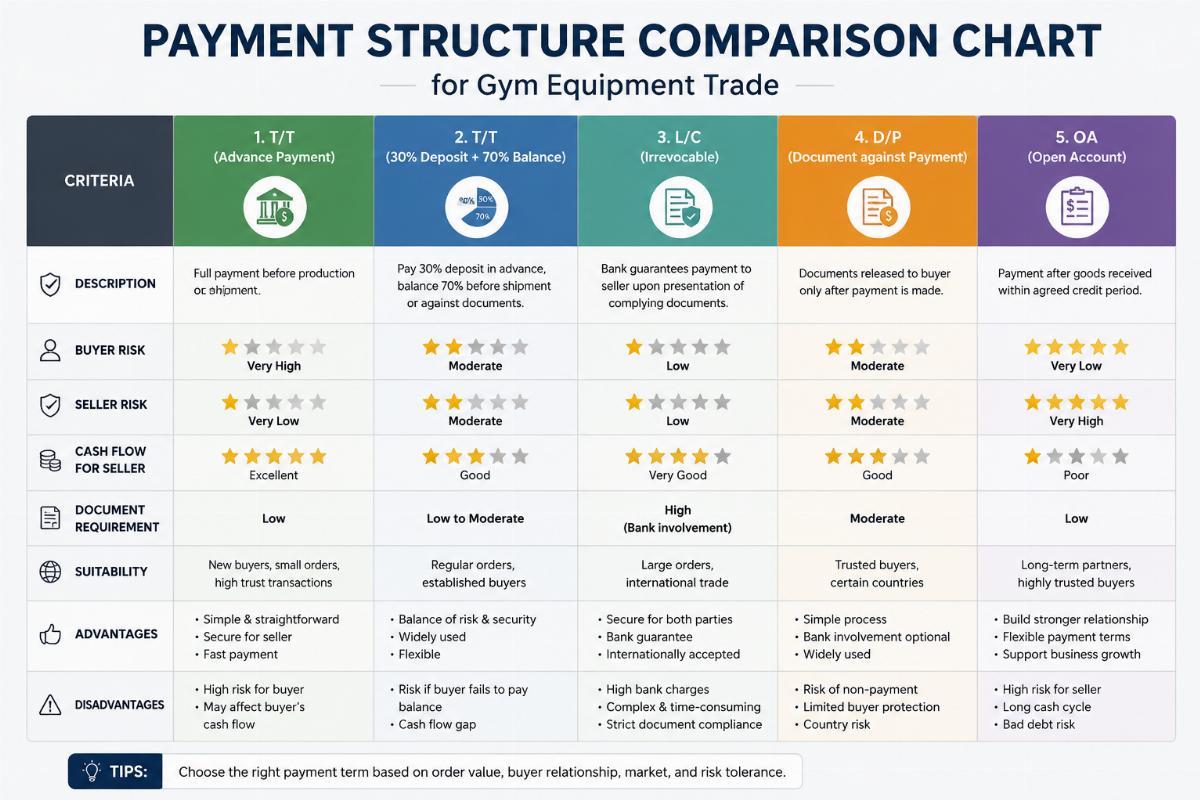
Four mainstream payment structures dominate commercial fitness equipment trade: full T/T with discount, milestone-based installments, documentary letters of credit, and equipment leasing arrangements. The choice depends on order volume, buyer cash flow cycle, and the importing country’s foreign exchange controls.
Full prepayment in a single T/T transfer remains common for smaller orders—think a boutique studio buying a functional trainer, a set of dumbbells, and rubber flooring. Sellers often offer a modest price reduction for immediate funds because it eliminates their working capital risk entirely. For larger commercial gym packages combining cardio lines, Smith machines, and free-weight zones, buyers rarely pay everything upfront. Instead, they split the amount across production stages.
Letters of credit apply when order values run high and the buyer’s local banking system supports documentary transactions. Banks in several Middle Eastern and African markets still rely heavily on L/C structures because their central banks require it for certain import categories. [NEED_CITE: ICC Uniform Customs and Practice for Documentary Credits applicability in machinery trade]
Equipment leasing has grown among gym operators who want to preserve cash for fit-out and marketing. Rather than purchasing treadmills and cable crossovers outright, they pay a monthly fee to a leasing company that owns the assets. The factory gets paid in full at shipment; the leasing firm carries the receivable.
A distributor in West Africa sourcing multiple container loads over a year typically uses milestone installments—a deposit when the purchase order is confirmed, a second payment after frame welding and powder coating pass inspection, and the balance before container stuffing. This gym equipment financing option keeps both sides exposed to manageable risk rather than concentrating it on one party.
How Do Installment Plans Work for Bulk Fitness Equipment?
Installment plans divide the total invoice into two to four tranches, each triggered by a verifiable production or shipping milestone, with ownership transferring only after the final payment clears.
A typical structure for a commercial gym package looks like this: a deposit of roughly one-third upon order confirmation, a second tranche after the main frame components pass quality inspection, and the balance settled before the container is sealed. Some buyers negotiate a small retention amount—held for a short period after delivery to cover any immediate warranty claims.
The critical mechanism here is the ownership retention clause. Until the seller receives full payment, the equipment legally remains their property even though it sits in the buyer’s facility. This clause protects the seller if the buyer defaults mid-stream. [NEED_CITE: retention of title clauses in international equipment supply contracts]
I worked with a hotel developer in South America outfitting three properties simultaneously. They wanted to spread payments across delivery waves—first property paid in one cycle, second property in the next. We structured the gym equipment financing options so each building’s equipment list had its own milestone schedule. The factory produced in parallel, but payment triggers stayed independent. This prevented a cash flow bottleneck on the buyer side while keeping production continuity.
Penalty clauses matter. If a buyer misses a milestone payment by more than a defined window, the seller can halt production on subsequent batches without breaching the contract. Conversely, if the seller delays shipment past the agreed date, the buyer may deduct a daily penalty from the final tranche. Both sides need these guardrails.
One recurring mistake: buyers assume installment plans mean the seller is absorbing financing costs. In reality, the seller builds a modest cost buffer into the unit price to cover the extended receivable period. The buyer trades time for cash flow availability, but the total cost is slightly higher than a single upfront payment. Understanding this dynamic prevents awkward renegotiations later.

When Should Buyers Use Letters of Credit vs. Open Account?
Letters of credit protect both parties when trust is untested and order values are substantial, while open account terms suit repeat buyers with established credit histories—often backed by export credit insurance.
An irrevocable L/C at sight means the buyer’s bank guarantees payment once the seller presents compliant shipping documents. The seller gains payment certainty; the buyer gains assurance that goods shipped match the documented description. However, L/C operations involve bank fees on both sides and strict documentary compliance. A single discrepancy—say, a misspelled port name or a missing certificate—can delay payment by weeks. [NEED_CITE: common documentary discrepancy rates in trade finance]
Open account terms, where the seller ships first and invoices afterward, shift nearly all risk to the seller. They work when the buyer has a long transaction history and the seller carries credit insurance. China’s export credit insurer provides coverage against buyer default, political risk, and transfer restrictions. With a policy in place, the seller can offer net-thirty or net-sixty terms without betting the entire invoice on the buyer’s solvency.
A gym chain operator in Eastern Europe wanted to import a full cardio and strength package but their local bank charged steep L/C issuance fees. We structured the deal as open account with credit insurance coverage instead. The seller’s premium was a fraction of the bank fees the buyer would have paid, and both sides saved time on document preparation. This gym equipment financing option worked because the buyer had two prior orders with clean payment records.
The decision boundary is straightforward: if this is the first transaction or the order exceeds a certain value threshold, use L/C. If the relationship has survived multiple orders and the seller holds credit insurance, open account with defined payment windows becomes viable. Mixing both—L/C for the first container, open account for replenishment—is a practical middle path many distributors follow.

What Risks Come with Deferred Payment and How to Mitigate Them?
Deferred payment exposes sellers to buyer default, currency fluctuation, and documentary rejection—each requiring a specific hedging instrument.
Currency risk hits both sides. A buyer in a country with a weakening local currency may find the final installment costs significantly more in local terms than budgeted. Sellers invoicing in dollars face the opposite problem if their own costs are in a strengthening currency. Forward exchange contracts let both parties lock in a rate at order confirmation, eliminating surprise swings. [NEED_CITE: foreign exchange hedging instruments for cross-border machinery trade]
Buyer default risk is the one that keeps trade managers awake. A gym operator takes delivery of a full strength equipment line, faces unexpected construction delays at their facility, and suddenly cannot generate revenue to service the payment. Without credit insurance, the seller is chasing an overdue invoice across jurisdictions. With coverage from an export credit agency, the seller files a claim and recovers the insured portion while the agency pursues collection.
Documentary risk applies specifically to L/C transactions. Banks examine documents with mechanical precision. A commercial invoice showing a product description that differs even slightly from the L/C wording can trigger a discrepancy notice. The seller must correct and re-present, delaying payment and potentially incurring storage costs at the port. Experienced trade teams pre-check every document against the L/C terms before submission.
A fitness equipment distributor in the Middle East faced all three risks simultaneously on a large order. Their local currency depreciated sharply between order confirmation and final payment. The buyer tried to renegotiate the balance downward. The seller held firm because the contract specified the invoice currency and amount without adjustment clauses. The buyer eventually paid in full, but the relationship needed repair work afterward. This gym equipment financing options scenario underscores why currency terms must be locked explicitly in the contract, not left ambiguous.

How to Negotiate Payment Terms That Protect Both Sides?
Successful payment negotiations balance cash flow needs against risk exposure, with each clause serving a specific protective function for either the buyer or the seller.
Start with the deposit percentage. A deposit below a meaningful threshold gives the buyer easy exit leverage if market conditions shift. A deposit that is too large strains the buyer’s working capital before any goods are verified. Most commercial gym equipment deals land at a deposit that signals buyer commitment without creating excessive sunk cost before inspection.
Define milestone triggers with objective, verifiable criteria. "Payment due after production" is vague. "Payment due upon successful completion of pre-shipment inspection by buyer’s designated third-party agency" creates a clear gate. Both sides know exactly what must happen before funds move.
Include a retention clause for warranty security. Holding a small percentage of the invoice value for a defined period after delivery gives the buyer leverage to ensure the seller responds promptly to any early-life equipment issues. The seller accepts this because the retained amount is modest and the release date is contractually fixed.
Specify penalty rates for late payment and late shipment in identical daily percentages. Symmetry prevents either side from feeling the条款 are one-sided. A buyer who knows late payment triggers a daily charge takes internal approval processes seriously. A seller who knows late shipment costs money prioritizes production scheduling.
A gym equipment financing options negotiation I handled for a Southeast Asian chain involved all these elements. They wanted a low deposit, extended installment windows, and a generous retention period. We countered with a slightly higher deposit, tighter milestone definitions tied to third-party inspection reports, and a shorter retention window but with a clear warranty response SLA. Both sides signed within a week because the structure was transparent and the risk allocation was explicit.

Conclusion
Payment structure determines whether a gym equipment deal builds a lasting partnership or generates years of collection disputes. Match the financing mechanism to order scale, buyer creditworthiness, and import country regulations—whether through milestone installments, letters of credit, credit-insured open account, or leasing programs. Lock currency terms, define milestone triggers with third-party verification, and include symmetric penalty clauses so both sides share accountability equally.
