Which China Dumbbell OEM Factory Export Volume Top Three Should You Actually Work With?
You see "China dumbbell OEM factory export volume top three" in supplier profiles and assume bigger means better. I've watched buyers chase this claim, only to face delayed samples, rejected customization requests, and ignored emails because they misread what high export volume actually signals about how a factory operates.
Large export volume tells you what a factory is built to handle—bulk orders, long cycles, established brands—not whether it can serve your specific order type, timeline, or customization needs. You're reading a business model indicator, not a quality certificate, and matching your requirements to the right factory structure matters more than chasing volume rankings.
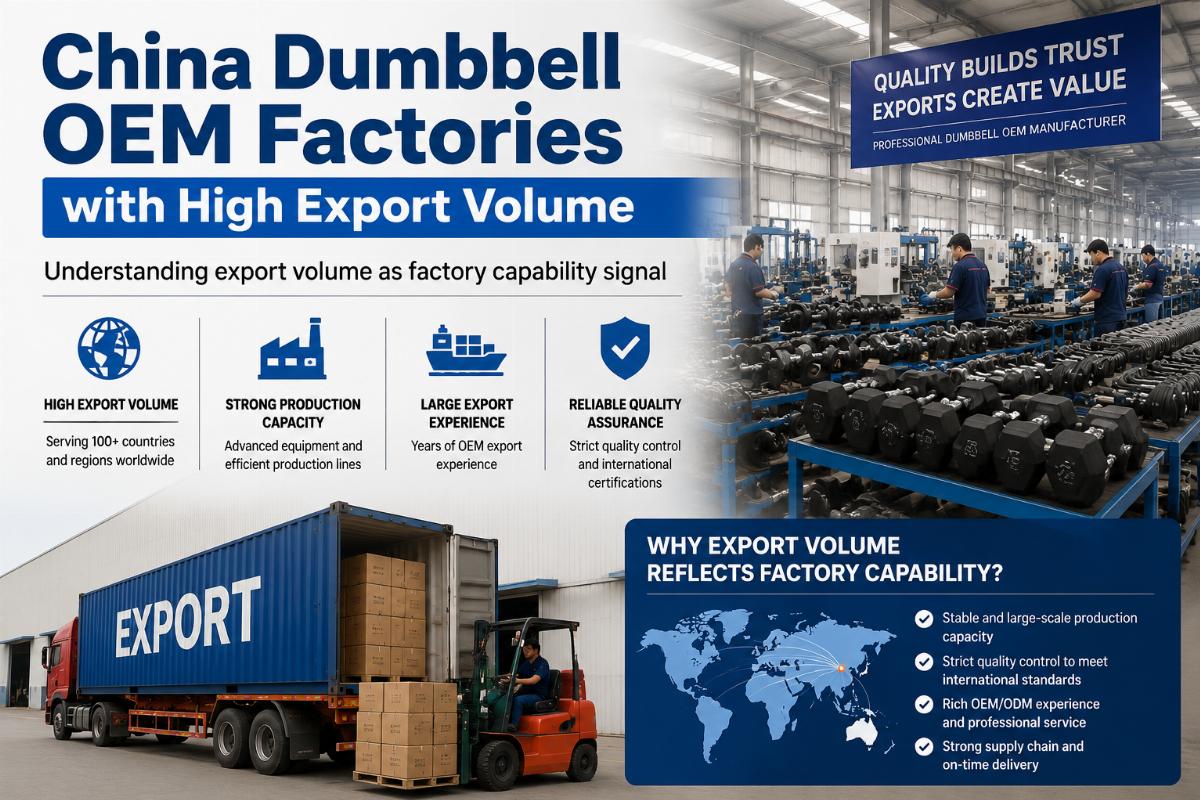
I work with buyers who filter suppliers by export size, thinking it guarantees reliability. Then they discover the "top exporter" requires 5,000-unit MOQs1, won't adjust mold designs, and takes 90 days for first samples2. The factory isn't bad—it's optimized for a buyer profile the client doesn't match.
What Does "Export Volume Top Three" Actually Mean in Dumbbell Manufacturing?
You search for top exporters expecting a clear ranking. I've reviewed supplier claims and found the phrase means different things depending on who's measuring and what they're counting—total shipment weight, order value, customer count, or something else entirely.
No unified "top three" ranking exists for China dumbbell OEM factories3. "Export volume" can refer to tonnage shipped, FOB value, number of containers, or active client count, and suppliers use whichever metric makes them look largest without explaining the measurement basis.
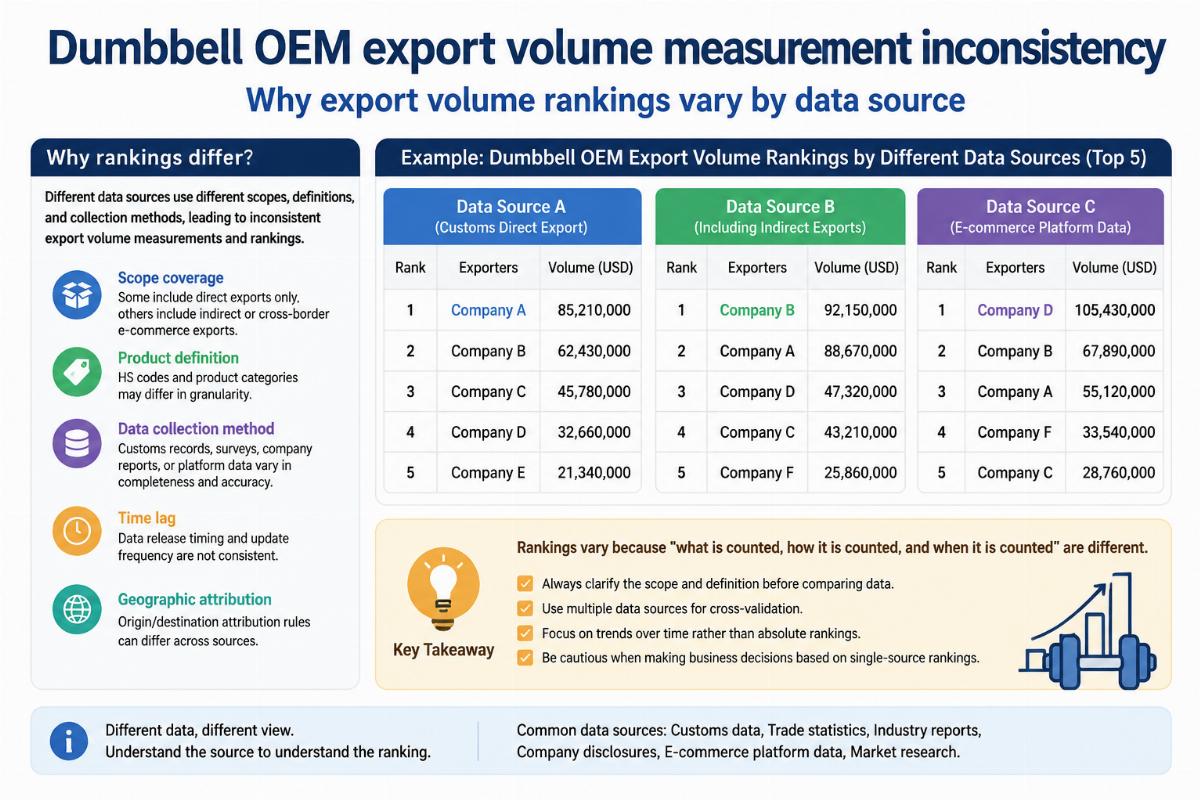
When I evaluate suppliers who claim high export volume, I ask them to clarify: volume of what, measured how, over what period, and verified by whom. A factory shipping 10,000 tons of basic cast iron dumbbells to one market looks different from a factory exporting 200 custom rubber hex designs to 15 countries. Both could claim "top volume," but they serve opposite buyer needs.
How Export Volume Numbers Get Reported
| Measurement Method | What It Actually Tells You | What It Hides |
|---|---|---|
| Total tonnage shipped | Factory has bulk production capacity and raw material access | Doesn't show product diversity, customization ability, or quality tier |
| FOB shipment value | Factory may handle premium products or serve high-value markets | Doesn't indicate production volume or how many clients they manage |
| Number of active buyers | Factory can manage multiple relationships and smaller orders | Doesn't show order sizes, repeat rate, or whether clients stay long-term |
| Container count per quarter | Logistics efficiency and consistent output | Doesn't reveal product types, design flexibility, or service responsiveness |
I don't dismiss export volume claims as meaningless. I treat them as unverified capability signals that require follow-up questions: Which countries do you export to? What's your average order size? Can you share recent Bill of Lading samples? Do your certifications match retail product standards or commercial gym equipment specs? The answers show whether the factory's infrastructure matches my client's order profile.
Why "Top Three" Is a Marketing Claim, Not an Audit Result
China has hundreds of dumbbell OEM factories across Zhejiang, Shandong, Jiangsu, and Hebei provinces4. No single authority audits and ranks them by export volume. When a supplier says "we're top three," they're either citing:
- Internal sales data they can define however they want
- A regional trade association ranking that covers only member factories
- Customs data filtered by HS code, which groups all weight training equipment together5
- Third-party platform badges that measure supplier responsiveness, not actual shipments
I verify volume claims by cross-referencing: I check the factory's trade history on customs databases, ask for major client references (with permission), review their production floor size during video calls, and compare their claimed capacity against visible equipment and workforce. Large exporters have certain physical markers—multiple production lines, dedicated QC labs, export documentation teams, substantial raw material inventory. If those don't match the "top three" claim, I adjust my evaluation.
How Do I Tell If a High-Volume Factory Fits My Order Requirements?
You assume large exporters handle all order types well. I've seen factories with massive output turn down 500-unit trial orders because their systems aren't built for small-batch flexibility, custom packaging, or rapid sampling cycles.
High export volume usually means the factory optimizes for bulk orders, standardized designs, and long production schedules. If you need custom molds, low MOQs, or fast prototyping, mid-sized factories often respond better because their business model depends on flexibility, not volume efficiency.
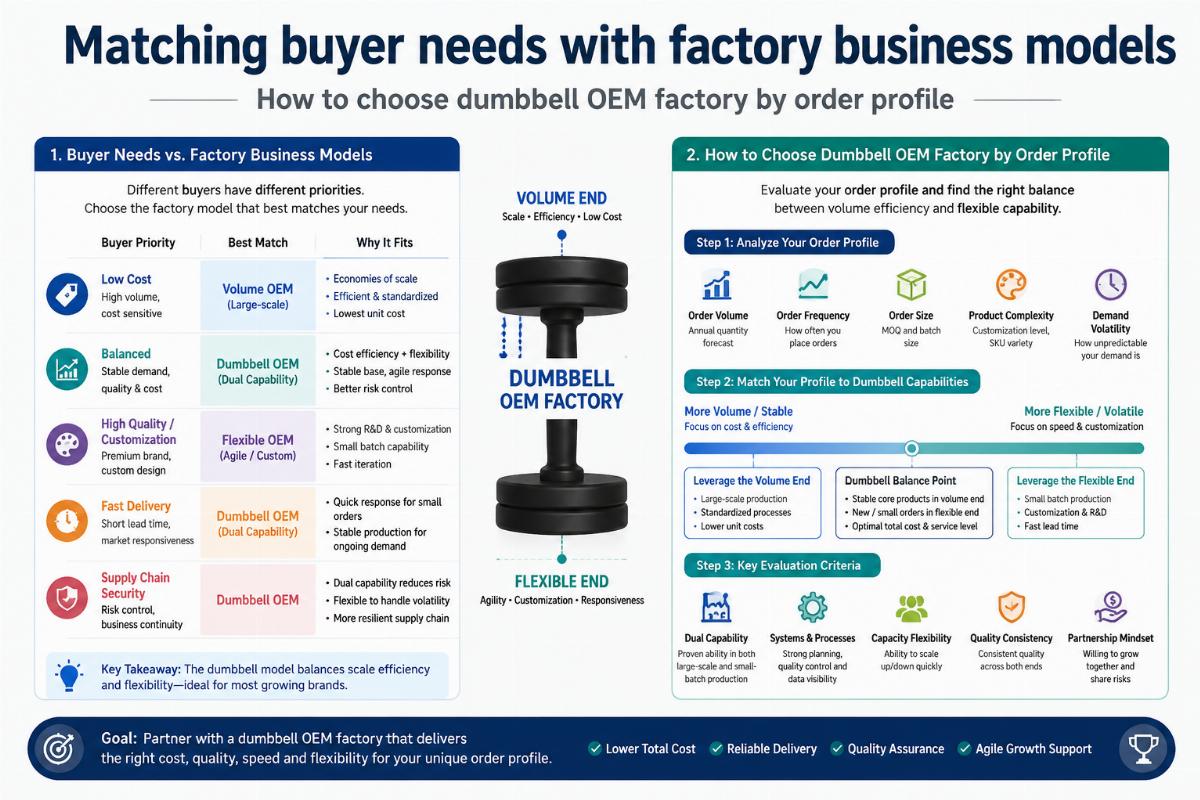
When I evaluate whether a high-volume factory suits a client, I map the client's order characteristics against what large-scale operations prioritize. A factory exporting 50 containers monthly is built around repeat orders from established brands who order the same SKUs quarterly. They have fixed mold libraries, bulk material contracts, and production schedules booked months ahead. They can deliver consistent quality at competitive pricing—but only if you fit their operational rhythm.
Factory Capability vs. Your Order Profile Checklist
| Your Order Profile | Large Exporter Strengths | Large Exporter Weaknesses | When to Consider Mid-Sized Factories |
|---|---|---|---|
| First-time buyer, 300-1,000 units | Established quality systems, certifications ready | High MOQ requirements, won't adjust processes for small orders | Mid-sized factories need trial orders to build relationships and offer flexibility |
| Custom design or new mold | Advanced manufacturing equipment | Long sampling cycles, reluctant to invest in unproven designs | Smaller factories take design risks and iterate faster |
| Repeat bulk orders, stable SKUs | Volume pricing, consistent output, reliable lead times | Less focus on service responsiveness or design collaboration | Large exporters excel here—this matches their model |
| Mixed product lines (dumbbells + kettlebells + racks) | One-stop sourcing, consolidated shipping | May subcontract some items, reducing quality control | Specialized mid-sized factories often control full production in-house |
| Tight delivery deadlines (under 30 days) | Large raw material inventory, multiple shifts | Production schedule rigidity, prioritize existing clients | Smaller factories can reallocate capacity faster |
I don't tell buyers to avoid large exporters. I tell them to verify whether the factory's business priorities align with their order structure. If you're placing a 10,000-unit repeat order with standard specs, a high-volume factory gives you stability and cost advantages. If you're launching a new brand with custom rubber coating and need three sample revisions, that same factory may deprioritize your emails because you don't fit their operational focus.
Questions I Ask to Decode Export Volume Claims
During supplier evaluation calls, I ask:
- "What's your most common order size?" If they say 5,000 units and you need 500, you're outside their sweet spot.
- "How many active clients do you serve simultaneously?" Large exporters may have 10-20 major clients; smaller factories may juggle 50-100 smaller accounts, indicating different service models.
- "What's your sampling lead time for a new design?" If it's 45-60 days, they're optimized for bulk production, not rapid iteration.
- "Can you show me a recent order similar to mine?" This reveals whether they've handled your product type, order size, and customization level before.
- "Which certifications do you maintain?" Retail-focused factories have CE, REACH, CPSC; gym equipment exporters prioritize ISO, SGS, or TÜV. Mismatches indicate target market differences.
I also check their export markets. A factory shipping 90% to Europe and North America likely meets stricter regulatory standards and has better documentation systems than one exporting primarily to developing markets. Not better or worse—just aligned with different compliance requirements that affect your import process.
Should I Choose Mid-Sized Factories Over High Export Volume Suppliers?
You worry smaller factories lack quality control or financial stability. I've worked with mid-sized operations that outperformed large exporters on custom projects because their entire business model depends on service flexibility and design collaboration.
Mid-sized dumbbell OEM factories often handle custom designs, low-MOQ trial orders, and faster iteration better than large exporters. They're not "lower quality"—they're optimized for buyers who need responsiveness, customization, and relationship-based service over volume pricing.
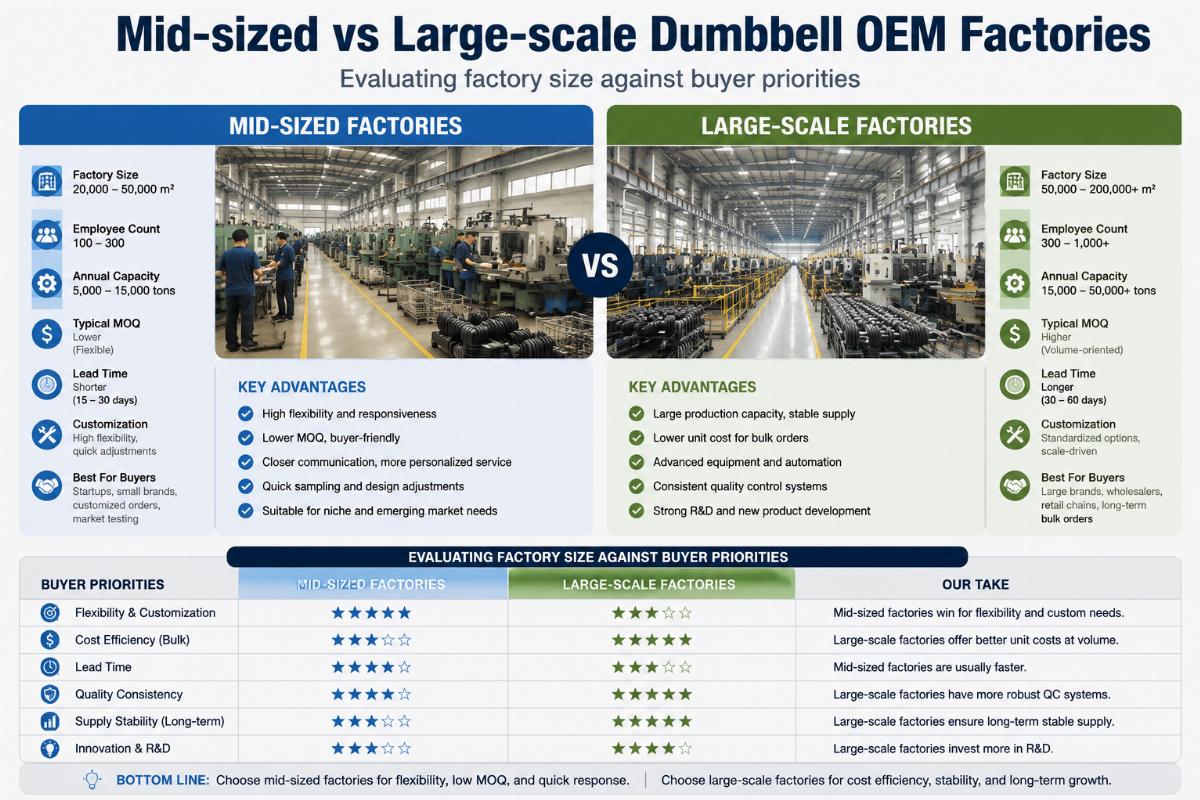
I evaluate factories by what they're built to do best, not by size hierarchy. A 200-employee factory with three production lines may offer better value for a 1,000-unit custom order than a 1,000-employee exporter whose systems require 5,000-unit batches to trigger production scheduling. The mid-sized factory's decision-makers respond to emails directly, adjust mold designs between samples, and expedite orders because each client represents a larger percentage of their revenue.
When Mid-Sized Factories Outperform Large Exporters
I've seen situations where buyers chose large exporters based on volume claims, then switched to mid-sized suppliers after experiencing:
- Sample delays: Large factories queue samples behind bulk production; smaller operations prioritize samples to win orders
- Design rigidity: High-volume suppliers use existing molds to protect margins; mid-sized factories invest in custom tooling to build client relationships
- Communication gaps: Big exporters assign junior sales staff to small accounts; smaller factories involve production managers or owners in client discussions
- MOQ negotiation: Large factories hold firm on minimums; mid-sized operations adjust MOQs to secure new clients
I also verify financial stability differently. Large export volume doesn't guarantee stability—I've seen high-volume factories face cash flow issues during raw material price spikes because they operate on thin margins. I check business licenses, request audited financial statements if possible, and verify production equipment ownership versus leasing arrangements.
How I Match Factory Size to Order Complexity
| Order Characteristic | Large Exporter Advantage | Mid-Sized Factory Advantage | Verification Steps I Use |
|---|---|---|---|
| Standard catalog products | Lower unit pricing, consistent quality | Faster order processing, direct communication | Compare pricing and minimum order requirements |
| Custom logo/packaging only | Established printing/labeling partnerships | Willing to adjust minimums, faster setup | Request packaging samples and setup fees |
| New mold development | Advanced molding equipment | Design collaboration, iterative sampling | Ask about mold ownership, revision policies |
| Mixed material types (rubber, urethane, chrome) | Integrated material supply chains | In-house coating and finishing control | Tour facility via video, check subcontracting practices |
| Ongoing design modifications | Stable for locked specs | Flexible for seasonal updates or testing | Review past client projects with design evolution |
I guide buyers to evaluate what matters most for their business model. If you're scaling an established Amazon product and need predictable costs, large exporters provide stability. If you're testing market response to a new design and need three sample iterations before committing to 2,000 units, mid-sized factories accommodate that learning curve better.
How Can I Verify Export Volume Claims Without Audit Authority?
You want to confirm a factory's export scale but can't access official trade data. I use indirect verification methods that reveal whether their claimed volume matches observable operational markers.
You can verify export volume signals by checking shipment records on customs databases, reviewing third-party audit reports, requesting major client references, and comparing claimed capacity against visible production infrastructure during facility tours.
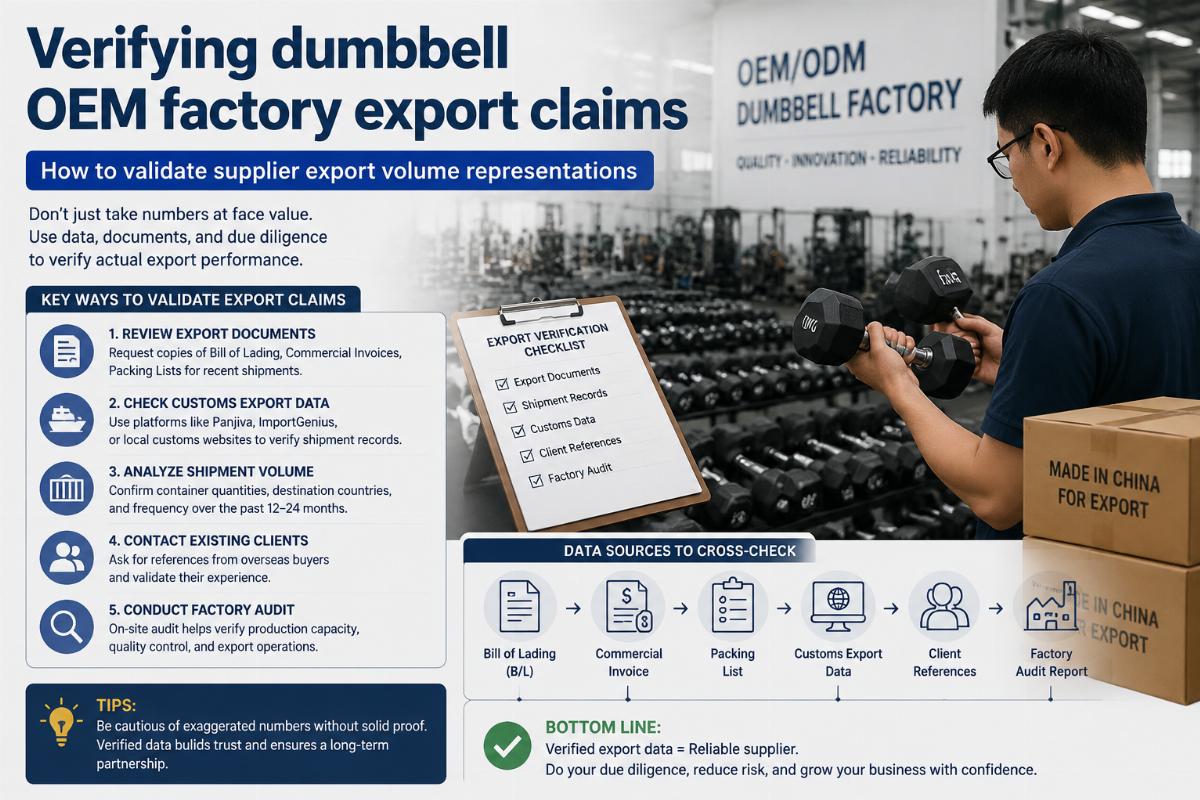
When I assess a supplier's export claims, I don't expect them to share confidential sales data. I look for consistent evidence across multiple verification points that either supports or contradicts their positioning as a high-volume exporter.
Verification Methods I Use During Supplier Evaluation
1. Customs database cross-reference
I search the factory's export records on platforms like ImportGenius, Panjiva, or China Customs data services using their company name and HS codes for weight training equipment. This shows:
- Which countries they ship to and how frequently
- Average shipment sizes (in weight or container count)
- Whether export activity is consistent or sporadic
- Major buyer names (sometimes visible, depending on data source)
2. Third-party audit reports
I request recent audit results from SGS, Bureau Veritas, TÜV, or Intertek6. Large exporters maintain updated audit reports because major buyers require them. The reports verify:
- Production capacity claims (square meters, machinery count, worker headcount)
- Management systems (ISO 90017, social compliance standards)
- Whether the factory owns or leases facilities and equipment
- Client visit logs (high-volume factories receive regular buyer audits)
3. Client reference checks
I ask for three client references who've placed orders in the past 12 months. When contacting references, I confirm:
- Order sizes and frequency
- Lead time accuracy
- Whether the factory handled customization requests
- Post-shipment support quality
- Whether clients are regional distributors, brands, or other trading companies
4. Production facility video tours
During virtual factory tours, I check for operational markers that match high-volume claims:
- Multiple active production lines (not empty floor space)
- Raw material inventory sufficient for weeks of production
- Dedicated quality control labs with testing equipment
- Export documentation teams (not just one sales person handling everything)
- Material handling systems (forklifts, pallet racks, organized warehousing)
5. Certification scope review
I examine whether their certifications cover the product lines and markets they claim to serve. A factory exporting primarily to the EU should have CE, REACH, and possibly FSC for packaging8. North America-focused exporters need CPSC compliance for retail channels9. If certifications don't match claimed export markets, I question the volume distribution.
Red Flags That Suggest Export Volume Misrepresentation
| Red Flag | What It Indicates | How I Verify |
|---|---|---|
| Factory won't share customs records or Bill of Lading samples | May not export at volumes claimed | Check third-party trade databases independently |
| Certifications don't match claimed export markets | May serve different markets than stated | Request certification scope documents and test reports |
| No major client references available | May rely on small orders or indirect trading | Ask for buyer visit logs or audit schedules |
| Production floor doesn't match capacity claims | May subcontract production or exaggerate scale | Conduct unannounced video tour or hire local inspector |
| Can't explain recent large-order handling | May not have experience with bulk production | Request detailed production schedule examples |
I also watch for consistency across communication touchpoints. If a supplier claims "top three exporter" status but assigns a single salesperson to handle inquiries, samples, quality control, and logistics, their operational structure doesn't match large-scale export management. High-volume factories have specialized teams because export complexity requires it.
What Should I Prioritize Over Export Volume Rankings?
You realize export volume is one data point among many. I guide buyers to build evaluation frameworks that match their order requirements, risk tolerance, and long-term sourcing strategy instead of chasing rankings.
Prioritize production capability alignment, quality consistency verification, communication responsiveness, and total cost of ownership10 over export volume rankings. A factory that matches your order profile and timeline delivers better outcomes than the largest exporter who can't accommodate your requirements.
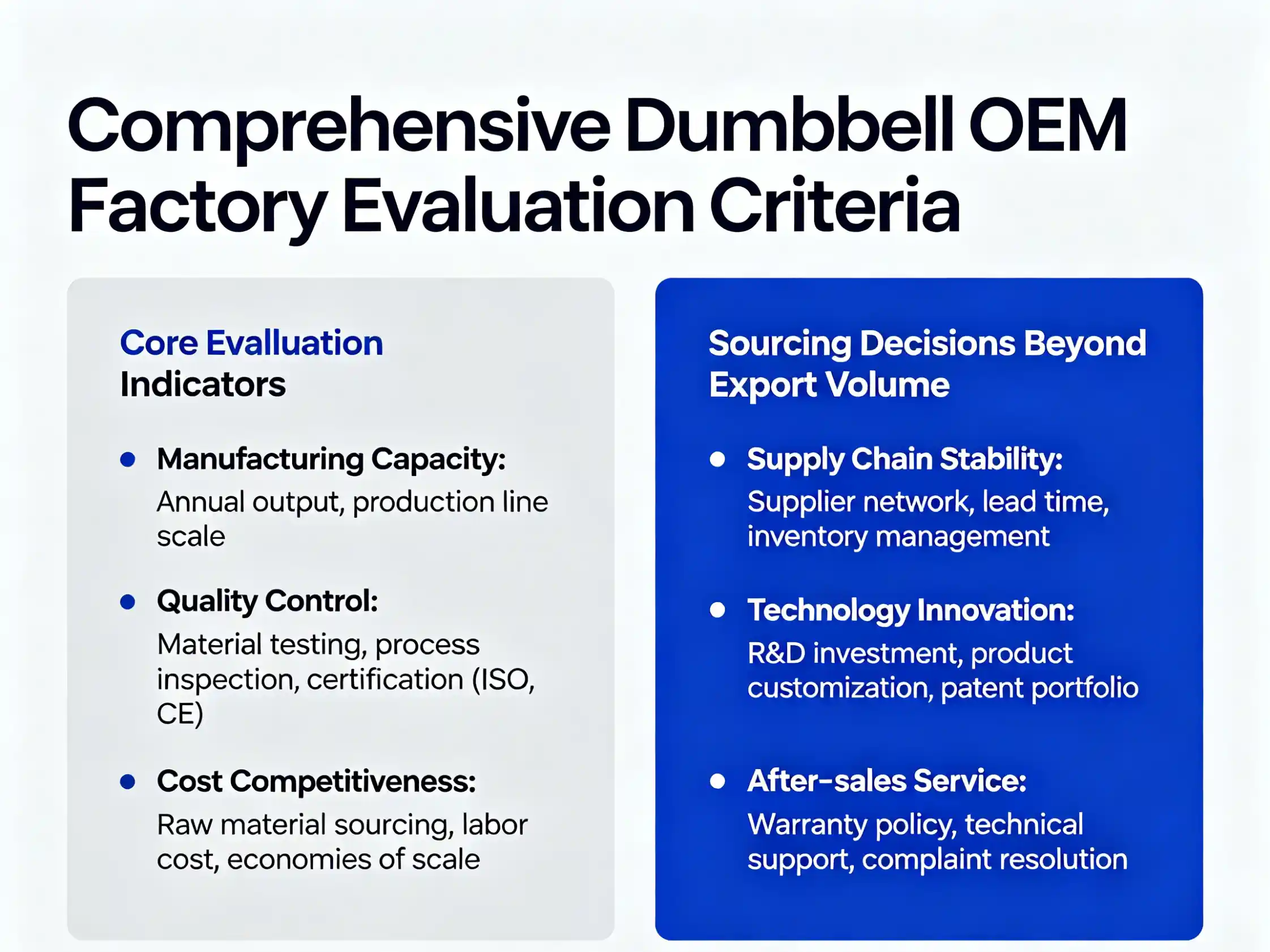
I help buyers create weighted evaluation criteria based on what matters most for their business. A first-time Amazon seller launching a new dumbbell line needs different factory attributes than an established fitness equipment distributor managing seasonal inventory for 50 retail locations.
Evaluation Framework I Use With Clients
1. Production capability match (30% weight)
Does the factory's equipment, capacity, and specialization fit your product requirements?
- Verify: Request production flow documentation, check machinery types, confirm material sourcing
2. Quality consistency systems (25% weight)
Can they maintain specs across production runs and handle quality issues proactively?
- Verify: Review QC procedures, request defect rate data, check inspection equipment
3. Communication and responsiveness (20% weight)
Do they answer technical questions clearly and respond to issues within your timeline?
- Verify: Track email response times, test problem-solving during sampling, evaluate English proficiency
4. Total cost of ownership (15% weight)
Does pricing include all costs—tooling, sampling, shipping, quality failures, delay penalties?
- Verify: Request itemized quotations, calculate landed cost with potential defect replacement rates
5. Flexibility and service (10% weight)
Will they adjust to your design changes, order timing, or customization needs?
- Verify: Test MOQ negotiation, ask about mid-production modifications, check sampling revision policies
I assign remaining weight to factors like payment terms, intellectual property protection, and scalability potential based on client priorities. A buyer concerned about design
"What is a typical Minimum Order Quantity (MOQ) for low ... - Orbit", https://orbit-kb.mit.edu/hc/en-us/articles/360039224292-What-is-a-typical-Minimum-Order-Quantity-MOQ-for-low-volume-manufacturing-in-China. Manufacturing economics literature explains that MOQs are set to cover fixed setup costs including tooling, material procurement, and production line configuration, with larger facilities requiring higher volumes to achieve cost efficiency. Evidence role: mechanism; source type: education. Supports: why manufacturers set minimum order quantities based on production efficiency. Scope note: This explains the economic rationale for MOQs generally rather than confirming specific unit thresholds for dumbbell production ↩
"How to shorten product development lead-time - Planet Lean", https://www.planet-lean.com/articles/product-development-lead-time. Product development literature indicates that sampling timelines for manufactured goods depend on tooling requirements, material sourcing, and production queue position, with complex or custom designs requiring several weeks to months. Evidence role: mechanism; source type: education. Supports: typical timeframes for sampling processes in manufacturing. Scope note: This describes general sampling processes rather than specifically validating 90-day timelines for dumbbell manufacturing ↩
"China Trade Statistics | WITS", https://wits.worldbank.org/countryprofile/en/chn. Chinese customs and trade authorities publish aggregate export data by HS code and region, but do not maintain publicly accessible rankings of individual manufacturers by export volume within specific product categories. Evidence role: general_support; source type: government. Supports: the absence of unified official ranking systems for manufacturer export volume in specific product categories. Scope note: This describes general trade data practices rather than specifically addressing dumbbell manufacturers ↩
"The “Belt and Road” Initiative and China's sporting goods exports", https://pmc.ncbi.nlm.nih.gov/articles/PMC11259841/. Industry analyses identify eastern coastal provinces, particularly Zhejiang and Shandong, as major centers for sports and fitness equipment manufacturing due to established supply chains and port access. Evidence role: general_support; source type: research. Supports: the concentration of fitness equipment manufacturing in eastern Chinese provinces. Scope note: This supports regional concentration patterns but does not verify the specific count of dumbbell manufacturers ↩
"Notices - Harmonized Tariff Schedule", https://hts.usitc.gov/search?query=95069100. The World Customs Organization's Harmonized System classifies weight training equipment under heading 9506 (articles and equipment for general physical exercise), which encompasses various types of exercise apparatus without distinguishing specific product types like dumbbells at the 6-digit level. Evidence role: definition; source type: government. Supports: how the Harmonized System classifies fitness and sports equipment. ↩
"Bureau Veritas Certification", https://certification.bureauveritas.com/. International testing, inspection, and certification companies provide independent verification services including factory audits, product testing, and management system certification across global supply chains. Evidence role: general_support; source type: institution. Supports: the role of international inspection and certification bodies in supply chain verification. ↩
"ISO 9001:2015 - Quality management systems — Requirements", https://www.iso.org/standard/62085.html. ISO 9001, published by the International Organization for Standardization, specifies requirements for quality management systems and is used by organizations to demonstrate their ability to consistently provide products that meet customer and regulatory requirements. Evidence role: definition; source type: institution. Supports: what ISO 9001 certification represents in manufacturing contexts. ↩
"EU REACH - International Trade Administration", https://www.trade.gov/eu-reach. The European Union requires CE marking for products meeting health, safety, and environmental protection standards, REACH registration for chemical substances, and recognizes FSC certification for sustainably sourced wood and paper products. Evidence role: general_support; source type: government. Supports: regulatory and certification requirements for products sold in European markets. ↩
"Regulations, Laws & Standards", https://www.cpsc.gov/Regulations-Laws--Standards. The US Consumer Product Safety Commission establishes and enforces safety standards for consumer products sold in the United States, requiring manufacturers and importers to certify compliance with applicable regulations. Evidence role: general_support; source type: government. Supports: US regulatory requirements for consumer products. ↩
"Total Cost of Ownership (TCO) in Procurement - CADDi", https://us.caddi.com/resources/insights/total-cost-ownership. Total cost of ownership is a financial estimate that encompasses all direct and indirect costs associated with purchasing, operating, and maintaining a product or service over its lifecycle, including acquisition price, transportation, quality failures, and support costs. Evidence role: definition; source type: education. Supports: the procurement concept of evaluating all costs associated with acquiring and using a product. ↩